




Prediction: AI Titan Palantir Technologies Is 27% Below Its All-Time High -- and This Decline Is Just Getting Started
Key Points
Artificial intelligence (AI) is the hottest trend on Wall Street, with shares of data-mining specialist Palantir skyrocketing nearly 2,300% since the beginning of 2023.
Investors have gravitated to Palantir due to its sustainable moat and pristine balance sheet.
However, historical headwinds and valuation concerns may be impossible to overcome for Wall Street's hottest AI stock.
- 10 stocks we like better than Palantir Technologies ›
No trend has captured the attention and capital of investors over the last three years quite like the rise of artificial intelligence (AI). Empowering software and systems with the tools to make split-second decisions and become more efficient over time, without human intervention/oversight, is a technological breakthrough that can benefit most global industries.
Although graphics processing unit (GPU) company Nvidia is commonly viewed as the face of the AI revolution, a strong argument can be made that data-mining specialist Palantir Technologies (NASDAQ: PLTR) is the top dog in the AI arena.
Where to invest $1,000 right now? Our analyst team just revealed what they believe are the 10 best stocks to buy right now. Continue »
Since the beginning of 2023, shares of Palantir have rallied nearly 2,300%, with the company adding north of $350 billion in market value. Investors have latched onto its sustainable moat and eye-popping sales growth.

Image source: Getty Images.
But despite Palantir's ideal positioning, its shares are down 27% from their all-time high set on Nov. 3, 2025. While some investors may view this sizable correction as a buying opportunity, I believe it's the start of a considerably steeper move lower.
Palantir's sustainable moat has intrigued investors
Before digging into the company's potential headwinds, it's imperative to lay the groundwork for how it rallied almost 3,000% at one point in less than three years.
At the center of investors' optimism is Palantir's sustainable competitive edge. Neither of its two core operating platforms, Gotham and Foundry, has large-scale competitors, meaning the operating cash flow Palantir is generating tends to be predictable looking years into the future.
The most valuable of the two artificial intelligence- and machine-learning-driven software-as-a-service (SaaS) platforms at the moment is Gotham. This segment aids the U.S. government and its immediate allies in military mission planning/execution and can be used to gather and analyze data. Gotham is the more mature of the two operating segments and the one responsible for the lion's share of its recurring profit.
Meanwhile, Foundry has all the tools needed to become a key driver of cash flow growth toward the end of this decade (and beyond). This is a subscription-driven SaaS platform that helps businesses streamline their operations by making sense of their data. Global commercial customer count increased 49% in the September-ended quarter from the prior-year period, albeit to just 742 clients. This relatively small figure demonstrates how extensive the runway still is for Foundry to expand.
To build on this point, investors appreciate the predictability and transparency of Palantir's operating model. The government contracts secured with Gotham commonly span four to five years, while Foundry's subscription service does a fantastic job of retaining existing clients.
Palantir's pristine balance sheet is the icing on the cake that's lured investors to the stock. It ended September with over $6.4 billion in combined cash, cash equivalents, and marketable securities, and no debt. This affords CEO Alex Karp and his board the luxury of making aggressive investments in innovation while rewarding shareholders through buybacks.

Image source: Getty Images.
Moat aside, investors' expectations for Palantir are unattainable
But when things seem too good to be true on Wall Street, this often turns out to be the case. Although Palantir Technologies has well-defined competitive advantages and a cash-rich balance sheet, it's going to struggle to live up to the lofty expectations that have been set.
To begin with, every game-changing technology spanning more than three decades has endured a bubble-bursting event during its early expansion phase. The advent and proliferation of the internet in the mid-1990s is a perfect example. While businesses latched onto the internet with open arms, just as they've adopted artificial intelligence infrastructure and software, it took more than half a decade for companies to understand how to optimize this technology. Despite otherworldly AI infrastructure sales, we're years away from companies optimizing their AI solutions.
History tells us that AI is unlikely to be the exception to the rule and avoid a bubble-bursting event. If history were to repeat, the faces of the AI revolution, such as Palantir, would be among the hardest hit.
Valuation is another undeniable and perhaps more immediate concern for Palantir's shareholders.
Although value is in the eye of the beholder, the time-tested price-to-sales (P/S) ratio doesn't leave much room for argument. Dating back to the advent of the internet, P/S ratios of 30 or higher for companies at the forefront of a next-big-thing trend have indicated the presence of a bubble. While the P/S ratio can't tell investors when the music might stop for a game-changing innovation, it does have a phenomenal track record of foreshadowing eventual trouble for pricey stocks.
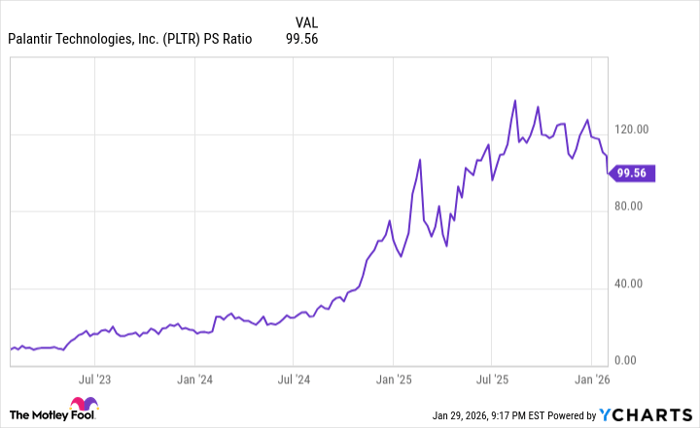
PLTR PS Ratio data by YCharts.
Palantir entered 2026 with a P/S ratio of more than 110! Even with outsize sales growth and a 27% decline in its share price since Nov. 3, its P/S ratio stood at roughly 100 on Jan. 29. Historical data for next-big-thing trends makes clear that P/S ratios above 30 aren't sustainable over an extended period -- let alone a triple-digit P/S ratio.
Something else to consider is that heightened U.S. government defense spending isn't guaranteed to continue. Although Gotham is benefiting during President Donald Trump's second term, midterm elections and the 2028 presidential election can change the growth trajectory for this core operating segment in an instant.
To be clear, Palantir isn't a bad company. It's a solid business with a sustainable moat that can likely sustain a double-digit growth rate. But expecting Palantir stock to maintain its otherworldly premium or to hold up if/when the AI bubble bursts is unrealistic.
Palantir's 27% decline looks to be just the start of a much larger move lower in 2026.
Should you buy stock in Palantir Technologies right now?
Before you buy stock in Palantir Technologies, consider this:
The Motley Fool Stock Advisor analyst team just identified what they believe are the 10 best stocks for investors to buy now… and Palantir Technologies wasn’t one of them. The 10 stocks that made the cut could produce monster returns in the coming years.
Consider when Netflix made this list on December 17, 2004... if you invested $1,000 at the time of our recommendation, you’d have $450,256!* Or when Nvidia made this list on April 15, 2005... if you invested $1,000 at the time of our recommendation, you’d have $1,171,666!*
Now, it’s worth noting Stock Advisor’s total average return is 942% — a market-crushing outperformance compared to 196% for the S&P 500. Don't miss the latest top 10 list, available with Stock Advisor, and join an investing community built by individual investors for individual investors.
See the 10 stocks »
*Stock Advisor returns as of February 2, 2026.
Sean Williams has no position in any of the stocks mentioned. The Motley Fool has positions in and recommends Nvidia and Palantir Technologies. The Motley Fool has a disclosure policy.
Recommended Articles


