




Why Outer Space Holds the Key to Transforming Mining Forever in 2026
Key Points
Rio Tinto is leading the integration of an exciting new technology that utilizes cosmic rays.
Miners are using the technology to identify deposits, improve leaching, and make mines safer.
- 10 stocks we like better than Rio Tinto Group ›
Forgive the hyperbole, but cosmic rays from supernovas could really save the Earth -- or at least, make it much easier to mine and leach key materials like copper, nickel, and uranium. That's why miners such as Freeport-McMoRan (NYSE: FCX), NexGen Energy (NYSE: NXE), Rio Tinto (NYSE: RIO), and BHP Group (NYSE: BHP) have all signed up for muon technology, and investors can expect major developments from them in 2026 as they move into commercialization.
What are muons?
Cosmic rays are mainly high-energy protons produced by galactic events, such as shock waves from exploding stars (supernovae). Traveling at almost the speed of light, they collide with particles in the Earth's atmosphere, creating particles that decay and produce muons that exist for microseconds. However, it doesn't take long for a muon travelling at such high speeds to travel vast distances, and they can be used to revolutionize how mining companies work.
Where to invest $1,000 right now? Our analyst team just revealed what they believe are the 10 best stocks to buy right now, when you join Stock Advisor. See the stocks »

Image source: Getty Images.
According to the US Department of Energy, "one muon hits every square centimeter of the Earth every minute at sea level." They are about 200 times heavier than electrons, so when they collide with materials on Earth, they plow through them, but lose energy depending on what they hit. For example, copper, nickel, and uranium are high-density materials that will change a muon's energy when it hits them.
Consequently, engineers can use equipment beneath mining deposits to detect and monitor muons, and how they behave after passing through minerals, thereby building a 3D map of the deposit from the collected data, whether from a mine or a leaching deposit.
Companies using muon technology
Muon technology has moved beyond the research and development stage, and this year will mark pivotal developments in commercial applications.
- In late 2025, Rio Tinto signed a five-year partnership with Ideon Technologies, a company that uses muon tomography to develop 3D Earth subsurface models, which can help Rio identify copper and iron ore deposits.
- BHP is already using Ideon's technology to image nickel deposits in Australia.
- NexGen (a uranium miner) is using Ideon's muon technology on its Rock I uranium project in Canada, which management believes will be the "largest, low-cost producing uranium mine globally."
Muon technology goes beyond identifying deposits
In addition to the obvious benefits of accurately mapping mining deposits, miners are using muon tomography to enhance operations in other ways. For example, copper miner Freeport-McMoRan suffered a fatal tragedy at a mine in Grasberg, Indonesia, when workers were trapped underground following a mud rush incident. The company will install muon detection technology to verify site safety.
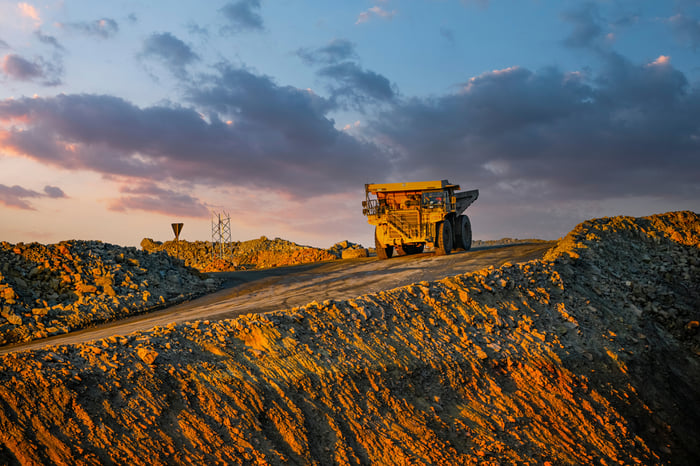
Image source: Getty Images.
A leaching opportunity
The mining community is always excited by the potential for leaching to enable them to extract value from waste stockpiles. It offers the promise of a low-cost solution to the problem of growing production in a world where obtaining mining permits isn't always straightforward.
One of the challenges inherent in leaching is knowing where the chemicals, or, in Rio Tinto's Nuton technology case, cultivated microorganisms, are reaching the right places in the leaching stockpile. As such, Rio Tinto is using muon technology to monitor heap leaching processes and improve the efficiency of its bio-heap technology, Nuton, for copper recovery.
It's a technology that's been 30 years in the making, and Rio was proud to announce the first copper produced by its Nuton technology at its Johnson Camp, Arizona, site in late 2025. Rio Tinto Copper chief executive Katie Jackson noted that it took copper "projects typically take about 18 years to move from concept to production," but "Nuton has now proven its ability to do this in just 18 months."
Muon technology played a key role in Rio's leaching heaps, which are highly engineered structures. Indeed, Rio recently signed a two-year deal with Amazon Web Services (AWS) whereby AWS will use copper produced by Nuton, while Rio will use "AWS platforms to simulate heap-leach performance and feed advanced analytics into Nuton's decision systems." Muon tomography is essential to ensuring Rio's leaching technology operates efficiently.
A high-tech future for mining
These developments enable miners to accurately map deposits, improve safety, and develop revolutionary leaching technology. That's a major plus in improving the efficiency of existing mining/leaching deposits and ensuring an adequate supply of key materials in the future.
Should you buy stock in Rio Tinto Group right now?
Before you buy stock in Rio Tinto Group, consider this:
The Motley Fool Stock Advisor analyst team just identified what they believe are the 10 best stocks for investors to buy now… and Rio Tinto Group wasn’t one of them. The 10 stocks that made the cut could produce monster returns in the coming years.
Consider when Netflix made this list on December 17, 2004... if you invested $1,000 at the time of our recommendation, you’d have $470,587!* Or when Nvidia made this list on April 15, 2005... if you invested $1,000 at the time of our recommendation, you’d have $1,091,605!*
Now, it’s worth noting Stock Advisor’s total average return is 930% — a market-crushing outperformance compared to 192% for the S&P 500. Don't miss the latest top 10 list, available with Stock Advisor, and join an investing community built by individual investors for individual investors.
See the 10 stocks »
*Stock Advisor returns as of January 22, 2026.
Lee Samaha has no position in any of the stocks mentioned. The Motley Fool has positions in and recommends Amazon. The Motley Fool recommends BHP Group. The Motley Fool has a disclosure policy.
Recommended Articles


