


When is the US President Trump’s speech at WEF in Davos and how could it affect EUR/USD

 Trending Articles
- Gold Price Forecast: PCE Data Weakens Fed Rate Hike Expectations, Can Gold Price Hold Steady at $4,000?
- Iran insists on control of Hormuz amid reports of US talks
- Gold Price Forecast: Gold Price Falls Below $4,000, PCE Data May Push Gold Down to $3,900
- June Non-Farm Payrolls Preview: Did White House Economic Advisor Give an Early Hint? How Will US Stocks, Dollar and Gold React?
- Crypto market sheds over 50% of its value amid Bitcoin's brief decline below $60K
- Australian Dollar edges lower to near 0.6900 on Fed hike bets
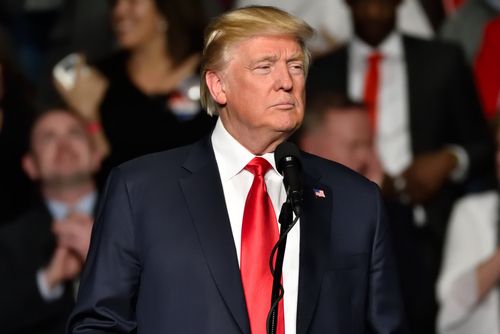
United States (US) President Donald Trump is scheduled to deliver his speech at the World Economic Forum (WEF) in Davos after 13:00 GMT. Trump’s trip to Davos was delayed after Air Force One was forced to turn around due to a "minor electrical issue".
Trump’s speech will be closely watched by financial market participants as it will indicate what other measures the White House has at its disposal to intensify pressure on European Union (EU) members, who oppose Washington’s plans to acquire Greenland.
Greenland’s Prime Minister (PM) Jens-Frederik Nielsen has clarified in a joint statement with Denmark’s Mette Frederiksen that his economy prefers to remain a semi-autonomous Danish territory.
So far, President Trump has imposed 10% tariffs on several EU members: France, Germany, Denmark, Norway, Sweden, the Netherlands and Finland, and the United Kingdom (UK), which will become effective from February 1, for opposing US control of Greenland, and warned that additional duties could rise to 25% from the summer if no deal is done.
In response, EU members have warned of proportionate countermeasures against Trump’s tariff threats, calling them “blackmail”. French President Emmanuel Macron has stressed the need to deploy an anti-coercion tool, nicknamed a "trade bazooka", in retaliation to Trump’s tariff threats. In the WEF on Tuesday, Macron said that the world is reaching a time of “instability and imbalances,” and the answer is “more cooperation,” not a system that accepts “the law of the strongest”, The New York Times (YT) reported.
Officials across the globe have also condemned threats of additional import duties by Washington. Canadian Prime Minister Mark Carney affirmed support for EU members, citing “Middle powers must act together because if we're not at the table, we're on the menu", BBC reported.
Signs of Washington deploying military action on Greenland for forceful acquisition through comments from US President Trump would be unfavorable for the US Dollar, as they might escalate tensions between the world’s largest economies, potentially leading to a trade war. On the contrary, Trump’s gentle comments on the Greenland crisis would ease geopolitical tensions, boosting hopes of improvement in the appeal of risky assets, the US Dollar, and US assets.
How could Trump’s speech affect EUR/USD?
Signs of Washington deploying military action on Greenland for forceful acquisition through comments from US President Trump would be unfavorable for the US Dollar, as they might escalate tensions between the world’s largest economies, potentially leading to a trade war. On the contrary, Trump’s gentle comments on the Greenland crisis would ease geopolitical tensions, boosting hopes of improvement in the appeal of risky assets, the US Dollar, and US assets.
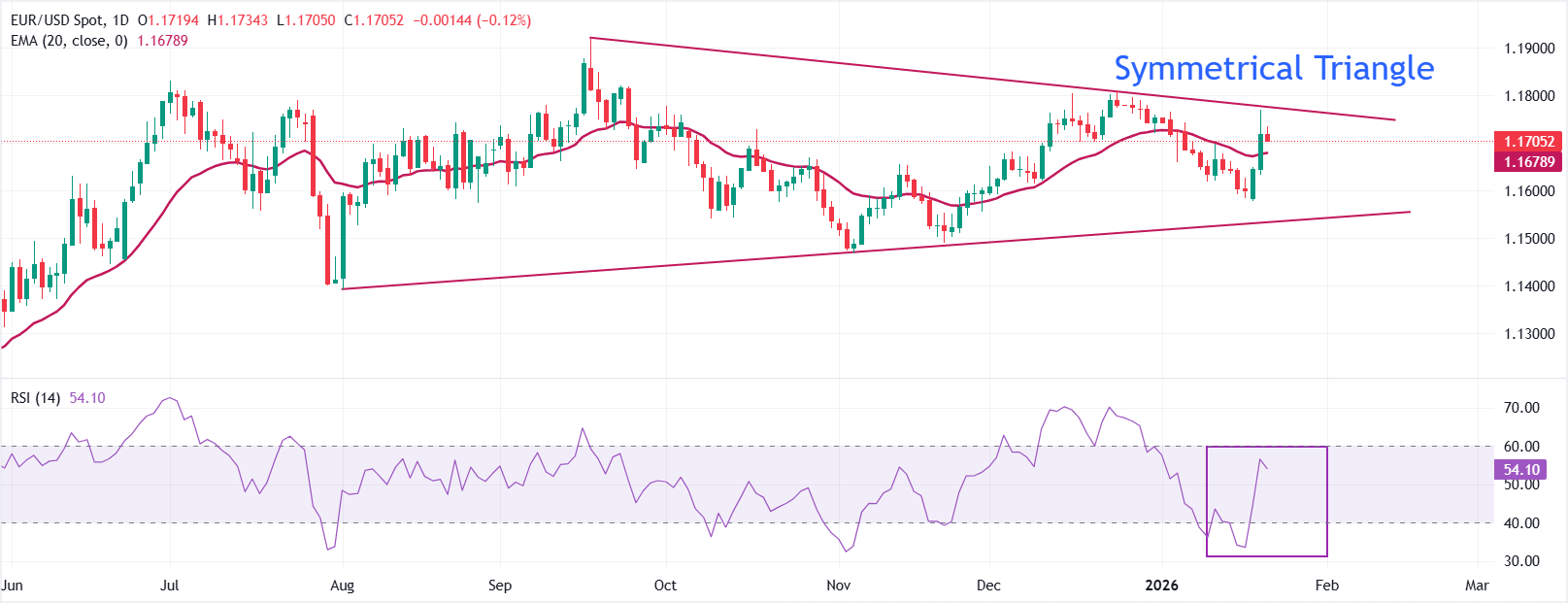
EUR/USD trades lower at around 1.1700 as of writing. The 20-day Exponential Moving Average (EMA) at 1.1679 edges higher beneath spot, supporting the short-term bias. A pullback would be expected to find initial demand around this dynamic level.
The 14-day Relative Strength Index (RSI) at 54 is neutral-to-firm, consistent with a measured upside impulse. A descending trend line from 1.1921 caps advances, with resistance at 1.1775. A daily close through this barrier could extend gains.
The rising trend line from 1.1393 underpins the broader structure, offering support near 1.1533. Failure to clear 1.1775 would keep rallies capped and leave scope for consolidation above the trend base. A sustained push beyond the descending barrier would shift focus higher, whereas holding below it would preserve a rangebound tone.
(The technical analysis of this story was written with the help of an AI tool.)
Read more
* The content presented above, whether from a third party or not, is considered as general advice only. This article should not be construed as containing investment advice, investment recommendations, an offer of or solicitation for any transactions in financial instruments.


