



 Trending Articles
- Gold Price Forecast: Gold May Break $4,500 as Fed Rate-Hike Expectations Continue to Cool
- Gold gains momentum to near $4,400 as Fed hike expectations drop despite Us-Iran tensions
- Gold Price Forecast: Will Gold Rise or Fall in the Short Term as Fed July Minutes Approach?
- Forex Today: US Dollar stabilizes ahead of next batch of US data
- Australian Dollar gains as US Dollar struggles amid fading Fed rate hike bets
- WTI declines below $82.50 as oil inventories rise far more than expected

Bitcoin has fallen below $90,000 as markets digest rising macro tension between the United States and the European Union, alongside fresh geopolitical friction tied to Greenland.
On-chain data shows a key handover inside the market: new whales now hold a larger share of Bitcoin’s Realized Cap than long-term OG whales.
With new whales carrying a cost basis near $98,000 and roughly $6 billion in unrealized losses, Bitcoin’s rebounds can look weaker and selling can return quickly when macro headlines turn risk-off.
Bitcoin slipped under the $90,000 level as a broader risk-off mood hit both equities and crypto. Traders pointed to rising macroeconomic tension between the United States and the European Union, and to renewed concern around Greenland, as uncertainty pushed investors to cut exposure to higher-beta assets.

The price move comes with a deeper change in market structure. Analyst MorenoDV reports that, for the first time, new whales account for a larger share of Bitcoin’s Realized Cap than long-term OG whales. Realized Cap estimates the network’s aggregate cost basis by valuing coins at the price of their last on-chain movement, so this shift implies that a meaningful portion of BTC supply has changed hands more recently and at higher prices.
That transfer matters because it can change short-term supply behavior. When newer large holders dominate realized capital, the marginal supply can sit with investors who entered later in the cycle and who may react faster to volatility. Bitcoin is still trying to reclaim $90,000, and this whale mix helps explain why rebounds can feel less steady and why selling pressure can return quickly during macro-driven pullbacks.
New Whales Now Set Bitcoin’s Short-Term Tone
Realized Cap tracks cost basis by marking coins to the price of their last on-chain move. When the metric leans toward new whales, it signals that large, newer holders now carry more weight in the market’s effective cost base.

In this framework, new whales refer to short-term holder whales with more than 1,000 BTC and a UTXO age below 155 days. This definition points to capital that arrived later in the trend rather than to cycle-tested holders.
The numbers show why this group may be more reactive. The realized price of new whales sits near $98,000, while spot price is still trading below that level. This gap leaves the cohort with an estimated $6 billion in unrealized losses, and those losses can shape behavior during fast moves.
On-chain realized PnL data supports that picture. Since the market peak, new whales have accounted for most realized losses, and they have often sold into weakness and used short rebounds to reduce positions. This pattern looks more like risk management than long-term conviction.
Long-term whales tell a different story. With a realized price around $40,000, OG whales remain strongly in profit, and their activity has been smaller than the flows linked to new whales. For now, the market’s short-term direction is being driven by this newer, more fragile whale cohort.
Bitcoin Breaks Below Key Support
Bitcoin has shown renewed weakness after losing the $90,000 psychological level, and price is now trading near $88,300 on the daily chart. The broader setup still reflects a clear downtrend from the late-2025 highs, followed by a recovery attempt that failed.
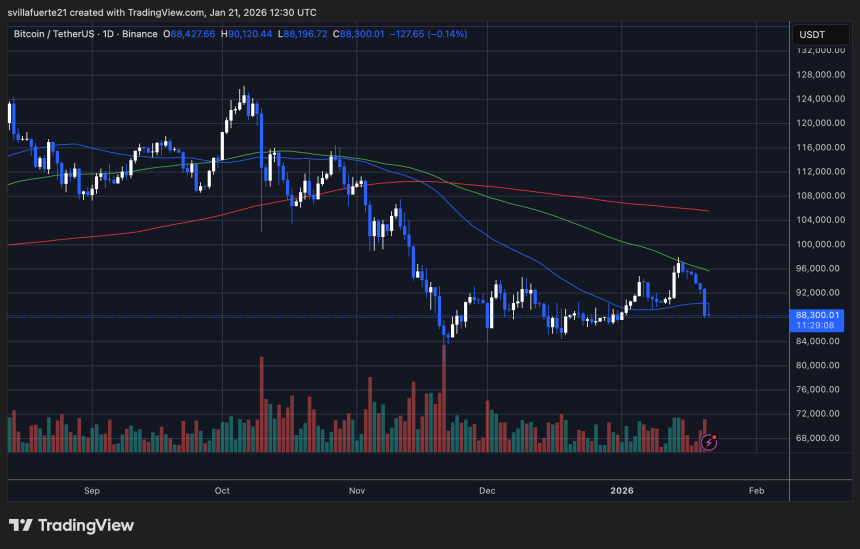
After a sharp drop in November, BTC stabilized and built a short consolidation base. The rebound into early January did not hold momentum, and the move quickly turned into another rejection.
From a technical standpoint, Bitcoin remains below its major moving averages, and those levels are acting as dynamic resistance. The shorter-term average has turned down, and the broader trend line above it still slopes lower. This structure suggests sellers continue to control rallies and momentum remains capped.
The market’s reaction near the mid-$90K area reinforces that view. Buyers pushed price higher, but sellers rejected the move quickly, which suggests overhead supply remains heavy and demand has not yet been strong enough to flip the trend.
Volume behavior also fits the same story. The largest spikes appeared during the selloff leg, while recent recovery attempts have drawn weaker participation. As long as Bitcoin stays below the $90K–$92K zone, price action points to a market still searching for a stable bottom, and downside risk remains elevated if fear spreads across the broader crypto market.
Read more
The above content was completed with the assistance of AI and has been reviewed by an editor.


