


Bitcoin ETFs: What You Need to Know About Inflows, Outflows, and Price Moves
Key Points
ETF inflows and outflows measure money entering or leaving a fund, not the performance of the underlying cryptocurrency (or other assets).
The Grayscale Bitcoin Trust lost billions in assets despite Bitcoin's 140% gains, while the iShares Bitcoin Trust attracted record inflows during the same period.
Fund flows can move opposite to crypto prices when investors migrate to cheaper alternatives or take profits during rallies.
- 10 stocks we like better than iShares Bitcoin Trust ›
Cryptocurrencies can be confusing. So can exchange-traded funds (ETFs). And when you combine the two concepts into crypto-based ETFs, there are so many dark corners and financial enigmas to explore.
The mystery includes some of the most commonly used terms in crypto ETF headlines. You've seen a million breathless banners about inflows and outflows by now -- but have you looked into what they actually mean? Adding more confusion to the situation, the inflow and outflow balance sometimes looks bullish when the crypto market is doing well, and bearish when cryptocurrencies don't look too exciting.
Where to invest $1,000 right now? Our analyst team just revealed what they believe are the 10 best stocks to buy right now. Learn More »
So let's break down the nuances of crypto ETF inflows and outflows -- and why these metrics often oppose the broader cryptocurrency market's mood.

Image source: Getty Images.
What are inflows and outflows, anyway?
First, let me explain what inflows and outflows are.
These ETF performance metrics don't directly affect an investor's returns. They are more closely related to measuring the quality and popularity of specific ETFs, usually compared to rival funds with similar investment goals.
I'm talking about the amount of money being added to a fund (with inflows) or taken out of the ETF (outflows). Growing or reducing the cash being invested in a fund may have an indirect effect on the underlying asset. It's like tipping the scales while weighing bananas at the grocery store -- the weighing process can affect the results. But for the most parts, the average ETF has minimal market-moving powers.
A tale of two Bitcoin ETFs
Here's where I want to get specific. Two of the largest spot Bitcoin (CRYPTO: BTC) ETFs hold dramatically positions in the crypto-fund sector, and their differences will help me illustrate some fundamental concepts for you.
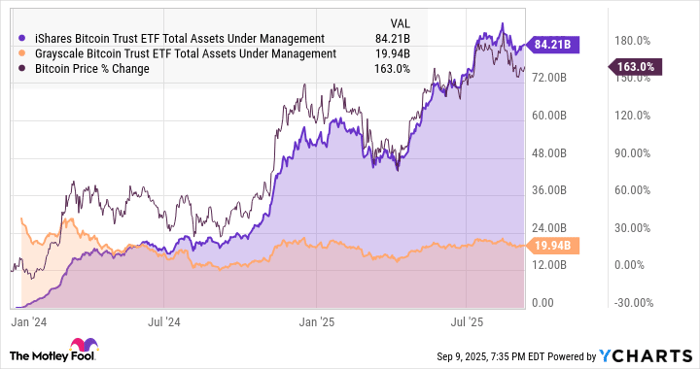
Say hello to the iShares Bitcoin Trust (NASDAQ: IBIT) and the Grayscale Bitcoin Trust (NYSEMKT: GBTC) -- two of the largest spot-price Bitcoin ETFs measured by the amount of assets under management (AUM). The iShares fund is the larger one, with $84.2 billion of AUM on Sept. 9. The Grayscale ETF's AUM stops at $19.9 billion.
But it wasn't always like that. Grayscale launched the Bitcoin Trust as a publicly traded, classic mutual fund in 2015. It then filed the paperwork to convert this fund into an ETF in October 2021, more than two years before the conversion took effect.
iShares was a later addition to the Bitcoin ETF market, starting the filings and cash funding in 2023. Fund manager BlackRock put this ETF on the market as soon as the U.S. Securities and Exchange Commission (SEC) allowed it on Jan. 11, 2024.
The great Bitcoin ETF migration
The Grayscale fund had been around for nearly a decade, when the SEC flipped the switch on proper Bitcoin ETFs, amassing $28.6 billion of investor assets by the ETF launch date. BlackRock's iShares ETF started from nothing.
Then the inflows and outflows started.
Grayscale Bitcoin Trust's AUM started to shrink right away, while the iShares fund grew its AUM at a remarkable speed. I'm including Bitcoin's price trends in this chart, to demonstrate how closely a fund's AUM can be related to the investment asset's price changes over time -- or not:
IBIT Total Assets Under Management data by YCharts
Fees may matter more than you think
The iShares fund's AUM volume tends to rise when Bitcoin prices are up, and fall when the leading cryptocurrency is trending down. This makes sense, as Bitcoin's price moves inspire bullish or bearish long-term expectation for the cryptocurrency -- and its ETFs. It's not a perfect 1:1 correlation, as investors sometimes embrace or reject certain ETFs for other reasons, but the bond is very tight.
The mathematical closeness of the Grayscale Bitcoin ETF's AUM to Bitcoin's price chart is looser, and the AUM value often trends down. This makes sense to me, because investors have plenty of reason to choose a different Bitcoin ETF these days.
You see, Grayscale charges beefy management fees for this fund. The iShares fund's annual expense ratio stands at 0.25%, and was entirely canceled in the first few months as a marketing incentive. Grayscale is sticking to a 1.5% expense ratio.
What difference does a percentage point (well, 1.25%) make in this context? Actually plenty, especially for large-scale investors with a long time horizon.
Let's say you're a deep-pocketed institutional investor with $100,000 in the Grayscale Bitcoin Trust, perhaps started in the pre-ETF days. You're paying Grayscale $1,500 a year for its fund management services. Then you move those finds to the iShares alternative, with an annual fee of $250 instead. You'll have the same Bitcoin exposure either way, but Grayscale's exorbitant fees can make a real difference in the long run.
So the iShares fund has seen 82% asset inflows over the last year, while Grayscale's fund shrank by 17%. Their market performance was largely indistinguishable, with 140% to 141% total returns over this period.
In other words, the two funds offered very similar market performance, but investors backed away from Grayscale and adopted iShares as a clear favorite. With low fees, BlackRock's financial backing, and the familiar iShares brand name, this fund is popular for good reasons.
And the asset flows can measure its popularity over time, or compare it to rival funds.
Should you invest $1,000 in iShares Bitcoin Trust right now?
Before you buy stock in iShares Bitcoin Trust, consider this:
The Motley Fool Stock Advisor analyst team just identified what they believe are the 10 best stocks for investors to buy now… and iShares Bitcoin Trust wasn’t one of them. The 10 stocks that made the cut could produce monster returns in the coming years.
Consider when Netflix made this list on December 17, 2004... if you invested $1,000 at the time of our recommendation, you’d have $681,260!* Or when Nvidia made this list on April 15, 2005... if you invested $1,000 at the time of our recommendation, you’d have $1,046,676!*
Now, it’s worth noting Stock Advisor’s total average return is 1,066% — a market-crushing outperformance compared to 186% for the S&P 500. Don’t miss out on the latest top 10 list, available when you join Stock Advisor.
See the 10 stocks »
*Stock Advisor returns as of September 8, 2025
Anders Bylund has positions in Bitcoin, Grayscale Bitcoin Trust (BTC), and iShares Bitcoin Trust. The Motley Fool has positions in and recommends Bitcoin. The Motley Fool has a disclosure policy.
Recommended Articles


