


Dow Jones Industrial Average rises as oil prices plunge on hopes for easing Iran pressure
- The Dow gained over 250 points in choppy trading as Crude Oil falls sharply on hopes the Iran war could be nearing its end.
- Oil plunged roughly 10% after the International Energy Agency called an emergency meeting to discuss releasing strategic crude reserves.
- Salesforce and UnitedHealth dragged on the blue-chip index, while Caterpillar and Cisco led gainers on the day.
- Wednesday's Consumer Price Index report is expected to show headline inflation holding steady at 2.4% year-over-year.
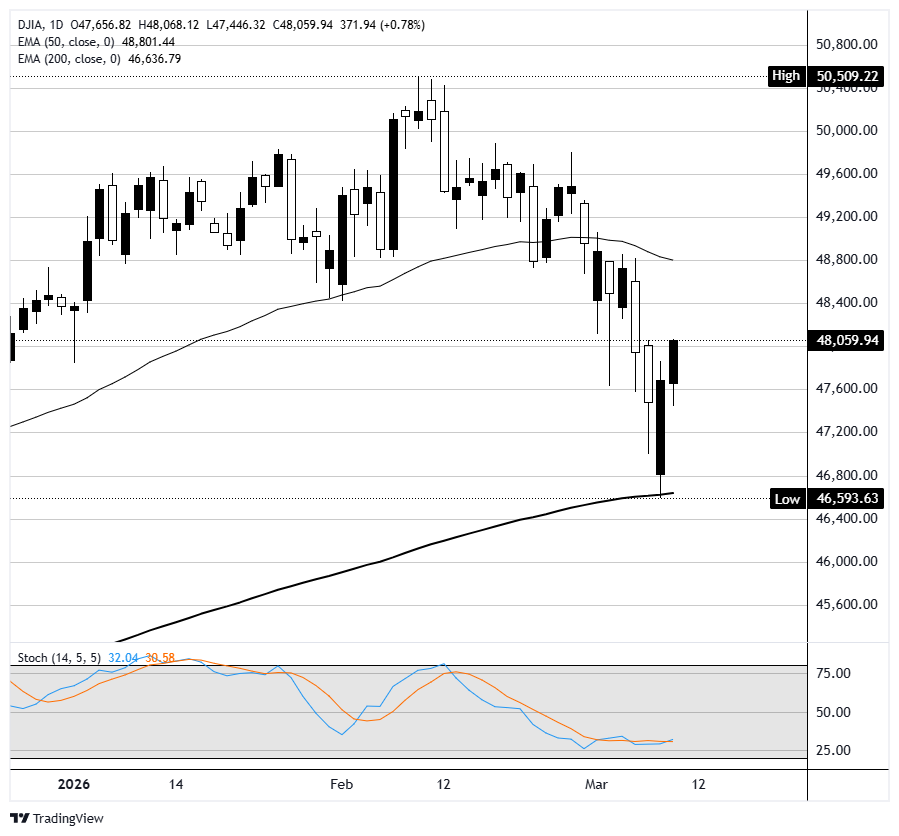
The Dow Jones Industrial Average rose to retest chart territory north of 48,000 on Tuesday, building on Monday's dramatic reversal. The S&P 500 and the Nasdaq Composite both gained ground as well as equity markets execute a broad turnaround. Trading was choppy throughout the session, with the Dow falling as much as 300 points at its lows before recovering. The comeback was driven largely by a sharp retreat in Crude Oil prices as traders grow hopeful that the US-Iran conflict may be approaching its end, and as the International Energy Agency (IEA) convened an emergency meeting to discuss a coordinated release of strategic crude reserves.
Oil prices retreat as IEA weighs emergency stockpile release
Crude Oil prices fell sharply on Tuesday, pulling back from levels that had topped $100 a barrel earlier in the week. West Texas Intermediate futures were last down around 10% to trade near $84 a barrel, while Brent crude shed a similar amount to roughly $88. The decline came after the IEA called a meeting of its more than 30 member countries to assess whether to make emergency stockpiles available to offset supply disruptions caused by the conflict. The move followed comments from President Trump on Monday suggesting the war was "very complete, pretty much," although Iranian authorities signaled they were prepared to continue fighting. Despite the pullback, Oil remains well above pre-war levels and the Strait of Hormuz, a critical chokepoint for global crude flows, remains effectively closed.
Industrials lead Dow gainers while software and healthcare lag
Caterpillar (CAT) led the Dow higher with a gain of more than 3%, extending its strong 2026 run. The heavy equipment maker has benefited from robust demand tied to AI data center construction and infrastructure spending. Cisco (CSCO) also outperformed, rising around 1.7% on the session. On the downside, Salesforce (CRM) was among the biggest laggards, falling roughly 3% amid broader concerns about enterprise software spending. UnitedHealth Group (UNH) dropped around 1.7%, acting as a significant drag on the price-weighted index. International Business Machines (IBM) also declined over 2%, continuing a weak stretch for the stock which is down more than 11% year-to-date.
Existing home sales beat expectations on lower mortgage rates
Existing home sales unexpectedly rose 1.7% month-over-month in February to a seasonally adjusted annual rate of 4.09 million units, according to data from the National Association of Realtors (NAR) released Tuesday. The result easily topped the consensus estimate of 3.89 million units. January's figure was also revised higher to 4.02 million from the previously reported 3.91 million pace. The rebound was supported by lower mortgage rates and a moderation in house-price growth, with the 30-year fixed rate averaging around 6% last week. NAR's Housing Affordability Index edged up to 117.6, its highest level since March 2022. However, the spike in Oil prices since the start of the Iran war has pushed Treasury yields higher, which could feed through to higher mortgage rates just as the spring buying season gets underway.
Gold rallies as safe-haven demand holds firm
Gold futures rose to around $5,195 per ounce on Tuesday, benefiting from continued safe-haven demand as geopolitical uncertainty lingered. The US Dollar weakened, with the Dollar Index falling around 0.5% to 98.66, providing an additional tailwind for bullion. Silver also surged, jumping around 5.5% on the day. The precious metals rally came despite the broader pullback in Oil, suggesting that markets are not yet fully convinced that the Iran conflict will resolve quickly. Treasury yields edged lower, with the 10-year yield slipping to around 4.12%.
Consumer Price Index data due Wednesday
Markets are now turning their attention to Wednesday's Consumer Price Index (CPI) report for February, due at 12:30 p.m. GMT. Economists expect headline CPI to rise 0.3% month-over-month, up from 0.2% in January, with the year-over-year figure expected to hold steady at 2.4%. Core CPI, which excludes food and energy, is forecast at 0.2% to 0.3% month-over-month and 2.5% year-over-year. Crucially, the February data was collected before the Iran war began and will not reflect the recent surge in energy prices. That impact is expected to show up in March and April readings. With roughly 97% of market participants pricing in unchanged rates at the Federal Reserve's (Fed) March meeting, the CPI print is unlikely to shift the near-term policy outlook, but it will provide an important baseline ahead of what could be a more volatile inflation picture in the months ahead.
Dow Jones daily chart
Dow Jones FAQs
The Dow Jones Industrial Average, one of the oldest stock market indices in the world, is compiled of the 30 most traded stocks in the US. The index is price-weighted rather than weighted by capitalization. It is calculated by summing the prices of the constituent stocks and dividing them by a factor, currently 0.152. The index was founded by Charles Dow, who also founded the Wall Street Journal. In later years it has been criticized for not being broadly representative enough because it only tracks 30 conglomerates, unlike broader indices such as the S&P 500.
Many different factors drive the Dow Jones Industrial Average (DJIA). The aggregate performance of the component companies revealed in quarterly company earnings reports is the main one. US and global macroeconomic data also contributes as it impacts on investor sentiment. The level of interest rates, set by the Federal Reserve (Fed), also influences the DJIA as it affects the cost of credit, on which many corporations are heavily reliant. Therefore, inflation can be a major driver as well as other metrics which impact the Fed decisions.
Dow Theory is a method for identifying the primary trend of the stock market developed by Charles Dow. A key step is to compare the direction of the Dow Jones Industrial Average (DJIA) and the Dow Jones Transportation Average (DJTA) and only follow trends where both are moving in the same direction. Volume is a confirmatory criteria. The theory uses elements of peak and trough analysis. Dow’s theory posits three trend phases: accumulation, when smart money starts buying or selling; public participation, when the wider public joins in; and distribution, when the smart money exits.
There are a number of ways to trade the DJIA. One is to use ETFs which allow investors to trade the DJIA as a single security, rather than having to buy shares in all 30 constituent companies. A leading example is the SPDR Dow Jones Industrial Average ETF (DIA). DJIA futures contracts enable traders to speculate on the future value of the index and Options provide the right, but not the obligation, to buy or sell the index at a predetermined price in the future. Mutual funds enable investors to buy a share of a diversified portfolio of DJIA stocks thus providing exposure to the overall index.
Recommended Articles


