


Dow Jones Industrial Average edges higher ahead of pivotal Nvidia earnings
- Dow gains 122 points as Wall Street positions ahead of Nvidia's fiscal Q4 results after the close.
- Software stocks extend Tuesday's rebound as AI disruption fears ease.
- PayPal rallies for a second day on reports Stripe is weighing an acquisition.
- Gold pulls back from record highs, dipping below $5,200 per ounce.
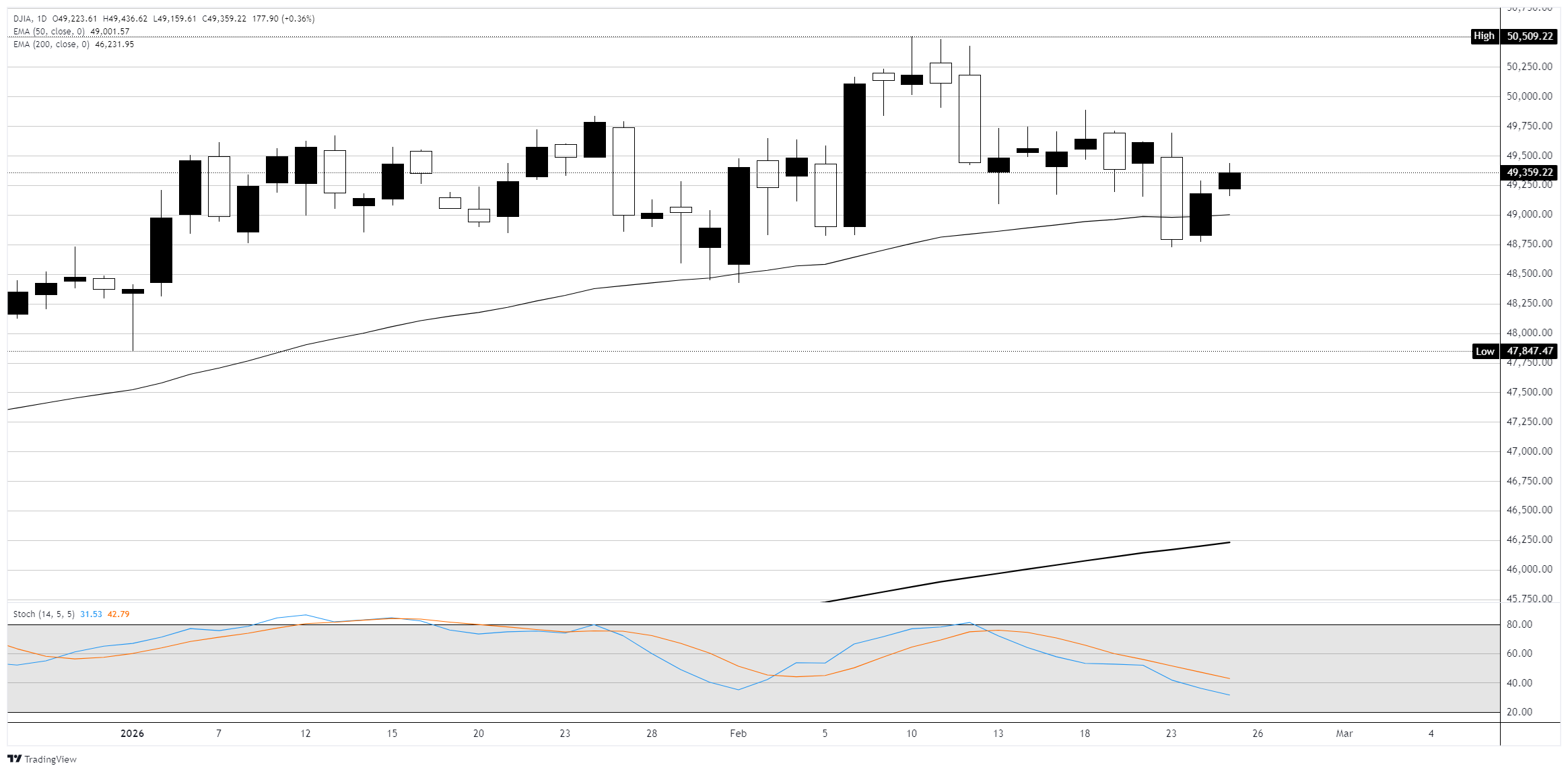
The Dow Jones Industrial Average (DJIA) rose around 200 points, or 0.4%, taking a fresh run at the 49,400 region on Wednesday as equity markets traded cautiously bullish ahead of Nvidia's highly anticipated fiscal fourth-quarter earnings report after the bell. The S&P 500 gained 0.54% to around 6,927, while the Nasdaq Composite added roughly 1%, led by continued strength in semiconductor and software names. All three major indexes built on Tuesday's rebound from Monday's sharp selloff, though volume and conviction were muted with traders reluctant to take big directional bets before the AI bellwether's results.
All eyes on Nvidia as AI spending cycle faces its biggest test
Nvidia (NVDA) was the undisputed focal point of the session, with the chipmaker set to report fiscal Q4 2026 results after the close. Wall Street consensus called for earnings per share of $1.53 on revenue of $65.7 billion, both representing roughly 68-72% year-over-year growth. The results are expected to provide the clearest read yet on demand for Nvidia's Blackwell architecture and the sustainability of the hyperscaler AI capital expenditure cycle, after Meta (META), Alphabet (GOOGL), and Amazon (AMZN) collectively guided to over $500 billion in 2026 capex. Nvidia shares drifted about 1% higher during the session as chip stocks broadly firmed, with Advanced Micro Devices (AMD) extending Tuesday's 9% surge following its multiyear, 6-gigawatt GPU deal with Meta. Polymarket traders priced in a 94.5% probability of an earnings beat heading into the print.
Software rebounds as AI disruption panic fades
The software sector continued to claw back losses from Monday's brutal selloff, which saw the iShares Expanded Tech-Software Sector ETF (IGV) drop nearly 5% on fears that AI-powered coding tools could undermine legacy business models. Salesforce (CRM) added to Tuesday's 4.7% gain, while ServiceNow (NOW) and cybersecurity names like Zscaler (ZS) and CrowdStrike (CRWD) also pushed higher. International Business Machines (IBM) rose 2.5%, leading Dow gainers and bouncing back from Monday's 13% plunge — its worst day since 2000 — which was triggered by Anthropic's Claude Code announcement. Jefferies analyst Brent Thill said IBM's mainframe business is more resilient than the market gave it credit for. Microsoft (MSFT) gained 2.2%, with Cerity Partners' Jim Lebenthal noting the stock trades at an attractive low-20s multiple after sliding nearly 20% in 2026.
PayPal surges on Stripe acquisition reports
PayPal (PYPL) continued its torrid two-day rally, climbing a cumulative 13% after Bloomberg reported that privately held payments giant Stripe is weighing an acquisition of all or parts of the company. The report followed Monday's initial news that PayPal had attracted unsolicited takeover interest from multiple potential buyers, including banks. PayPal's market cap sat around $43 billion at Tuesday's close of $47.02, a fraction of Stripe's recently disclosed $159 billion private valuation. Both companies have declined to comment, and the discussions were described as preliminary with no certainty of a deal.
Trump SOTU keeps tariff outlook steady; Gold retreats
President Donald Trump delivered the longest State of the Union address in history on Tuesday night, but markets largely shrugged off the speech on Wednesday. Wolfe Research analyst Tobin Marcus noted the address was light on economic policy specifics, with Trump focused on portraying the economy in a positive light rather than signaling any escalation in trade policy. This was a relief for investors still digesting the Supreme Court's ruling last week that struck down Trump's sweeping IEEPA-based tariffs, and the subsequent executive order imposing a new 10% global levy. Gold pulled back, trading around $5,120 per ounce after retreating from recent record highs, as the risk-on tone and lack of fresh tariff escalation reduced safe-haven demand. On the monetary policy front, the CME FedWatch Tool showed a 96% probability that the Federal Reserve (Fed) will hold rates steady at the March 18 meeting, though Fed Governor Christopher Waller's comment earlier in the week that the March decision is a "coin flip" kept the door ajar for a surprise cut from the current 3.50-3.75% target range.
Dow Jones daily chart
Dow Jones FAQs
The Dow Jones Industrial Average, one of the oldest stock market indices in the world, is compiled of the 30 most traded stocks in the US. The index is price-weighted rather than weighted by capitalization. It is calculated by summing the prices of the constituent stocks and dividing them by a factor, currently 0.152. The index was founded by Charles Dow, who also founded the Wall Street Journal. In later years it has been criticized for not being broadly representative enough because it only tracks 30 conglomerates, unlike broader indices such as the S&P 500.
Many different factors drive the Dow Jones Industrial Average (DJIA). The aggregate performance of the component companies revealed in quarterly company earnings reports is the main one. US and global macroeconomic data also contributes as it impacts on investor sentiment. The level of interest rates, set by the Federal Reserve (Fed), also influences the DJIA as it affects the cost of credit, on which many corporations are heavily reliant. Therefore, inflation can be a major driver as well as other metrics which impact the Fed decisions.
Dow Theory is a method for identifying the primary trend of the stock market developed by Charles Dow. A key step is to compare the direction of the Dow Jones Industrial Average (DJIA) and the Dow Jones Transportation Average (DJTA) and only follow trends where both are moving in the same direction. Volume is a confirmatory criteria. The theory uses elements of peak and trough analysis. Dow’s theory posits three trend phases: accumulation, when smart money starts buying or selling; public participation, when the wider public joins in; and distribution, when the smart money exits.
There are a number of ways to trade the DJIA. One is to use ETFs which allow investors to trade the DJIA as a single security, rather than having to buy shares in all 30 constituent companies. A leading example is the SPDR Dow Jones Industrial Average ETF (DIA). DJIA futures contracts enable traders to speculate on the future value of the index and Options provide the right, but not the obligation, to buy or sell the index at a predetermined price in the future. Mutual funds enable investors to buy a share of a diversified portfolio of DJIA stocks thus providing exposure to the overall index.
Recommended Articles


