


What Is Bitcoin? How Did It Become a Global Reserve Asset? What Are Its Future Trends?
TradingKey - From being virtually worthless to becoming a global reserve asset, what has Bitcoin experienced? What achievements has it made so far? What does the future hold? We will analyze these questions one by one.
Bitcoin: From Obscurity to Global Recognition
Bitcoin (BTC) is the world's first cryptocurrency, proposed by an individual or group under the pseudonym "Satoshi Nakamoto" in 2008 and officially launched in 2009. In its early days, Bitcoin was largely unknown, primarily circulating among cryptography enthusiasts and tech enthusiasts who often exchanged it for free.
On May 22, 2010, programmer Laszlo Hanyecz used 10,000 Bitcoins to purchase two pizzas, marking Bitcoin's first real-world transaction. In July of the same year, the Bitcoin exchange Mt. Gox was established, becoming the most important early Bitcoin trading platform.
In 2011, Bitcoin began to be used for some illegal transactions, such as on the dark web marketplace Silk Road, significantly increasing its notoriety. In February 2011, Bitcoin's price reached $1 for the first time, attracting media attention and gradually entering the public eye.
In 2021, El Salvador became the first country to adopt Bitcoin as legal tender. In January 2024, the U.S. SEC approved Bitcoin spot ETFs. In March 2025, President Trump announced and signed an executive order to include Bitcoin in the U.S. cryptocurrency reserve.
Is Bitcoin a Currency?
In the whitepaper, Satoshi Nakamoto defined Bitcoin as a peer-to-peer electronic payment system, which remains its most fundamental definition. As Bitcoin evolved, particularly with shifting regulatory attitudes, its definition has also expanded, leading to various interpretations such as a digital asset, virtual commodity, and more. A few countries, including El Salvador and the Central African Republic, have even elevated its status to legal tender.
Regardless of how Bitcoin is defined, its inherent characteristics remain unchanged, as outlined below:
Category | Feature | Description |
Technical Features | Decentralization | The Bitcoin network is maintained by global nodes with no central authority. |
Proof of Work (PoW) | Mining solves mathematical problems to verify transactions and create new blocks. | |
Cryptographic Security | Uses public and private keys to ensure transaction security and privacy. | |
Transparency | All transaction records are publicly accessible, but user identities are anonymous. | |
Economic Features | Scarcity | Limited to 21 million coins, making it anti-inflationary. |
Divisibility | Bitcoin can be divided into 8 decimal places, with the smallest unit being 0.00000001 BTC, called a "Satoshi." | |
Global Circulation | Bitcoin can be transferred globally without border restrictions. | |
| Peer-to-Peer Payments | Users can send Bitcoin directly to others without intermediaries like banks. |
Censorship Resistance | Bitcoin transactions do not require real identity information, allowing users to transact without interference. |
Bitcoin's Characteristics, Source: TradingKey.
What Are Bitcoin's Applications?
After more than a decade of development, Bitcoin has transformed from being virtually worthless to having widespread applications, including payments, value storage, investments, decentralized finance, and more, as detailed below:
Application Area | Specific Scenarios | Use Cases |
Payments | Cross-border, micro, peer-to-peer payments | Bitcoin can be sent globally to anyone without intermediaries like banks. |
Value Storage | Digital gold, safe-haven asset | With a fixed supply, Bitcoin is seen as a hedge against inflation and currency devaluation in countries like Argentina, Venezuela, Turkey, and Zimbabwe. |
Investments | Investment tool | As a new investment asset, Bitcoin attracts institutional and individual investors and has entered traditional stock markets. |
Decentralized Finance | Collateral and lending | Bitcoin can be used as collateral for loans in decentralized finance platforms. |
Technical Platform | Smart contracts | Through sidechains and the Lightning Network, Bitcoin can enable more complex smart contract functionalities, driving innovations like Bitcoin inscriptions and runes. |
Bitcoin's Application Scenarios, Source: TradingKey.
How Has Bitcoin Performed in the Market?
Since its inception in 2009, Bitcoin's price has experienced significant volatility, undergoing three complete bull and bear cycles, with each bull market peak surpassing the previous one. Currently, Bitcoin is in its fourth major bull market, with its peak price yet to be determined.
Cycle | Time | Peak Price | Low Price | Drawdown |
Early Stage | 2009-2012 | $30 | $2 | 93% |
First Bull Market | 2013 | $1,163 | $152 | 87% |
Second Bull Market | 2017 | $19,783 | $3,122 | 84% |
Third Bull Market | 2021 | $68,789 | $15,480 | 77% |
Fourth Bull Market | 2025 | TBD | TBD | TBD |
Bitcoin's Four Bull Markets: Price Changes, Source: TradingKey.
Bitcoin has experienced astonishing growth in each bull market but has also faced significant drawdowns during bear markets, ranging from 77% to 93%. However, as Bitcoin matures, each bear market drawdown has been smaller than the previous one.
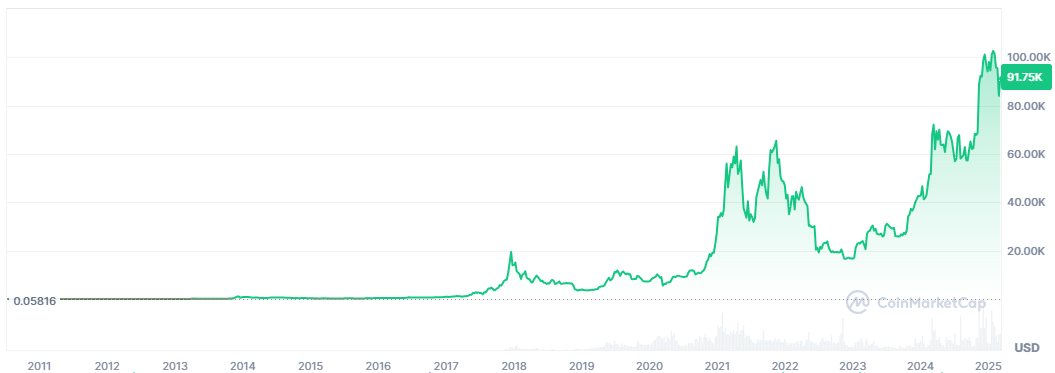
Bitcoin Price Chart (2011-2025), Source: CoinMarketCap.
In the early days, Bitcoin was the only cryptocurrency, accounting for 100% of the market. After its success, many other virtual currencies emerged post-2011, such as LTC, DOGE, and ETH, causing Bitcoin's market share to decline. In 2017, the ICO boom led to a surge in cryptocurrencies, reducing Bitcoin's market share to around 33%. However, with increasing global adoption and institutional investment, Bitcoin has regained dominance, maintaining a market share of approximately 60%.
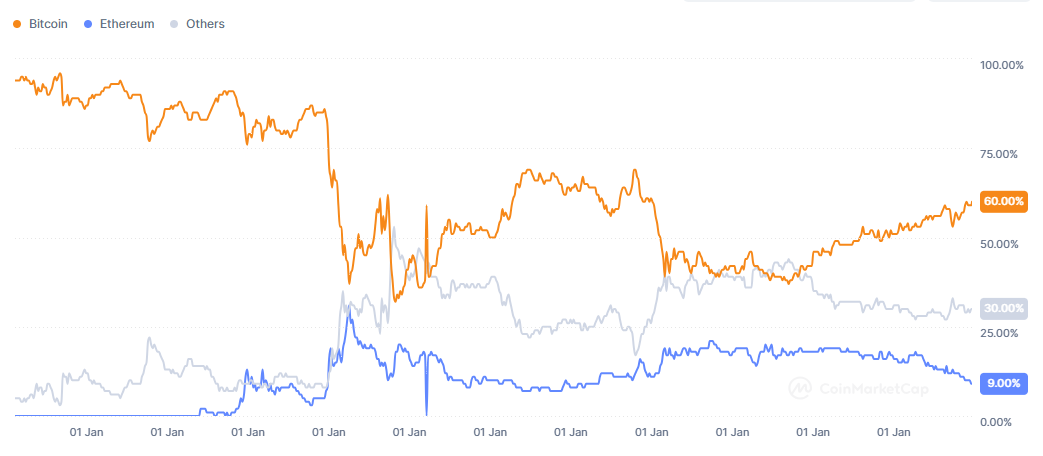
Bitcoin and Altcoin Market Share (2013-2025), Source: CoinMarketCap.
Why Is Bitcoin's Price So Volatile?
Bitcoin's price fluctuations are influenced by various factors, including macroeconomic conditions, regulatory policies, market supply and demand, and event-driven developments. These factors are interconnected and collectively contribute to Bitcoin's high volatility.
Category | Factors | Examples |
Macroeconomics | Global economic conditions, monetary policies | Economic uncertainty (e.g., inflation, recession) may drive demand for Bitcoin as a safe-haven asset. Central bank policies (especially the Fed) can also impact Bitcoin prices. |
Regulation | Government regulations, tax policies, international sanctions | Government regulations, tax policies, international sanctions | Regulatory policies (e.g., legalization, bans) affect market confidence. Taxation influences investor participation. Sanctions may push countries like Russia and Iran to use Bitcoin for cross-border payments. |
Market | Supply and demand, celebrity influence | Bitcoin's fixed supply of 21 million coins directly impacts prices. Statements from figures like Elon Musk and Donald Trump can have short-term effects. |
Event-Driven | Major events, black swan events | Bitcoin halvings, the "September 4" crackdown in China, SEC approval of Bitcoin spot ETFs, Trump's election, and the establishment of a U.S. Bitcoin reserve are key events. Unforeseen events like COVID-19 and the Russia-Ukraine conflict also play a role. |
Bitcoin's Future Trends
Bitcoin has moved beyond its early stages of instability, limited applications, and regulatory resistance and is now entering a phase of maturity, stability, compliance, and diversified applications. Its future prospects are increasingly clear.
Technology and Applications
Layer 2 technologies such as the Lightning Network, will enhance Bitcoin's transaction speed and scalability, making it more suitable for everyday payments. Schnorr signatures and MAST will improve privacy and security. Upgrades like Taproot and sidechains (e.g., Liquid, RSK) will expand Bitcoin's smart contract capabilities, enabling more decentralized applications (DApps).
Regulation and Policy
Governments worldwide are gradually developing and refining cryptocurrency regulatory frameworks, promoting Bitcoin's compliance. The U.S., for example, has made Bitcoin spot ETFs a significant part of its stock market. The Trump's administration has also shifted from hostile stance to more favourable regulations, establishing a cryptocurrency strategic reserve—an initiative that has inspired similar moves in countries like Japan, Brazil, and Hong Kong.
Market Trends
Institutional investors such as Tesla, MicroStrategy, and Grayscale, are entering the market, allocating Bitcoin as a strategic reserve, which is expected to further expand the market. As Bitcoin matures, its volatility has been decreasing, a trend likely to continue.
As technology advances, markets mature, and regulations improve, Bitcoin is poised to play an increasingly significant role in the global financial system. However, all investments carry risks, so decisions should be made based on individual risk tolerance.
Recommended Articles


