

CleanSpark Doubles Down As Bitcoin Mining Reaches Breaking Point

Source Beincrypto

CleanSpark purchased 7 new mining facilities in East Tennessee, consolidating operations in a new region. These investments come at a difficult time for Bitcoin miners.

The company hopes to close some facilities before the end of the month to carry out upgrades for a long-term plan.

Tennessee’s Mining Hub

On September 11, Bitcoin miner CleanSpark announced that it would acquire seven new mining facilities in East Tennessee. CleanSpark is a low-carbon mining firm that primarily uses renewable electricity to power its operations, making East Tennessee a particularly attractive destination.

According to court documents related to CleanSpark’s recent purchases, all seven facilities are preexisting mining operations that changed ownership. In other words, CleanSpark is consolidating the area’s mining infrastructure, not expanding it as a new hub.

These purchases amounted to a sum of $27.5 million, and CleanSpark will close these sites before the end of the month. After this closing, CleanSpark will conduct a series of upgrades, using S21 pro miners to increase “the company’s current hashrate by over 22 percent,” according to the press release.

“With this additional 5 EH/s expected to begin hashing over the coming weeks, we now expect to achieve 37 EH/s before the end of 2024. As we’ve previously discussed, our timing of the market on mining server purchases intentionally locked in low prices so that we could take advantage of opportunities like this and immediately fill acquired data center space,” Zach Bradford, CleanSpark’s CEO, said.

Bitcoin miners have moved to East Tennessee in the last two years for various reasons. The region is attractive to new investors due to cheap land and friendly mining regulations. However, it is the vast hydroelectric infrastructure that makes large-scale Bitcoin mining possible.

Read more: Liquid Bitcoin Hashrate Protocol: A Guide to Mining Bitcoin With NFTs

Since the 1930s, the Tennessee Valley Authority (TVA) has maintained a formidable hydroelectric power grid in the region. Therefore, the area has comparatively few coal-based power plants. This makes East Tennessee particularly attractive to a firm like CleanSpark, which prides itself on low emissions.

As Bradford himself put it, “Tennessee has a similar political and energy environment to Georgia, where we’ve deployed nearly $1 billion of capital and operate nearly 500 MW.” The investment, in other words, could be a first step. If CleanSpark’s new facilities are a success, it may lead to further intensification of crypto mining infrastructure in the region.

Bitcoin Mining Difficulty

However, several obstacles exist between CleanSpark and a long-term infrastructure construction project. As Bradford mentioned, this purchase was timed to close a deal when the asking price was the lowest.

New data suggests that mining difficulty is at an all-time high, which is concerning next to Bitcoin’s price drops. When mining difficulty is high, it usually means there are more miners competing, which increases the energy and resources needed to mine new blocks. If the price of Bitcoin drops during this time, it can become less profitable for miners.

This creates concern because miners might struggle to cover operational costs, especially if they rely heavily on Bitcoin’s value for their revenue. In some cases, sustained high difficulty and low Bitcoin prices can lead to miners shutting down operations, which aligns with what investment bank Jefferies said in a research report.

“September is shaping up to be another difficult month as BTC remains below $60K and the network hashrate continues to climb,” analysts at Jefferies wrote.
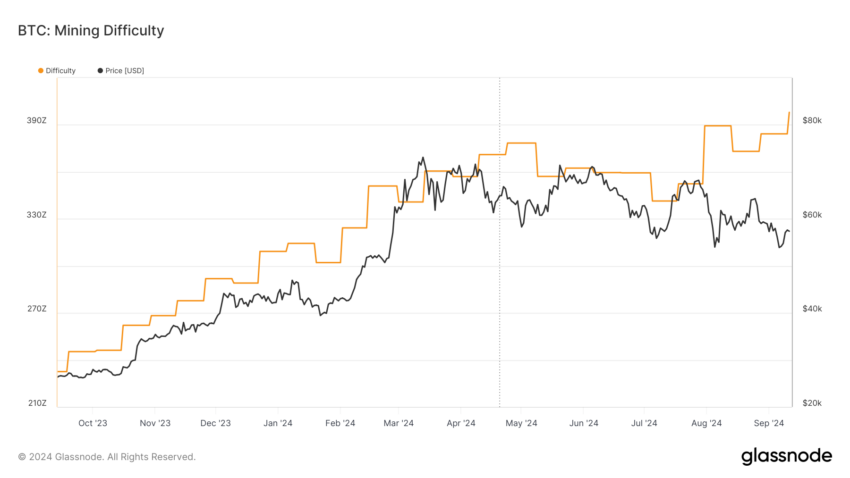
Bitcoin Mining DifficultyBitcoin Mining Difficulty. Source: Glassnode

These broader economic downturns coincide with a difficult moment for CleanSpark itself. The company’s stock valuation has been on a steady decline and may be crossing critical thresholds. Specifically, CleanSpark’s short-term moving average has nearly descended past its long-term moving average, a so-called “death cross” suggesting a long-term decline.

Read more: 5 Best Platforms To Buy Bitcoin Mining Stocks After 2024 Halving

These price moves may shake investor confidence in the context of increasing hardship for the entire industry.

Disclaimer: For information purposes only. Past performance is not indicative of future results.
placeholder
Gold Price Forecast: XAU/USD drifts higher above $4,200 as Fed delivers expected cutGold price (XAU/USD) gains momentum to around $4,235 during the early Asian session on Thursday. The precious metal extends its upside after the US Federal Reserve (Fed) delivered an expected third consecutive interest rate cut and maintained its outlook for just one cut in 2026.
Author  FXStreet
Dec 11, Thu
Gold price (XAU/USD) gains momentum to around $4,235 during the early Asian session on Thursday. The precious metal extends its upside after the US Federal Reserve (Fed) delivered an expected third consecutive interest rate cut and maintained its outlook for just one cut in 2026.
placeholder
Ethereum Price Slips Lower — $3,000 Looms as the Key BattlegroundEthereum is attempting to recover from a $3,026 low but remains below $3,200 and the 100-hour SMA, with a bearish trend line near $3,175 capping rebounds as bulls need a clean break above $3,200 to target $3,250–$3,400, while a drop below $3,050 risks a retest of $3,000 and $2,940.
Author  Mitrade
Dec 15, Mon
Ethereum is attempting to recover from a $3,026 low but remains below $3,200 and the 100-hour SMA, with a bearish trend line near $3,175 capping rebounds as bulls need a clean break above $3,200 to target $3,250–$3,400, while a drop below $3,050 risks a retest of $3,000 and $2,940.
placeholder
Macro Analysts: Hawkish Japan Could Push Bitcoin Below $70KAnalysts predict Bitcoin may face further declines towards the $70,000 mark if the Bank of Japan raises interest rates as expected.
Author  Mitrade
Dec 15, Mon
Analysts predict Bitcoin may face further declines towards the $70,000 mark if the Bank of Japan raises interest rates as expected.
placeholder
Bitcoin Slides 5% as Sellers Lean In — Can BTC Reclaim $88,000?Bitcoin has dropped back below $88,000 after rolling over from $90,500, with price still trading under the 100-hour Simple Moving Average. The sell-off found a floor at $85,151, and BTC is now consolidating near that base, but rebounds are facing pressure from a bearish trend line around $89,000. Bulls need to retake $88,000–$89,000 to ease downside risk; failure to do so keeps $85,500–$85,000 and then $83,500 in play, with $80,000 as the deeper “line in the sand.” Bitcoin (BTC) is back in damage-control mode after a sharp pullback wiped out recent gains. The price failed to reclaim the $90,000–$90,500 band, rolled over, and slid through $88,500 before briefly dipping under $87,000. Buyers did show up around $85,000, but the rebound so far looks more like stabilization than a clear trend reversal. Bitcoin dips hard, finds a bid near $85,000(h3) BTC’s latest move lower began when it couldn’t build follow-through above $90,000 and $90,500. Once that upside stalled, sellers took control and pushed price down through $88,500. The slide accelerated enough to spike below $87,000, but the market didn’t free-fall. Bulls defended the $85,000 zone, printing a low at $85,151. Since then, Bitcoin has been consolidating below the 23.6% Fibonacci retracement of the drop from the $93,560 swing high to the $85,151 low — a clue that the bounce is still shallow and that sellers haven’t fully backed off yet. Structurally, BTC is still on the back foot: It’s trading below $88,000, and It remains below the 100-hour Simple Moving Average, keeping short-term trend pressure pointed downward. Resistance is layered, and $89,000 is the problem area(h3) If bulls try to turn this into a recovery, they’ll have to climb through multiple ceilings in quick succession. First, BTC faces resistance around $87,150, followed by a more meaningful barrier near $87,500. From there, the market’s attention snaps back to $88,000 — the level BTC just lost and now needs to reclaim. A close back above $88,000 would improve the tone, but it doesn’t solve the bigger issue: there’s a bearish trend line on the hourly BTC/USD chart (Kraken feed) with resistance near $89,000, which also lines up with the next technical hurdle. If BTC can push through $89,000 and hold, the rebound could extend toward $90,000, with follow-through targets at $91,000 and $91,500. But until price clears that $88,000–$89,000 zone, rallies are at risk of being sold rather than chased. If BTC fails to reclaim resistance, the downside path is clear(h3) The near-term bear case is simple: if Bitcoin can’t climb back above the $87,000 area and keep traction, sellers may attempt another leg lower. Support levels line up like this: Immediate support: $85,500 First major support: $85,000 Next support: $83,500 Then $82,500 in the near term Below that, the major “don’t break this” level is still $80,000. If BTC slips under $80,000, the risk of acceleration to the downside increases significantly — not because it’s magic, but because it’s the kind of psychological and structural level that tends to trigger forced de-risking. Indicators: momentum still leans bearish(h3) The intraday indicators aren’t offering much comfort yet: Hourly MACD is losing pace in the bearish zone. Hourly RSI remains below 50, suggesting sellers still have the upper hand on short timeframes. So while the $85,000 defense held for now, the market hasn’t flipped bullish — it’s just stopped bleeding.
Author  Mitrade
21 hours ago
Bitcoin has dropped back below $88,000 after rolling over from $90,500, with price still trading under the 100-hour Simple Moving Average. The sell-off found a floor at $85,151, and BTC is now consolidating near that base, but rebounds are facing pressure from a bearish trend line around $89,000. Bulls need to retake $88,000–$89,000 to ease downside risk; failure to do so keeps $85,500–$85,000 and then $83,500 in play, with $80,000 as the deeper “line in the sand.” Bitcoin (BTC) is back in damage-control mode after a sharp pullback wiped out recent gains. The price failed to reclaim the $90,000–$90,500 band, rolled over, and slid through $88,500 before briefly dipping under $87,000. Buyers did show up around $85,000, but the rebound so far looks more like stabilization than a clear trend reversal. Bitcoin dips hard, finds a bid near $85,000(h3) BTC’s latest move lower began when it couldn’t build follow-through above $90,000 and $90,500. Once that upside stalled, sellers took control and pushed price down through $88,500. The slide accelerated enough to spike below $87,000, but the market didn’t free-fall. Bulls defended the $85,000 zone, printing a low at $85,151. Since then, Bitcoin has been consolidating below the 23.6% Fibonacci retracement of the drop from the $93,560 swing high to the $85,151 low — a clue that the bounce is still shallow and that sellers haven’t fully backed off yet. Structurally, BTC is still on the back foot: It’s trading below $88,000, and It remains below the 100-hour Simple Moving Average, keeping short-term trend pressure pointed downward. Resistance is layered, and $89,000 is the problem area(h3) If bulls try to turn this into a recovery, they’ll have to climb through multiple ceilings in quick succession. First, BTC faces resistance around $87,150, followed by a more meaningful barrier near $87,500. From there, the market’s attention snaps back to $88,000 — the level BTC just lost and now needs to reclaim. A close back above $88,000 would improve the tone, but it doesn’t solve the bigger issue: there’s a bearish trend line on the hourly BTC/USD chart (Kraken feed) with resistance near $89,000, which also lines up with the next technical hurdle. If BTC can push through $89,000 and hold, the rebound could extend toward $90,000, with follow-through targets at $91,000 and $91,500. But until price clears that $88,000–$89,000 zone, rallies are at risk of being sold rather than chased. If BTC fails to reclaim resistance, the downside path is clear(h3) The near-term bear case is simple: if Bitcoin can’t climb back above the $87,000 area and keep traction, sellers may attempt another leg lower. Support levels line up like this: Immediate support: $85,500 First major support: $85,000 Next support: $83,500 Then $82,500 in the near term Below that, the major “don’t break this” level is still $80,000. If BTC slips under $80,000, the risk of acceleration to the downside increases significantly — not because it’s magic, but because it’s the kind of psychological and structural level that tends to trigger forced de-risking. Indicators: momentum still leans bearish(h3) The intraday indicators aren’t offering much comfort yet: Hourly MACD is losing pace in the bearish zone. Hourly RSI remains below 50, suggesting sellers still have the upper hand on short timeframes. So while the $85,000 defense held for now, the market hasn’t flipped bullish — it’s just stopped bleeding.
placeholder
Senate Delays Crypto Market Structure Hearings to Early 2026The Senate Banking Committee has postponed cryptocurrency market structure hearings until 2026, citing ongoing bipartisan negotiations.
Author  Mitrade
18 hours ago
The Senate Banking Committee has postponed cryptocurrency market structure hearings until 2026, citing ongoing bipartisan negotiations.
goTop
quote