


Cryptopolitan Report: Bill Gates Says Nobody Has A Plan For AI. 56% Of Our Readers Agree
What Gates Actually Wrote
On August 26, Bill Gates published an essay on Gates Notes titled “The turbulent AI era is here. The choices we make now are critical”. For a man who has been an AI optimist for the large part over the past few years, the shift in tone here is striking.
The line that stood out was this one: “AI will either be the greatest equalizer ever invented, or the worst source of injustice.” Throughout the essay, he does not claim to know which but he does reiterate that nobody is steering. “Right now, we are not preparing for it,” he wrote. “I don’t see evidence that leaders, experts, and communities are confronting the challenges adequately. There is no plan to ease the entry into the AI era.”
It’s important to note that he distinguishes his position from a general anti-AI stance. Gates is genuinely bullish on AI’s capabilities in fields like medicine, education, agriculture and science. His trepidation is on distribution and pace rather than capability.
The comparison he uses is with his own experience. Gates helped build the personal computer and the advent of this technology completely changed the way people worked over a generation. Compared to that, he believes, AI has the power to transform work and life way faster. AI performs cognitive work, spreads through infrastructure that already exists, and requires no specialised skill to operate. As he put it, “AI will take on work in law, customer service, medicine, software and manufacturing, and it will hit those industries over the course of a decade rather than a few generations.”
The Three Things He Is Worried About
Jobs comes first. He stresses that AI will have a significant impact on jobs and that White-collar roles are already being hit modestly. He also states that the biggest risk is among entry-level and mid-level roles, particularly where AI systems operate without a human checking each step. He cites a Stanford Research paper by Brynjolfsson, Chandar and Chen which compared two groups of young workers aged between 22 and 25. Those in roles that were heavily exposed to AI and those in jobs that weren’t exposed. The second group kept growing while the first ended up around 19% smaller than it should have been. The jobs are not disappearing so much as never being posted.
Malicious use comes second. Gates argues that crimes which used to require real skill and tact are becoming increasingly available to anyone. Cyberattacks, fraud and disinformation can spread rapidly and easily when a model can do the hard parts for you. He extends the same worry to engineering biological threats. He also flags the risk of models acting against human interests in ways that become hard to reverse.
Children come third, and this is the section that reads most personally. He states that talking to AI now is simply too easy. There is no risk of being misunderstood with no real effort required from the other. That comfort is the concern and when you strip out any sort of real friction, he argues that these tools can become addictive, particularly for teenagers and that relying on them stunts critical thinking and social development.
Running underneath all three is a charge aimed squarely at his own industry. Gates has said the tech sector downplays these risks in public while acknowledging them privately, driven by competitive and fundraising pressure. His line on this is direct: it is good that some AI companies propose solutions to problems their own technology created, but we should not expect them to lead the charge.
What He Wants Done About It
Three proposals, and the first two got most of the coverage.
A tax on AI tokens and robots. The logic is an asymmetry in the existing tax code. Hire a person and you pay payroll tax on their earnings. Buy a robot and you write it off as a business expense. Gates argues the system currently nudges employers toward machines, and that a targeted levy would slow that nudge slightly while funding retraining and a stronger safety net. He floated a version of this in 2017 and it was received as eccentric. He is candid that it remains a hard sell, telling Axios it would be a larger change to the tax system than any in his lifetime, at a moment when politics is more polarised than any in his lifetime.
“Human Reserved” jobs. The more unusual idea, and the one he seems least certain about. Gates borrows the logic of nature reserves: land societies could develop but choose not to, because the loss would be permanent. Applied to labour, certain roles would be deliberately kept in human hands even where AI could technically perform them. Some protections would be permanent, like a doctor delivering a terminal diagnosis. Others would be transitional, and here he offers a concrete case. You cannot tell a 55-year-old who has spent a career in construction to move into elder care and expect that to work. He has floated getting the reserved share of work up to around 40%, using shorter workdays and earlier retirement to spread what remains. He told GeekWire he worked parts of this through in conversation with Claude, which is either encouraging or slightly absurd depending on your priors.
New institutions, domestic and international. The least detailed of the three, and effectively an admission that the first two cannot happen without machinery that does not currently exist.
Gates is upfront that the Human Reserved concept has holes. Who decides what qualifies. How rules survive across borders. How you stop firms routing around them. These, he writes, will need to be worked out in public. The International Federation of Robotics has already dismissed the tax proposal as solving a problem that does not exist.
Reader Pulse: The Poll
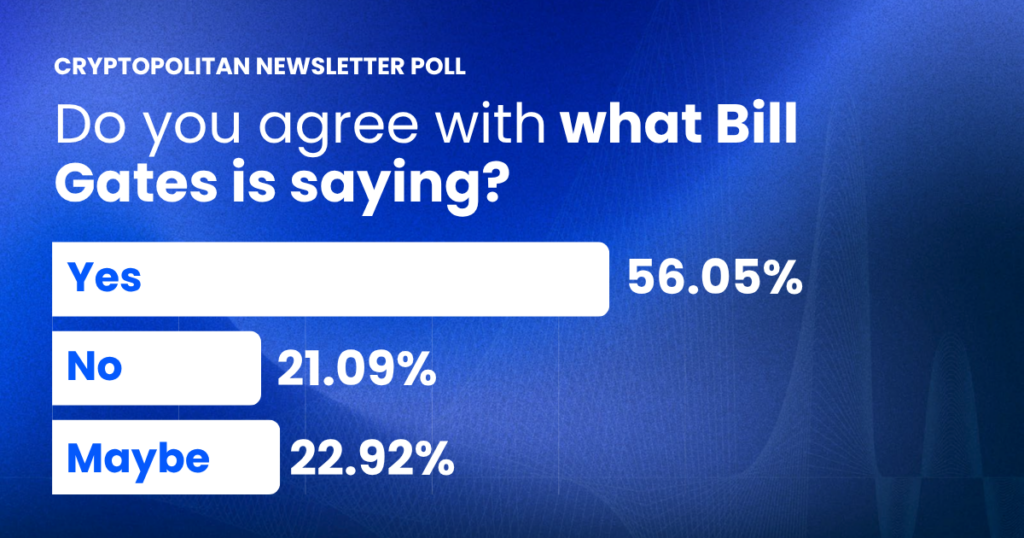
What the Split Reveals
The useful context here is not who these newsletter readers are but what they have told us before. This is an audience that follows AI closely enough to read about it daily, and across three polls this year it has shown a consistent pattern: high literacy, low personal enthusiasm. In May, 38% said they had never used an AI agent, with another quarter unsure what one was. Later that same month, the largest group said they do not consult AI before making life decisions. Now a majority is agreeing with a warning about the technology from a man who has no obvious incentive to deliver one.
Read together, those results describe a group that watches this sector attentively and keeps it at arm’s length personally. That makes the 56% less surprising than it first appears, and arguably more meaningful.
Yes (56.05%): A decisive majority, and our read is that the specificity did the work. Gates did not warn vaguely about the future. He cited a named Stanford study, identified where the damage shows up first, and proposed policies concrete enough to argue with. Warnings from senior industry figures usually arrive as abstractions about existential risk, which are easy to nod along to and impossible to act on. This one came with a mechanism and a timeline, and readers who track this space daily would recognise the difference.
Maybe (~23.6%): Almost a quarter hedged, and the hedge reconstructs easily. You can accept the diagnosis while rejecting the treatment. Someone might agree entirely that entry-level hiring is contracting and that children spending hours with chatbots deserves attention, while thinking a token tax is unenforceable and Human Reserved is a category nobody can define. The poll offered one box for agreement, and this group used the middle option to register partial support.
No (~20.4%): One in five disagreed, and the strongest version of that position is not techno-optimism. It is scepticism about the messenger. Gates built a company that consolidated extraordinary control over how the world computes, spent years in antitrust proceedings over it, and is now proposing constraints while Microsoft holds one of the largest positions in AI. Whether that read is fair is debatable. It is coherent, and roughly a fifth of this audience appears to hold it.
So What Happens Now
Gates is not asking for a pause. He says so plainly, and his reasoning is that competition between firms and between countries makes any coordinated slowdown unworkable. His proposals go after the fallout instead.
Which puts the three ideas in an awkward spot. He admits the tax is a harder sell than anything he has attempted before. Human Reserved is closer to a sketch than a policy, and he says as much when he writes that the details will need to be worked out in public. The institutions he wants do not exist and there is no obvious process for building them.
So the proposals are not really the thing to watch. The claim underneath them is. Gates says the labour market moves faster than governments can respond, and that gets tested every quarter whether anyone is paying attention or not.
The Stanford numbers are where it shows up first. Right now the effect sits with workers aged 22 to 25 in the most exposed roles, which is narrow enough that reasonable people are reading it as a blip. Watch whether it stays there. If the same pattern turns up among 30 and 40 year olds over the next couple of years, an essay that currently reads as pessimistic starts to look like it was published early.
Our readers have already made their call on the diagnosis. The harder question, and the one Gates cannot answer either, is what anybody does about it.
If you're reading this, you’re already ahead. Stay there with our newsletter.
Recommended Articles


