

Dallas Fed warns of tokenized deposits impact on bank lending

Source Cryptopolitan

The Federal Reserve Bank of Dallas warned that each new entry into the recently popular tokenized deposits sheds from banks’ ability to fund loans for households and businesses when it weighed in on the stablecoins vs. tokenized deposits debate.

The paper by the Dallas apex bank returned three key areas where tokenized deposits will impact banks’ businesses and trickle into the economy:

  • 80% of the duration risk taken by banks ($5.8 trillion 10-year equivalents out of $7 trillion total) in the aggregate is supported by the duration characteristics of deposits.
  • A 10% reduction in the WAL of deposits would shrink maturity transformation capacity in the aggregate by about $580 billion 10-year equivalents.
  • A 10% increase in the price sensitivity of deposits (deposit rate beta) would result in a reduction of $700 billion 10-year equivalents of duration risk appetite from banks (assuming a deposit WAL of four years).

Why the Dallas Fed is not so hot on tokenized deposits

Dallas Fed economists Rosie Levy and Srini Ramaswamy came back with headaches over maturity transformation after looking at the potential outcomes from a hypothetical future where banks are handling customer funds on blockchain rails.

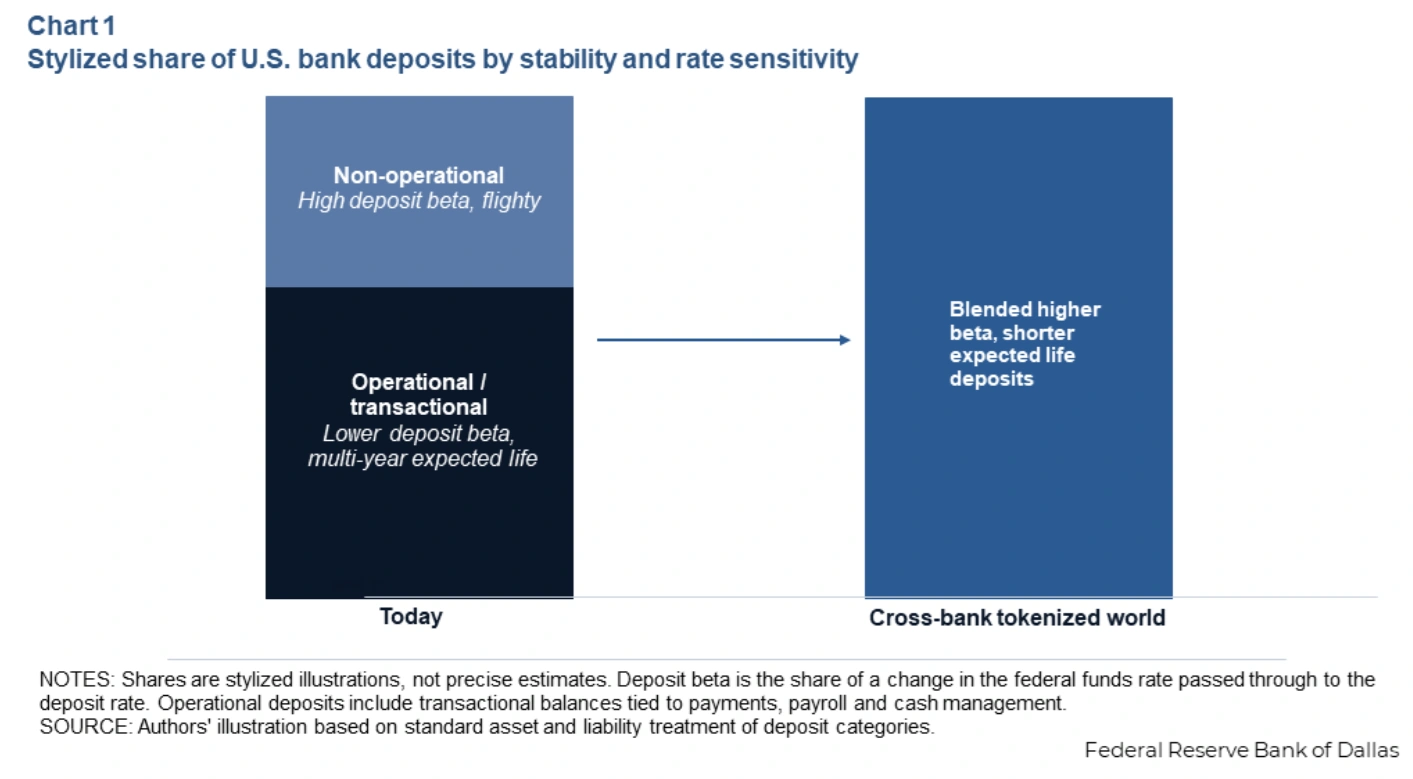
Maturity transformation refers to how the banking industry funds long-term loans with deposits that owners may need to withdraw at any time. The friction between initiating and completing a withdrawal is one of the pillars holding the current system.

Swap out traditional routes for the blockchain rails that tokenized deposits run, and bank customers will now be able to access their deposits instantly and around the clock.
Dallas Fed warns tokenized deposits could squeeze bank lending

That frictionless experience means anyone can move their money from one bank to another offering better rates in a matter of seconds, not days.

The headache escalates into a migraine when the economists consider a scenario where AI agents can automatically reroute money from programmable deposit tokens for customers.

In short, the Dallas Fed economists believe that banks cannot afford for stable deposits to become unstable reserves.

Banks chose tokenized deposits over stablecoins

Banks have been locked in a fight for their future since the Trump administration made passing stablecoin regulation a priority. In one of those frontiers, banking groups held up the CLARITY Act for months over concerns that stablecoin issuers were gaining a perceived edge by paying yields to customers.

Banks landed on tokenized deposits as a fully regulated alternative to stablecoins, which still lack a complete regulatory framework. With tokenized deposits, banks stay inside the existing bank rulebook and can even pay interest to holders.

A future where a competing system gains a competitive edge over banks will not only affect them, but it will also spread to the households and businesses that depend on them for credit facilities.

As the S&P Global ratings agency warned in June, banks could face inflated funding costs and lose a big chunk of their payment income if stablecoin firms see sizable growth at their expense.

McKinsey estimated that only about 15% flows back to the banking system as wholesale reserves on every $1,000 a customer converts into a third-party stablecoin.

Dallas Fed red flags or not, at least, with tokenized deposits, banks can pitch a comparable alternative to customers that still keeps 100% of their funds on the bank’s books.

The industry is already building the rails

The warning lands as US banks race to stand up the infrastructure. JPMorgan Chase, Citigroup, Bank of America and Wells Fargo are backing a shared tokenized deposit network run through The Clearing House, targeting a 2027 launch, Cryptopolitan previously reported.

Swift said in July that its blockchain ledger was ready for initial use, with 17 banks across six continents preparing pilots. And a coalition of 39 state bankers associations has formed the BankChain Alliance to give smaller lenders their own route on-chain.

For adoption to matter, the Dallas Fed noted, deposit tokens have to circulate beyond the bank that issued them, which is exactly what these consortia and associations are designed to enable.

Bankers are already weighing the fallout. Matt McAfee, head of enterprise innovation and digital assets at M&T Bank, told American Banker the risks feel “familiar” but are “heightened in a world where customers can move money 24/7.”

The economists stopped short of predicting how far adoption will go. They set out the potential consequences, they wrote, “without passing judgment on the likelihood of such adoption occurring.”

Don’t just read crypto news. Understand it. Subscribe to our newsletter. It's free.

Disclaimer: For information purposes only. Past performance is not indicative of future results.
placeholder
Pinduoduo Earnings Incoming: Morgan Stanley Sees Long-Term Profit Potential​Insights – On November 21, Chinese e-commerce giant Pinduoduo (PDD) will release its Q3 2024 earnings.
Author  Mitrade
Nov 20, 2024
​Insights – On November 21, Chinese e-commerce giant Pinduoduo (PDD) will release its Q3 2024 earnings.
placeholder
Bitcoin ETF Inflows For 2025 Now Outpace 2024, Data ShowsUS Bitcoin spot exchange-traded funds (ETFs) have seen more inflows this year so far compared to the same point in 2024, according to data.
Author  Bitcoinist
Jul 16, 2025
US Bitcoin spot exchange-traded funds (ETFs) have seen more inflows this year so far compared to the same point in 2024, according to data.
placeholder
Bitcoin briefly loses 2025 gains as crypto plunges over the weekend.Bitcoin experienced a sharp decline this weekend, briefly erasing its 2025 gains and dipping below its year-opening value of $93,507. The cryptocurrency fell to a low of $93,029 on Sunday, representing a 25% drop from its all-time high in October. Although it has rebounded slightly to around $94,209, the pressures on the market remain significant. The downturn occurred despite the reopening of the U.S. government on Thursday, which many had hoped would provide essential support for crypto markets. This year initially appeared promising for cryptocurrencies, particularly after the inauguration of President Donald Trump, who has established the most pro-crypto administration thus far. However, ongoing political tensions—including Trump's tariff strategies and the recent government shutdown, lasting a historic 43 days—have contributed to several rapid price pullbacks for Bitcoin throughout the year. Market dynamics are also being influenced by Bitcoin whales—investors holding large amounts of Bitcoin—who have been offloading portions of their assets, consequently stalling price rallies even as positive regulatory developments emerge. Despite these sell-offs, analysts from Glassnode argue that this behavior aligns with typical patterns seen among long-term investors during the concluding stages of bull markets, suggesting it is not indicative of a mass exodus. Notably, Bitcoin is not alone in its struggles, as Ethereum and Solana have also recorded declines of 7.95% and 28.3%, respectively, since the start of the year, while numerous altcoins have faced even steeper losses. Looking ahead, questions linger regarding the viability of the four-year cycle thesis, particularly given the increasing institutional support and regulatory frameworks now in place in the crypto landscape. Matt Hougan, chief investment officer at Bitwise, remains optimistic, suggesting a potential Bitcoin resurgence in 2026 driven by the “debasement trade” thesis and a broader trend toward increased adoption of stablecoins, tokenization, and decentralized finance. Hougan emphasized the soundness of the underlying fundamentals, pointing to a positive outlook for the sector in the longer term.
Author  Mitrade
Nov 17, 2025
Bitcoin experienced a sharp decline this weekend, briefly erasing its 2025 gains and dipping below its year-opening value of $93,507. The cryptocurrency fell to a low of $93,029 on Sunday, representing a 25% drop from its all-time high in October. Although it has rebounded slightly to around $94,209, the pressures on the market remain significant. The downturn occurred despite the reopening of the U.S. government on Thursday, which many had hoped would provide essential support for crypto markets. This year initially appeared promising for cryptocurrencies, particularly after the inauguration of President Donald Trump, who has established the most pro-crypto administration thus far. However, ongoing political tensions—including Trump's tariff strategies and the recent government shutdown, lasting a historic 43 days—have contributed to several rapid price pullbacks for Bitcoin throughout the year. Market dynamics are also being influenced by Bitcoin whales—investors holding large amounts of Bitcoin—who have been offloading portions of their assets, consequently stalling price rallies even as positive regulatory developments emerge. Despite these sell-offs, analysts from Glassnode argue that this behavior aligns with typical patterns seen among long-term investors during the concluding stages of bull markets, suggesting it is not indicative of a mass exodus. Notably, Bitcoin is not alone in its struggles, as Ethereum and Solana have also recorded declines of 7.95% and 28.3%, respectively, since the start of the year, while numerous altcoins have faced even steeper losses. Looking ahead, questions linger regarding the viability of the four-year cycle thesis, particularly given the increasing institutional support and regulatory frameworks now in place in the crypto landscape. Matt Hougan, chief investment officer at Bitwise, remains optimistic, suggesting a potential Bitcoin resurgence in 2026 driven by the “debasement trade” thesis and a broader trend toward increased adoption of stablecoins, tokenization, and decentralized finance. Hougan emphasized the soundness of the underlying fundamentals, pointing to a positive outlook for the sector in the longer term.
placeholder
Gold Price Forecast: US Treasury Yield Slump Pushes Gold Above $4,500, Will Gold Keep Rising?As of the Asian session on August 20, gold prices (XAUUSD) surged again today after breaking above $4,500 on Wednesday, reaching a nearly two-month high of $4,527.12 before pulling back i
Author  TradingKey
Aug 20, Thu
As of the Asian session on August 20, gold prices (XAUUSD) surged again today after breaking above $4,500 on Wednesday, reaching a nearly two-month high of $4,527.12 before pulling back i
placeholder
Ethereum Price Forecast: BitMine scoops 32K ETH, hints at further gainsEthereum (ETH) treasury company BitMine Immersion Technologies (BMNR) expanded its digital asset holdings last week with another round of acquisitions.
Author  FXStreet
Yesterday 01: 29
Ethereum (ETH) treasury company BitMine Immersion Technologies (BMNR) expanded its digital asset holdings last week with another round of acquisitions.
goTop
quote