


‘Coldest Crypto Winter Ever’: Bloomberg’s Weisenthal Lists 12 Reasons
Bloomberg’s Joe Weisenthal has revived and expanded his argument that crypto is stuck in what he calls the “coldest crypto winter ever,” pointing to a 12-part case that goes beyond price action and into market psychology, capital rotation, regulation, AI and quantum computing.
Writing in his Odd Lots newsletter and sharing the piece on X, Weisenthal said he had previously laid out 10 reasons in February for why the current downturn felt unusually punishing. “Well everything I cited then still holds,” he wrote, adding that two more factors have since made the backdrop look even worse.
Crypto’s Problem Is No Longer Just Crypto
The core of Weisenthal’s argument is that crypto’s weakness is taking place at a time when other speculative corners of the market are doing exceptionally well. That contrast matters. A bear market is one thing when risk assets are broadly under pressure; it is another when investors are watching adjacent trades explode higher.
One chart cited in the newsletter showed the Goldman Sachs non-profitable tech basket climbing sharply again, with Kevin Gordon, head of macro research and strategy at the Schwab Center for Financial Research, noting that the basket is “mooning again” in a way that resembles the 2021 boom. Another chart highlighted the Goldman Sachs US quantum computing basket, which has also moved materially higher after a dramatic rally.
For Weisenthal, that makes crypto’s malaise more painful. “First, other people are making SO MUCH MONEY,” he wrote, pointing to listed Nasdaq names and other equities that have surged in recent months. He specifically cited SK Hynix as up more than 250% year to date and Micron as up more than 260%, arguing that such gains intensify the feeling that crypto participants are missing the market’s main action.
He framed the mood with a reference to a famous New York Times headline: “Everyone Is Getting Hilariously Rich and You’re Not.”
The Original 10-Point Case
Weisenthal’s February argument, as summarized in the newsletter, was that the drawdown is occurring during rising anxiety about the dollar, removing one of crypto’s traditional macro narratives. He also argued that crypto can no longer plausibly rely on the idea that it is “so early,” while “crypto twitter is dead” and institutional adoption has already happened, reducing the expectation of a future adoption wave.
The regulatory backdrop, in his view, is also no longer an obvious future tailwind. He wrote that the environment is already “about as favorable as it gets,” implying that market participants may have less room to price in a major policy-driven reprieve.
Another factor is competition for attention and resources from artificial intelligence. Weisenthal said the AI boom is crowding out access to electricity, which matters directly for miners, while also taking “all the mental market share.” In his framing, crypto no longer looks like the obvious frontier trade for technology-minded investors.
The list also included darker reputational and structural concerns. Weisenthal wrote that crypto is “Epstein-adjacent,” citing its appearance in the Epstein files, and pointed to growing anxiety over quantum computing and its potential implications for Bitcoin’s security model.
He also singled out digital asset treasury companies, including Strategy, arguing that firms which had previously accumulated Bitcoin are now becoming sellers rather than buyers. He noted that Strategy had said it sold 32 bitcoins, a symbolic reversal for a company long associated with corporate Bitcoin accumulation.
FOMO Without CryptoThe two new points deepen the same theme: crypto is not merely down; it is being left out. Weisenthal wrote that, a month earlier, he might have said individual stocks were simply running hard without a broader speculative mania. Now, he said, the market is looking “more and more like some real FOMO everything rally.”
That is the sharper claim. If AI, quantum computing and speculative tech are rallying while crypto remains frozen, then crypto’s problem is not just liquidity, regulation or price momentum. It is relevance. For a sector built partly on being the highest-beta expression of technological change and monetary skepticism, losing the attention trade may be the most uncomfortable winter signal of all.
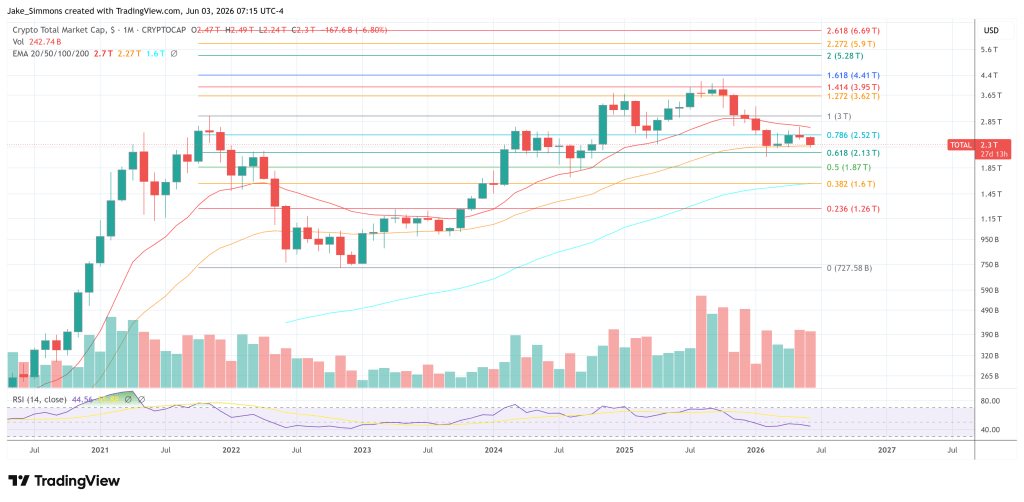
At press time, the total crypto market cap stood at $2.3 trillion.
Recommended Articles


