


March CPI Is Forecast at 3.7% as the Iran War Hits Consumers: Morgan Stanley and Strategy Are Buying Bitcoin Anyway
The March CPI report drops today at 8:30 AM Eastern Time (ET) and the number markets are bracing for is 3.7% year-over-year, up from 2.4% in February. A 130 basis-point jump would mean that this would mark the biggest monthly rise in years caused almost entirely by the conflict in Iran and the resultant oil shock filtering into gas prices, transportation and food costs. The February print was already a relic of the pre-war economy by the time it was published. This one won’t be. The oil shock is about to be printed in the data. The Fed already saw it coming. As reported by Yahoo Finance, it raised its inflation forecast from 2.4% to 2.7% at the March meeting and seven of 19 FOMC participants are pencilling in zero rate cuts this year.
Despite the macro narrative highlighting one of the most hostile inflation backdrops since the pandemic, institutional behaviour is telling a completely different story. Morgan Stanley has rolled out the first bank issued Bitcoin Spot ETF with the lowest fee in the market and drew in $34 million on day one while the broader BTC spot ETF market has seen total net inflows this week of over $545 million. At the same time, Strategy continues to accumulate Bitcoin at a relentless pace, adding another 4,871 BTC to its balance sheet.
What the March CPI Shows: the Iran War’s Inflation Tax Arrives
Economists have been bracing for this print for weeks. FactSet’s median estimate for March CPI sits at 3.4% YoY, while the broader FactSet consensus puts the number at 3.7% on an annual basis, with headline inflation rising 0.93% month-over-month, the biggest single month jump in years. Meanwhile the Cleveland Fed’s Inflation Nowcasting model is in the lower bound of the range and has it at 3.16%. As Morningstar reported, this CPI report is going to be the first real data set to reflect the surge in energy prices from the Iran war. Oil has shot up from around $70 before the war began to over $110. An over 70% rise that wasn’t limited to the pump. It moved into jet fuel, shipping costs, food transportation and eventually, the price of almost everything that gets trucked, railed or shipped across the country.
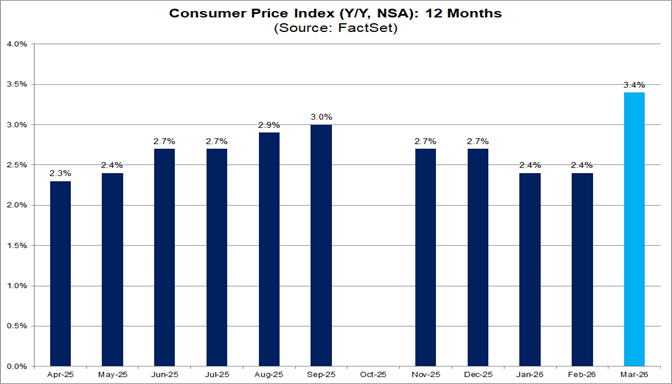
The Fed saw this coming and still could not get ahead of it. At the March 18 meeting, policymakers raised their 2026 inflation projections from 2.4% to 2.7%, a 30 basis point jump making the steepest single year upward revision in recent cycles, with core inflation revised up to the same level. The dot plot still shows one cut later this year, but seven of 19 FOMC participants now see zero cuts this year, and the longer-run neutral rate estimate edged higher.
If March CPI lands at or above 3.7%, the Fed’s forecast will already be obsolete on the day it prints. That’s before tariff passthrough, the San Francisco Fed has flagged that tariff-driven price pressures are expected to peak in Q2 2026, meaning the energy inflation from the war is now stacking directly on top of an already building cost base.
Morgan Stanley Just Bet on Bitcoin With a Bank-Issued ETF and It’s Not Alone
Just as the worst inflation print since the pandemic is expected to drop, Morgan Stanley, one of the largest banks in the world managing roughly $8 trillion in assets, launched the first bank-issued spot Bitcoin ETF. MSBT drew in $34 million in day one with over 1.6 million shares traded, and Bloomberg ETF analyst Eric Balchunas placed the debut in the top 1% of all ETF launches as reported by Fortune. At the same, the largest corporate bitcoin treasury company, Strategy, added another $330 million on BTC. The reason we are seeing this divergence isn’t actually a contradiction but more to do with timeframe. CPI is a backward-looking, monthly data point. Institutional moves like ETF launches and platform integrations are multi-year capital allocation decisions that are designed to outlive any single inflation cycle.
The Divergence: Why Institutions Don’t Flinch at 3.7% CPI
There’s precedent for this exact setup. In June 2022, when inflation peaked at 9.1% and macro conditions looked outright hostile, BlackRock moved forward with its initial Bitcoin ETF push, an infrastructure bet that has since scaled into one of the largest funds in the market. Today’s environment rhymes.
For traders, the March CPI matters immediately: a hotter-than-expected print reinforces rate hike risk and short-term pressure on BTC, while a softer number opens the door for relief rallies. But for institutions, the calculus is different. The regulatory backdrop is structurally improving, access points are expanding, and capital rails are being built out regardless of monthly volatility. Both views are rational, they’re just operating on entirely different clocks.
What to Watch: CPI Market Reaction, Islamabad Talks, and the ETF Race
The first number to watch today is the CPI print at 8:30 AM ET. BTC’s reaction in the two hours that follow will set the short-term tone. A reading above 3.7% likely pushes bitcoin toward the $69K support level as rate hike odds spike and any ceasefire-driven oil relief gets treated as temporary. A reading below 3.4% and this opens up the door to a retest of $72K and potentially the $73 to 75K range.
The second number to watch is oil, and that one hinges on Islamabad. VP Vance leads the US delegation into talks today alongside Steve Witkoff and Jared Kushner, with Iran’s Parliament Speaker Mohammad Baqer Ghalibaf and Foreign Minister Abbas Araghchi leading the Iranian side, the highest-level meeting between Washington and Tehran since the 1979 Islamic Revolution.
Markets have already shown how delicate the setup is and how the price of oil has been reacting to every piece of news filtering in. If talks produce a credible framework, easing supply constraints, inflation expectations could cool and risk assets benefit. If they stall, oil likely rebounds and reinforces the inflation spike narrative. At the same time, watch the Strait of Hormuz, still operating far below normal capacity after one of the largest supply disruptions in history, as any increase in vessel traffic would signal de-escalation. Layered on top is the ETF race: early MSBT inflows will indicate whether Morgan Stanley’s distribution engine is activating, especially given its fee advantage. Finally, all roads lead to the April 28–29 FOMC meeting, where this CPI print will shape the tone. If inflation confirms the spike, expect the Fed’s posture to harden further, potentially shifting the conversation from “higher for longer” to simply “higher.”
Don’t just read crypto news. Understand it. Subscribe to our newsletter. It's free.
Recommended Articles


