

US CPI Inflation Set to Jump in March, Putting an End to Gradual Two-Year Decline

Source Beincrypto

The US Bureau of Labor Statistics (BLS) will publish the March Consumer Price Index (CPI) data on Friday. The report is expected to show a jump in inflation, driven by the upsurge seen in crude Oil prices after the United States (US) and Israel launched a joint attack on Iran. 

The monthly CPI is forecast to rise 0.9%, following the 0.3% increase recorded in March, while the annual reading is seen climbing to its highest level since May 2024 at 3.3%, from 2.4% in February. Core CPI figures, which exclude volatile food and energy prices, are expected to come in at 0.3% and 2.7%, on a monthly and yearly basis, respectively. 

Since the beginning of the conflict in the Middle East on February 28, the barrel of West Texas Intermediate (WTI) is up about 40%, even after the sharp decline seen following the announcement of a two-week ceasefire between the US and Iran earlier this week. In March, WTI gained nearly 50%, rising from about $67 per barrel to settle near $100 by the end of the month. 

Previewing the inflation data, “the recent surge in crude prices will be the main factor behind the 0.9% m/m jump in the CPI. The Y/Y rate will leap close to 1pp to 3.3% in March, a two-year-high,” said TD Securities analysts. 

“Core inflation will stay shielded from the oil shock for now, rising 0.27% m/m. We look for tariff pass-through to continue playing a role by lifting goods prices. Supercore inflation likely stayed firm at 0.3%,” they added. 

What to Expect in the Next CPI Data Report?

CPI figures for March will reflect the impact of high oil prices on inflation, which shouldn’t be surprising. Even if the annual CPI inflation rises 3.3% in March, as forecast, investors could see that as a temporary increase in case they remain confident that Oil prices will come down significantly, with a permanent truce in the Middle East allowing the Strait of Hormuz to remain open. 

However, the growing uncertainty about the sustainability of a ceasefire and Iran’s condition to retain control of the strait in a peace agreement complicates the picture and raises doubts about a steady pullback in Oil prices. Hence, the developments in the Middle East are likely to shape inflation expectations, rather than the March CPI reading itself.

The Minutes from the Federal Reserve’s (Fed) March meeting showed that a number of policymakers are already pushing back the timing of potential rate cuts, reflecting lingering concerns that inflation could prove more persistent than expected. 

In fact, a large majority flagged the risk that price pressures could stay elevated for longer, particularly if higher Oil prices feed through more broadly. 

“Provided that underlying inflation excluding energy remains contained, the Fed can afford to look through the oil-price shock and refrain from raising rates amid a mixed US labor market backdrop,” BBH analysts said. 

How Could the US Consumer Price Index Report Affect Eur/USD?

Markets currently see about a 75% chance of the Fed leaving the policy rate unchanged at 3.5%-3.75% by the end of the year, compared to a 17% probability seen on March 9, according to the CME FedWatch Tool. 
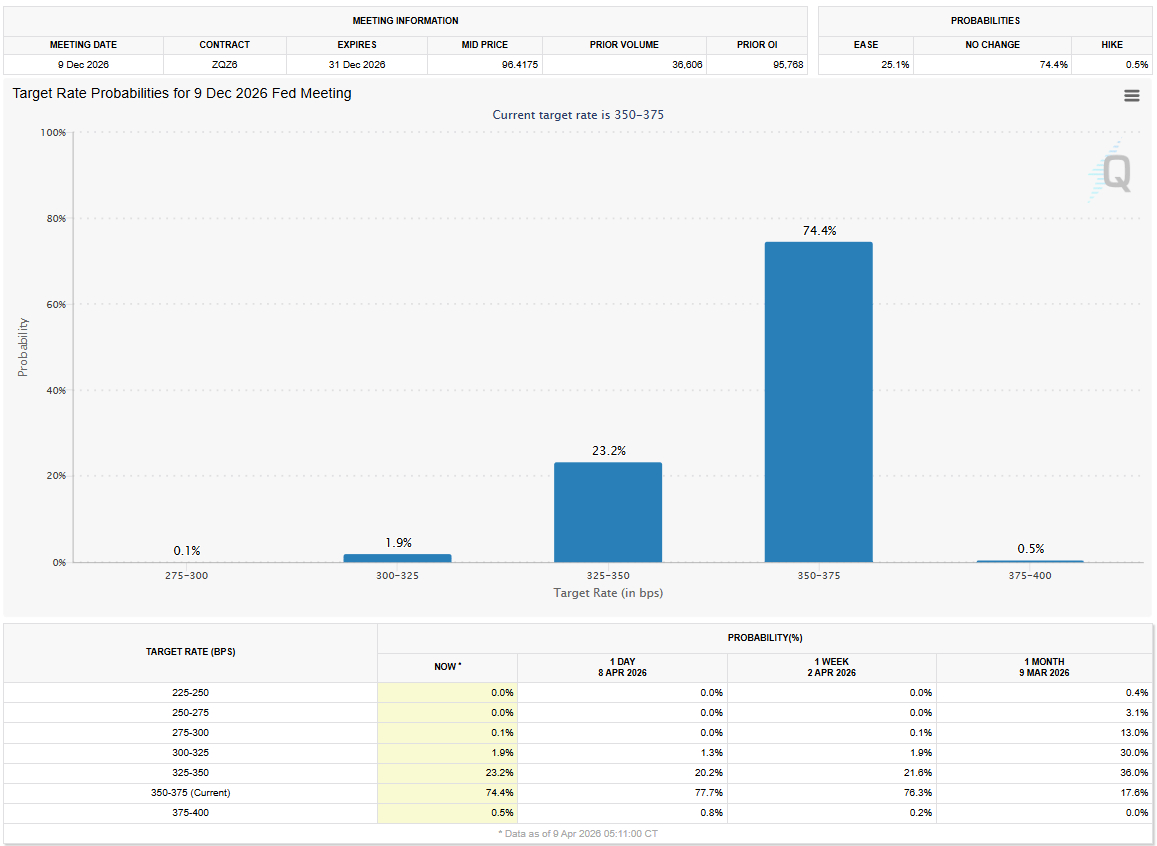
us cpiSource: CME Group 

A stronger-than-forecast monthly CPI print for March might not be able to influence the market pricing of the Fed’s interest-rate outlook in a significant way.

However, if a hot inflation print is combined with a re-escalation of the conflict in the Middle East and growing expectations about the naval activity in the Strait of Hormuz not going back to its pre-war state anytime soon, investors could reassess the probability of a Fed hike in response to persistent inflation. In this scenario, the US Dollar (USD) could gather strength and force EUR/USD to turn south. 

Conversely, the USD could remain under bearish pressure – and allow EUR/USD to extend its rebound – in case crude Oil prices continue to come down in a steady way, regardless of the March CPI figures. 

In summary, March inflation prints are unlikely to trigger a significant market reaction, while market focus remains on the US-Iran crisis and its impact on Oil prices. 

Eren Sengezer, FXStreet European Session Lead Analyst, shares a brief technical outlook for EUR/USD. 

“EUR/USD’s near-term technical outlook points to a bullish tilt. The Relative Strength Index (RSI) indicator on the daily chart climbed above 50 for the first time since the beginning of the US-Iran war and the pair broke above the two-month-old descending trend line.” 

“The Fibonacci 50% retracement level of the February-April trend aligns as the next resistance level at 1.1730 ahead of 1.1800 (Fibonacci 61.8% retracement) and 1.1900 (Fibonacci 78.6% retracement). On the downside, the immediate support is located at 1.1650 (Fibonacci 38.2% retracement). In case this support fails, technical sellers could show interest, opening the door for an extended slide toward 1.1560 (Fibonacci 23.6% retracement) and 1.1500 (static level, round level).”

Disclaimer: For information purposes only. Past performance is not indicative of future results.
placeholder
Bitcoin CME gaps at $35,000, $27,000 and $21,000, which one gets filled first?Prioritize filling the $27,000 gap and even try higher.
Author  FXStreet
Aug 22, 2023
Prioritize filling the $27,000 gap and even try higher.
placeholder
Pinduoduo Earnings Incoming: Morgan Stanley Sees Long-Term Profit Potential​Insights – On November 21, Chinese e-commerce giant Pinduoduo (PDD) will release its Q3 2024 earnings.
Author  Mitrade
Nov 20, 2024
​Insights – On November 21, Chinese e-commerce giant Pinduoduo (PDD) will release its Q3 2024 earnings.
placeholder
Elon Musk’s xAI and Neuralink Launch New Funding Rounds​Billionaire Elon Musk recently raised funds for his two high-profile tech companies, xAI and Neuralink.
Author  Insights
Jun 03, 2025
​Billionaire Elon Musk recently raised funds for his two high-profile tech companies, xAI and Neuralink.
placeholder
Bitcoin briefly loses 2025 gains as crypto plunges over the weekend.Bitcoin experienced a sharp decline this weekend, briefly erasing its 2025 gains and dipping below its year-opening value of $93,507. The cryptocurrency fell to a low of $93,029 on Sunday, representing a 25% drop from its all-time high in October. Although it has rebounded slightly to around $94,209, the pressures on the market remain significant. The downturn occurred despite the reopening of the U.S. government on Thursday, which many had hoped would provide essential support for crypto markets. This year initially appeared promising for cryptocurrencies, particularly after the inauguration of President Donald Trump, who has established the most pro-crypto administration thus far. However, ongoing political tensions—including Trump's tariff strategies and the recent government shutdown, lasting a historic 43 days—have contributed to several rapid price pullbacks for Bitcoin throughout the year. Market dynamics are also being influenced by Bitcoin whales—investors holding large amounts of Bitcoin—who have been offloading portions of their assets, consequently stalling price rallies even as positive regulatory developments emerge. Despite these sell-offs, analysts from Glassnode argue that this behavior aligns with typical patterns seen among long-term investors during the concluding stages of bull markets, suggesting it is not indicative of a mass exodus. Notably, Bitcoin is not alone in its struggles, as Ethereum and Solana have also recorded declines of 7.95% and 28.3%, respectively, since the start of the year, while numerous altcoins have faced even steeper losses. Looking ahead, questions linger regarding the viability of the four-year cycle thesis, particularly given the increasing institutional support and regulatory frameworks now in place in the crypto landscape. Matt Hougan, chief investment officer at Bitwise, remains optimistic, suggesting a potential Bitcoin resurgence in 2026 driven by the “debasement trade” thesis and a broader trend toward increased adoption of stablecoins, tokenization, and decentralized finance. Hougan emphasized the soundness of the underlying fundamentals, pointing to a positive outlook for the sector in the longer term.
Author  Mitrade
Nov 17, 2025
Bitcoin experienced a sharp decline this weekend, briefly erasing its 2025 gains and dipping below its year-opening value of $93,507. The cryptocurrency fell to a low of $93,029 on Sunday, representing a 25% drop from its all-time high in October. Although it has rebounded slightly to around $94,209, the pressures on the market remain significant. The downturn occurred despite the reopening of the U.S. government on Thursday, which many had hoped would provide essential support for crypto markets. This year initially appeared promising for cryptocurrencies, particularly after the inauguration of President Donald Trump, who has established the most pro-crypto administration thus far. However, ongoing political tensions—including Trump's tariff strategies and the recent government shutdown, lasting a historic 43 days—have contributed to several rapid price pullbacks for Bitcoin throughout the year. Market dynamics are also being influenced by Bitcoin whales—investors holding large amounts of Bitcoin—who have been offloading portions of their assets, consequently stalling price rallies even as positive regulatory developments emerge. Despite these sell-offs, analysts from Glassnode argue that this behavior aligns with typical patterns seen among long-term investors during the concluding stages of bull markets, suggesting it is not indicative of a mass exodus. Notably, Bitcoin is not alone in its struggles, as Ethereum and Solana have also recorded declines of 7.95% and 28.3%, respectively, since the start of the year, while numerous altcoins have faced even steeper losses. Looking ahead, questions linger regarding the viability of the four-year cycle thesis, particularly given the increasing institutional support and regulatory frameworks now in place in the crypto landscape. Matt Hougan, chief investment officer at Bitwise, remains optimistic, suggesting a potential Bitcoin resurgence in 2026 driven by the “debasement trade” thesis and a broader trend toward increased adoption of stablecoins, tokenization, and decentralized finance. Hougan emphasized the soundness of the underlying fundamentals, pointing to a positive outlook for the sector in the longer term.
placeholder
Gold edges lower below $4,750 amid fragile Middle East ceasefire Gold price (XAU/USD) trades in negative territory around $4,705 during the early Asian session on Thursday. The precious metal edges lower amid a temporary two-week ceasefire between the US and Iran.   
Author  FXStreet
Yesterday 09: 04
Gold price (XAU/USD) trades in negative territory around $4,705 during the early Asian session on Thursday. The precious metal edges lower amid a temporary two-week ceasefire between the US and Iran.   
goTop
quote