

Why A U.S. Court Says Binance Is Not (Yet) Liable for Terrorist Crypto Flows

Source Newsbtc

A lawsuit accusing the crypto exchange Binance of allowing terrorism financing by facilitating it has fallen apart after a US Federal court dismissed it.

Not Terrorist Supporters

The Troell et al. v. Binance case was dismissed in an opinion and order issued on March 6 by Judge Jeannette A. Vargas of the U.S. District Court for the Southern District of New York. The defendants’ motions were granted against a complaint brought by 535 plaintiffs, all of whom were victims or family members of victims of terrorist attacks.

The Accusation

The plaintiffs accused Binance, Changpeng “CZ” Zhao (its founder and former CEO) and BAM Trading Services (the company behind the Binance.US exchange) of facilitating 64 terrorist attacks carried out between 2016 and 2024. They claimed that Binance, Zhao and BAM Trading allowed wallets allegedly tied to Hamas, Hezbollah, ISIS, al‑Qaeda, Palestinian Islamic Jihad (PIJ) and Iranian proxies to move funds, amounting to aiding and abetting terrorism under the U.S. Anti‑Terrorism Act and the Justice Against Sponsors of Terrorism Act (JASTA).

Why The Crypto-Terror Financing Case Fell Apart

The court granted the motions to dismiss under Rule 12(b)(6), finding that the complaint failed to plausibly allege that Binance “knowingly provided substantial assistance” to the specific attacks at issue.

The Judge’s Two Big Criticisms

Judge Jeannette Vargas’s opinion is based on two fundamental weaknesses she identified in the plaintiffs’ theory. First, although the complaint leaned heavily on blockchain traces, sanctions‑list designations and reports of terrorist groups using Binance, it did not plausibly show that Binance, Zhao or BAM Trading knew at the time that specific wallets on the platform were controlled by FTO (Foreign Terrorist Organization) or their close associates.

Second, the court held that the plaintiffs failed to connect the alleged crypto flows on Binance to the 64 terrorist attacks they invoked. The complaint mapped out millions of dollars in transactions involving “FTO‑associated” or Iran‑linked wallets and described a broad ecosystem built to fund operations, but it did not identify who owned the wallets at issue, when specific transfers took place, what role those transfers played in operational planning. It also didn’t identify how any given Binance‑processed transaction materially advanced the specific bombings, rocket attacks, shootings, hostage‑takings, or the Wizard Spider ransomware incident that harmed the 535 plaintiffs.

The Law Behind The Reasoning

Under the U.S. Anti‑Terrorism Act and JASTA (The Justice Against Sponsors of Terrorism Act), it is not enough to show that designated terrorist organizations or sanctioned Iranian actors touched a platform at some point in time. Victims must plausibly allege that the defendant knew who it was dealing with and that its conduct was closely linked to the attacks at issue, not just to terrorism “in general.”

In this case, the judge held that generalized allegations about “terrorist‑associated wallets” on Binance, and references to lax KYC (Know Your Customer), VPN loopholes, and U.S. user evasion, did not amount to a concrete showing that Binance’s services materially advanced the operations that the plaintiffs suffered.

Plaintiffs still have 60 days to refile, so, in truth, Binance is not entirely out of the woods yet. Besides, Binance remains under intense scrutiny: the exchange is still navigating a $4.3 billion AML and sanctions plea deal, a court‑appointed monitor, and political pressure in Washington over alleged terror‑finance exposure, as detailed by Bitcoinist and NewsBTC.
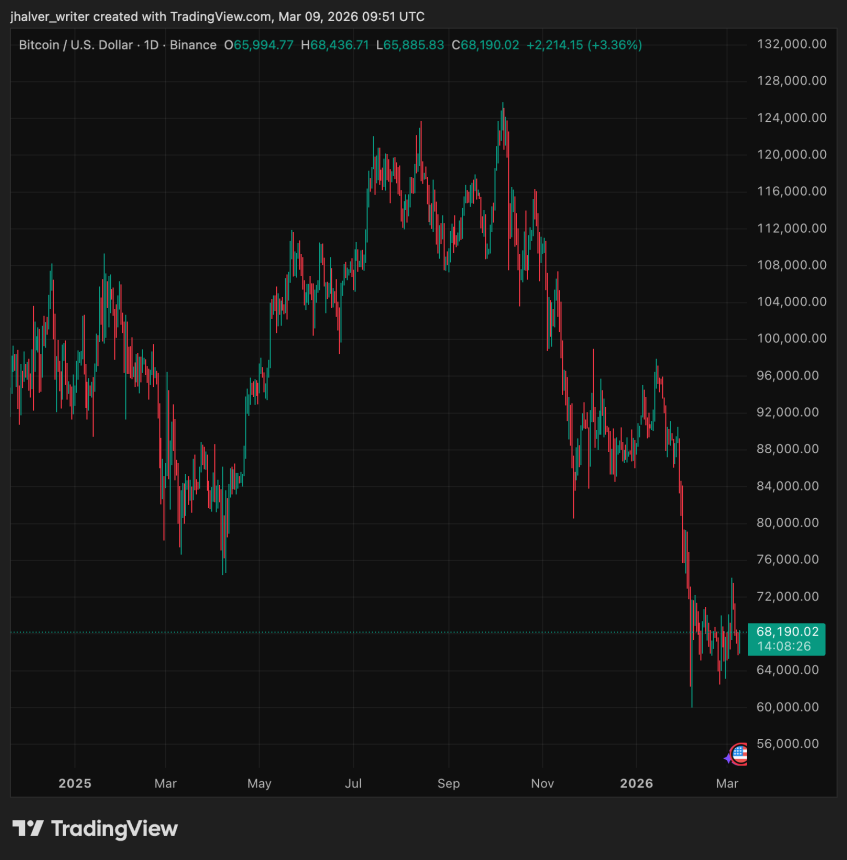
Bitcoin, BTC, BTCUSD

Cover image from ChatGPT, BTCUSD chart from Tradingview

Disclaimer: For information purposes only. Past performance is not indicative of future results.
placeholder
Bitcoin CME gaps at $35,000, $27,000 and $21,000, which one gets filled first?Prioritize filling the $27,000 gap and even try higher.
Author  FXStreet
Aug 22, 2023
Prioritize filling the $27,000 gap and even try higher.
placeholder
Pinduoduo Earnings Incoming: Morgan Stanley Sees Long-Term Profit Potential​Insights – On November 21, Chinese e-commerce giant Pinduoduo (PDD) will release its Q3 2024 earnings.
Author  Mitrade
Nov 20, 2024
​Insights – On November 21, Chinese e-commerce giant Pinduoduo (PDD) will release its Q3 2024 earnings.
placeholder
The dollar weakened, equities dipped, and gold hit record highsThe dollar weakened, equities fell, and gold set new records on Wednesday as investors waited for a Fed rate cut later in the day.
Author  Cryptopolitan
Sep 17, 2025
The dollar weakened, equities fell, and gold set new records on Wednesday as investors waited for a Fed rate cut later in the day.
placeholder
Bitcoin briefly loses 2025 gains as crypto plunges over the weekend.Bitcoin experienced a sharp decline this weekend, briefly erasing its 2025 gains and dipping below its year-opening value of $93,507. The cryptocurrency fell to a low of $93,029 on Sunday, representing a 25% drop from its all-time high in October. Although it has rebounded slightly to around $94,209, the pressures on the market remain significant. The downturn occurred despite the reopening of the U.S. government on Thursday, which many had hoped would provide essential support for crypto markets. This year initially appeared promising for cryptocurrencies, particularly after the inauguration of President Donald Trump, who has established the most pro-crypto administration thus far. However, ongoing political tensions—including Trump's tariff strategies and the recent government shutdown, lasting a historic 43 days—have contributed to several rapid price pullbacks for Bitcoin throughout the year. Market dynamics are also being influenced by Bitcoin whales—investors holding large amounts of Bitcoin—who have been offloading portions of their assets, consequently stalling price rallies even as positive regulatory developments emerge. Despite these sell-offs, analysts from Glassnode argue that this behavior aligns with typical patterns seen among long-term investors during the concluding stages of bull markets, suggesting it is not indicative of a mass exodus. Notably, Bitcoin is not alone in its struggles, as Ethereum and Solana have also recorded declines of 7.95% and 28.3%, respectively, since the start of the year, while numerous altcoins have faced even steeper losses. Looking ahead, questions linger regarding the viability of the four-year cycle thesis, particularly given the increasing institutional support and regulatory frameworks now in place in the crypto landscape. Matt Hougan, chief investment officer at Bitwise, remains optimistic, suggesting a potential Bitcoin resurgence in 2026 driven by the “debasement trade” thesis and a broader trend toward increased adoption of stablecoins, tokenization, and decentralized finance. Hougan emphasized the soundness of the underlying fundamentals, pointing to a positive outlook for the sector in the longer term.
Author  Mitrade
Nov 17, 2025
Bitcoin experienced a sharp decline this weekend, briefly erasing its 2025 gains and dipping below its year-opening value of $93,507. The cryptocurrency fell to a low of $93,029 on Sunday, representing a 25% drop from its all-time high in October. Although it has rebounded slightly to around $94,209, the pressures on the market remain significant. The downturn occurred despite the reopening of the U.S. government on Thursday, which many had hoped would provide essential support for crypto markets. This year initially appeared promising for cryptocurrencies, particularly after the inauguration of President Donald Trump, who has established the most pro-crypto administration thus far. However, ongoing political tensions—including Trump's tariff strategies and the recent government shutdown, lasting a historic 43 days—have contributed to several rapid price pullbacks for Bitcoin throughout the year. Market dynamics are also being influenced by Bitcoin whales—investors holding large amounts of Bitcoin—who have been offloading portions of their assets, consequently stalling price rallies even as positive regulatory developments emerge. Despite these sell-offs, analysts from Glassnode argue that this behavior aligns with typical patterns seen among long-term investors during the concluding stages of bull markets, suggesting it is not indicative of a mass exodus. Notably, Bitcoin is not alone in its struggles, as Ethereum and Solana have also recorded declines of 7.95% and 28.3%, respectively, since the start of the year, while numerous altcoins have faced even steeper losses. Looking ahead, questions linger regarding the viability of the four-year cycle thesis, particularly given the increasing institutional support and regulatory frameworks now in place in the crypto landscape. Matt Hougan, chief investment officer at Bitwise, remains optimistic, suggesting a potential Bitcoin resurgence in 2026 driven by the “debasement trade” thesis and a broader trend toward increased adoption of stablecoins, tokenization, and decentralized finance. Hougan emphasized the soundness of the underlying fundamentals, pointing to a positive outlook for the sector in the longer term.
placeholder
Silver Price Forecast: XAG/USD falls to near $72.00 amid fading safe-haven demandSilver price (XAG/USD) continues to lose ground after registering tiny losses in the previous day, trading around $72.90 during the Asian hours on Thursday. The safe-haven demand for the precious metal fades amid rising optimism over Middle East peace.
Author  FXStreet
Apr 02, Thu
Silver price (XAG/USD) continues to lose ground after registering tiny losses in the previous day, trading around $72.90 during the Asian hours on Thursday. The safe-haven demand for the precious metal fades amid rising optimism over Middle East peace.
goTop
quote