

Bitcoin Manipulation By Jane Street? Ex-Wall Street Market Maker Says No

Source Newsbtc

The latest Jane Street debate on X is meeting a blunt rebuttal from Ari Paul. The BlockTower founder, who says he used to work as a Wall Street market maker 15 years ago, argues that Bitcoin’s failure to push higher is better explained by spot sell-side than by a long-running suppression campaign.

Paul’s answer was direct. “In short: no,” he wrote, before adding that market makers do “game the system” in many ways, but that in liquid products such as BTC ETFs, the effect is usually limited to “meaningful but small costs to consumers,” not a lasting distortion of the underlying asset price. He framed the distinction as one between short-term microstructure games and a broader claim that one firm kept Bitcoin from reaching far higher levels.

Bitcoin Manipulation? Small Moves, Fast Reversions

To make that case, Paul pointed to the kind of behavior traders on desks know well. “For example, market makers may manipulate the price to run stop limit orders,” he wrote. “But that’s typically on an intraday timeframe. So they might run an asset like MSFT or BTC 2% in a weak market to trigger stops, then a few seconds or minutes later, the price is mostly back to where it was before.” In his telling, that is still manipulation, but it is not the same as structurally pinning Bitcoin below some imagined fair value for months.

That argument lands against a more conspiratorial narrative now circulating online, why Bitcoin is not already at $150,000. Paul’s pushback does not deny that large Wall Street firms can shape short-term trading conditions. It rejects the stronger claim that such activity is the central explanation for Bitcoin’s broader price path.

Paul’s core point was much less dramatic. “Why is BTC down? Because OGs sold tens of thousands of coins, and not enough people wanted to buy them.” That line closely matched the view from renowned on-chain analyst James Check, who argued that “Jane Street didn’t suppress the Bitcoin price” and that “HODLers all did,” by selling large amounts of spot into the market.

He added: “My point has always been the same; manipulation is a thing that has always, will always, and is indeed the literal job of large wall street firms. However, you do not need that as the central argument to explain why the price didn’t go higher, nor why it went lower. That can be well and truly explained by looking at spot sell-side.”

Paul did leave room for exceptions. He wrote that there are rare cases where Wall Street manipulates an asset in major ways over a longer period, but said those cases are uncommon because they are risky and harder to profit from than people assume.

“There are rare exceptions where Wall Street manipulates an asset in major ways longer term, but this is quite rare because it’s very risky and not as easy as it looks to profit. 99% of the time that an asset isn’t moving like you want and people are crying “manipulation”, it’s best to embrace the cognitive dissonance, avoid the “easy way out” of blaming manipulation,” Paul wrote.

That leaves the current Jane Street argument in a narrower frame. Yes, large firms can influence intraday flows, liquidity, and execution quality. But based on Paul’s account, that is a long way from proving that one market maker is the reason Bitcoin is not trading materially higher.

Notably, the Jane Street theory picked up fresh attention after Terraform Labs’ wind-down administrator sued the firm in Manhattan federal court, alleging insider trading tied to Terra’s 2022 collapse. The complaint says Jane Street used a private chat called “Bryce’s Secret” to obtain non-public information and alleges an 85 million UST trade on Curve that helped trigger a selloff; Jane Street has denied wrongdoing and called the case opportunistic.

At press time, BTC traded at $66,090.
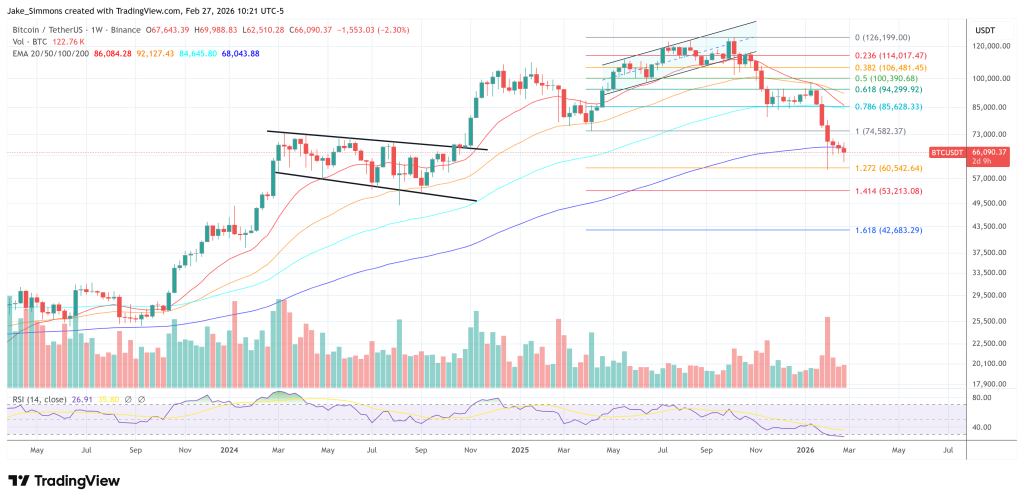
Bitcoin price chart
Disclaimer: For information purposes only. Past performance is not indicative of future results.
placeholder
Bitcoin CME gaps at $35,000, $27,000 and $21,000, which one gets filled first?Prioritize filling the $27,000 gap and even try higher.
Author  FXStreet
Aug 22, 2023
Prioritize filling the $27,000 gap and even try higher.
placeholder
Pinduoduo Earnings Incoming: Morgan Stanley Sees Long-Term Profit Potential​Insights – On November 21, Chinese e-commerce giant Pinduoduo (PDD) will release its Q3 2024 earnings.
Author  Mitrade
Nov 20, 2024
​Insights – On November 21, Chinese e-commerce giant Pinduoduo (PDD) will release its Q3 2024 earnings.
placeholder
Elon Musk’s xAI and Neuralink Launch New Funding Rounds​Billionaire Elon Musk recently raised funds for his two high-profile tech companies, xAI and Neuralink.
Author  Insights
Jun 03, 2025
​Billionaire Elon Musk recently raised funds for his two high-profile tech companies, xAI and Neuralink.
placeholder
Bitcoin briefly loses 2025 gains as crypto plunges over the weekend.Bitcoin experienced a sharp decline this weekend, briefly erasing its 2025 gains and dipping below its year-opening value of $93,507. The cryptocurrency fell to a low of $93,029 on Sunday, representing a 25% drop from its all-time high in October. Although it has rebounded slightly to around $94,209, the pressures on the market remain significant. The downturn occurred despite the reopening of the U.S. government on Thursday, which many had hoped would provide essential support for crypto markets. This year initially appeared promising for cryptocurrencies, particularly after the inauguration of President Donald Trump, who has established the most pro-crypto administration thus far. However, ongoing political tensions—including Trump's tariff strategies and the recent government shutdown, lasting a historic 43 days—have contributed to several rapid price pullbacks for Bitcoin throughout the year. Market dynamics are also being influenced by Bitcoin whales—investors holding large amounts of Bitcoin—who have been offloading portions of their assets, consequently stalling price rallies even as positive regulatory developments emerge. Despite these sell-offs, analysts from Glassnode argue that this behavior aligns with typical patterns seen among long-term investors during the concluding stages of bull markets, suggesting it is not indicative of a mass exodus. Notably, Bitcoin is not alone in its struggles, as Ethereum and Solana have also recorded declines of 7.95% and 28.3%, respectively, since the start of the year, while numerous altcoins have faced even steeper losses. Looking ahead, questions linger regarding the viability of the four-year cycle thesis, particularly given the increasing institutional support and regulatory frameworks now in place in the crypto landscape. Matt Hougan, chief investment officer at Bitwise, remains optimistic, suggesting a potential Bitcoin resurgence in 2026 driven by the “debasement trade” thesis and a broader trend toward increased adoption of stablecoins, tokenization, and decentralized finance. Hougan emphasized the soundness of the underlying fundamentals, pointing to a positive outlook for the sector in the longer term.
Author  Mitrade
Nov 17, 2025
Bitcoin experienced a sharp decline this weekend, briefly erasing its 2025 gains and dipping below its year-opening value of $93,507. The cryptocurrency fell to a low of $93,029 on Sunday, representing a 25% drop from its all-time high in October. Although it has rebounded slightly to around $94,209, the pressures on the market remain significant. The downturn occurred despite the reopening of the U.S. government on Thursday, which many had hoped would provide essential support for crypto markets. This year initially appeared promising for cryptocurrencies, particularly after the inauguration of President Donald Trump, who has established the most pro-crypto administration thus far. However, ongoing political tensions—including Trump's tariff strategies and the recent government shutdown, lasting a historic 43 days—have contributed to several rapid price pullbacks for Bitcoin throughout the year. Market dynamics are also being influenced by Bitcoin whales—investors holding large amounts of Bitcoin—who have been offloading portions of their assets, consequently stalling price rallies even as positive regulatory developments emerge. Despite these sell-offs, analysts from Glassnode argue that this behavior aligns with typical patterns seen among long-term investors during the concluding stages of bull markets, suggesting it is not indicative of a mass exodus. Notably, Bitcoin is not alone in its struggles, as Ethereum and Solana have also recorded declines of 7.95% and 28.3%, respectively, since the start of the year, while numerous altcoins have faced even steeper losses. Looking ahead, questions linger regarding the viability of the four-year cycle thesis, particularly given the increasing institutional support and regulatory frameworks now in place in the crypto landscape. Matt Hougan, chief investment officer at Bitwise, remains optimistic, suggesting a potential Bitcoin resurgence in 2026 driven by the “debasement trade” thesis and a broader trend toward increased adoption of stablecoins, tokenization, and decentralized finance. Hougan emphasized the soundness of the underlying fundamentals, pointing to a positive outlook for the sector in the longer term.
placeholder
Silver Price Forecast: XAG/USD falls to near $72.00 amid fading safe-haven demandSilver price (XAG/USD) continues to lose ground after registering tiny losses in the previous day, trading around $72.90 during the Asian hours on Thursday. The safe-haven demand for the precious metal fades amid rising optimism over Middle East peace.
Author  FXStreet
Apr 02, Thu
Silver price (XAG/USD) continues to lose ground after registering tiny losses in the previous day, trading around $72.90 during the Asian hours on Thursday. The safe-haven demand for the precious metal fades amid rising optimism over Middle East peace.
goTop
quote