


The 10 AM Bitcoin Dump Theory: Fact, Fiction, and the Alleged Role of Jane Street
Bitcoin’s (BTC) latest recovery has lifted sentiment across crypto markets, with traders pointing to renewed momentum after weeks of choppy price action.
However, the rebound has also revived something else: fresh allegations against Jane Street, a global quantitative trading firm and major liquidity provider. But how much of the circulating narrative is supported by evidence, and how much remains speculative? As the theory resurfaces, separating verifiable facts from online conjecture has become essential.
Jane Street’s Alleged 10 AM Bitcoin Sell-Off: Manipulation Theory or Market Myth?
Jane Street is dominating Crypto Twitter discussions, and the surge in attention extends beyond social media. Google Trends data shows that search interest for “Jane Street Bitcoin” recently reached an all-time high. This indicates a sharp rise in public curiosity.
Follow us on X to get the latest news as it happens
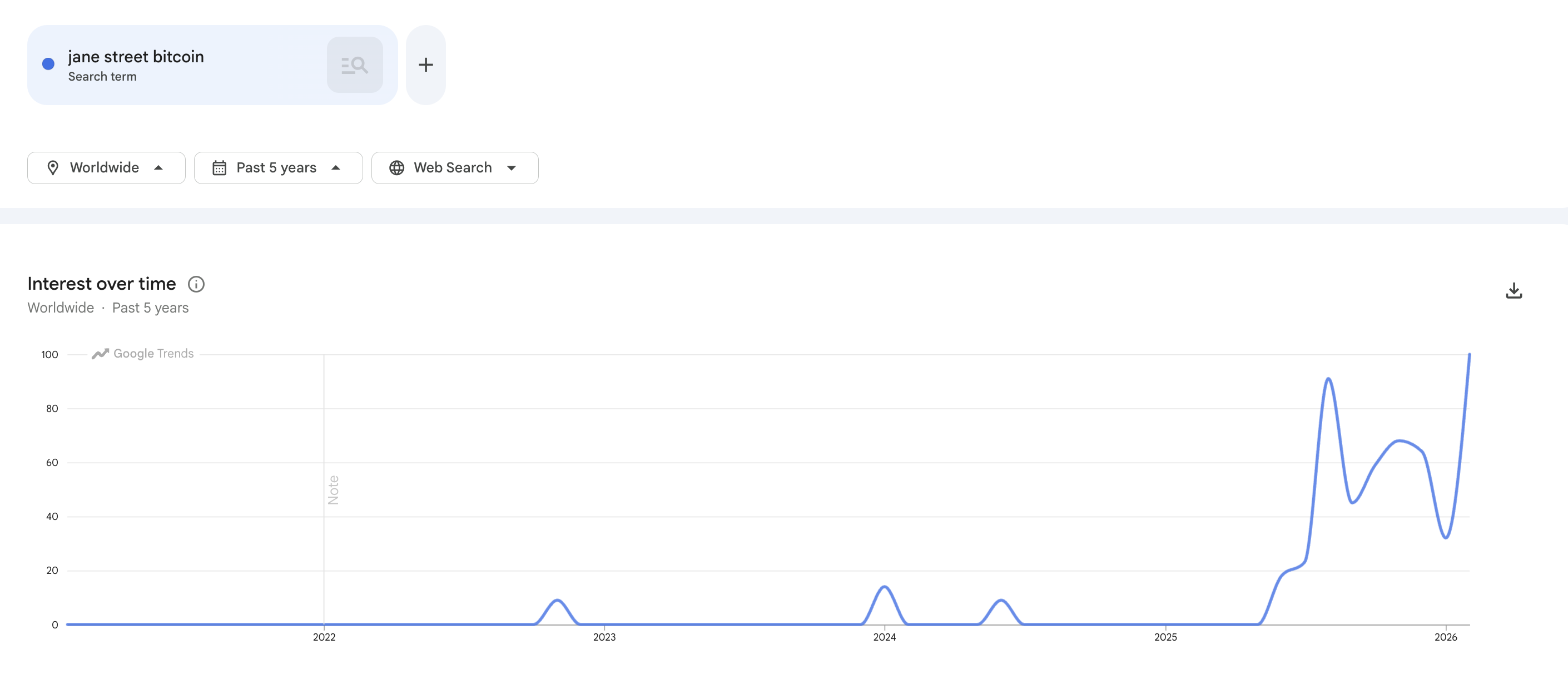 Search Interest for Jane Street Bitcoin. Source: Google Trends
What is driving this renewed focus? A simple search on X reveals numerous posts linking Jane Street to Bitcoin’s price action. At the center of the discussion are allegations of a so-called 10 AM Eastern Time Bitcoin sell-off pattern.
Since 2024, Zero Hedge has repeatedly pointed to what it describes as a recurring pattern. According to him, Bitcoin often experiences a sharp decline around 10 AM ET. Jane Street is frequently named in connection with the theory.
Similar allegations surfaced in December 2025.
“Jane Street is one of the largest high-frequency trading firms in the world. They have the speed and liquidity to move markets for a few minutes. The behavior looks simple: 1. Dump BTC at the open. 2. Push the price into liquidity pockets. 3. Re-enter lower. 4. Repeat daily,” Bull Theory posted.
At the time, BeInCrypto reported that no regulator, exchange, or independent data source had confirmed any coordinated activity. Notably, new allegations against Jane Street surfaced recently after Terraform Labs’ administrator sued the trading firm.
“Who crashed Luna and UST to 0 and brought down the entire crypto market in 2022? Jane Street. The same Jane Street accused of ‘10AM manipulation’ also front-ran the 2022 Terra collapse,” Ash Crypto said.
Jane Street has denied any wrongdoing and stated that it intends to defend itself in court. Nonetheless, some analysts started making connections between the lawsuit’s timing and Bitcoin’s price.
Several commentators on X have alleged that the legal action against Jane Street may have paused the supposed 10 AM sell-offs. According to this narrative, the absence of the previously observed intraday declines allowed Bitcoin’s price to climb over the past two days.
In a detailed post, Justin Bechler suggested that the alleged “daily flash crashes” had previously stopped after the Terraform Labs lawsuit filings became public early last year.
However, he claims the 10 AM pattern later resumed in Q3 2025. By December, he said, the intraday declines had returned with full force.
“Basically, the 10 am dumps stopped the moment Jane Street had lawyers looking over its shoulder, and started again when the heat died down,” he wrote. “Bitcoin should be at least $150,000 right now, and everyone knows it. Yesterday, a federal lawsuit was filed in Manhattan that explains exactly why it isn’t.”
Bechler further noted that Jane Street disclosed a large IBIT position in its Q4 2025 13F filing. It also sharply increased its MicroStrategy holdings.
“This looks like bullish accumulation if you don’t understand what Jane Street actually is. Jane Street is one of only four firms authorized to conduct in-kind creations and redemptions for IBIT. The others are Virtu Americas, JP Morgan Securities, and Marex. Jane Street is also an authorized participant for Fidelity’s and WisdomTree’s Bitcoin ETFs,” he said.
According to him, this role gives the firm “direct access to the mechanism that connects ETF share prices to actual Bitcoin.” Bechler stated that Jane Street can transfer Bitcoin in and out of the ETF structure, arbitrage price differences between the fund and the spot market, and hold inventory positions on a scale far beyond that of a typical market participant.
He also added that a 13F only shows long stock positions but does not require disclosure of options, futures, or swaps.
“When Jane Street reports holding $790 million in IBIT shares, the filing tells you nothing about whether those shares are hedged by puts, offset by short futures, or wrapped in a collar that makes the firm’s net Bitcoin exposure zero or even negative,” he remarked.
He noted that the public only sees what appears to be an accumulation. In reality, the position could represent a significant short exposure that resembles a long, since the offsetting leg of the trade remains hidden under current disclosure rules.
A Form 13F, he added, is merely a snapshot of one side of the balance sheet. The other side is not visible to anyone outside the firm.
“If the firm holds $790 million in IBIT shares and offsets that position with $790 million in put options or short futures, the net exposure is zero. If the derivative book exceeds the equity position, the net exposure is negative, meaning Jane Street profits when Bitcoin’s price falls. In either scenario, the firm has every incentive to use its privileged position as authorized participant to suppress the spot price, trigger liquidations, and harvest the spread,” Bechler commented.
The Counterarguments: Volatility, Not Villainy
Not everyone is convinced. Several analysts pushed back, arguing the 10 AM pattern is overstated. Julio Moreno, Head of Research at CryptoQuant, directly questioned the narrative.
He noted that the mechanics described, buying Bitcoin on the spot market and selling futures, are not unusual. According to Moreno, this is “what any other delta neutral fund does.”
Moreno also pointed to the lack of a broader market context in the discussion. He stressed that overall Bitcoin spot demand growth has been collapsing since early October 2025, a trend he described as an obvious driver of the price decline.
Benjamin Cowen, CEO of Into The Cryptoverse, also weighed in. He argued that Bitcoin has historically rallied into early March during every midterm year. He added that each market cycle tends to produce its own narrative to explain price movements.
“Bitcoin price action is not a manipulated conspiracy,” he wrote.
Furthermore, Jeff Park, chief investment officer at ProCap and an adviser to Bitwise, suggested that the debate reflects a misunderstanding of how ETF plumbing actually works.
He mentioned that the focus on individual firms, such as Jane Street, overlooks the structural mechanics governing all Authorized Participants (APs) within the Bitcoin ETF framework.
Users on X also began pointing out that Jane Street appeared to have deleted every post from its account following the lawsuit. This further fueled speculation online.
However, that claim was quickly debunked. Economist Alex Krüger clarified that Jane Street had no posts on its X account to begin with.
“The amount of fake news and false narratives spread around in crypto is truly remarkable. Jane Street had no posts to delete. Can corroborate that on the Wayback Machine,” he posted.
Why the 10 AM Jane Street sell-off Theory Resonates
Retail traders have watched Bitcoin shrug off bullish developments, including MicroStrategy purchases and a favorable regulatory environment, while price action remained weak and sentiment slid into extreme fear. In that context, a simple and identifiable explanation can be compelling.
The apparent pause in the alleged 10 AM pattern following a high-profile lawsuit fits neatly into a correlation-as-causation narrative that often gains traction on Crypto Twitter.
However, correlation does not constitute proof. For now, the 10 AM theory remains merely an allegation, not a fact.
Recommended Articles


