


Ethereum DeFi Warning: Vitalik Flags Oracles As A Hidden Time Bomb
Ethereum co-founder Vitalik Buterin is urging the Ethereum ecosystem to treat oracle design and decentralization as a priority security problem, warning that key parts of DeFi’s stack still hide uncomfortable fragilities behind the industry’s recent growth.
In a post outlining how the Ethereum Foundation is thinking about DeFi, Buterin framed decentralized finance as “a central part of the value that Ethereum provides” and argued that its next phase must pair renewed innovation with a harder line on security and centralization risks.
“Defi is a central part of the value that Ethereum provides. Financial empowerment is a central part of what it means to have agency and freedom in our current world. Finance is far from the only thing that Ethereum is good for, but it is an important thing,” Buterin wrote, positioning DeFi not as a side quest, but as one of Ethereum’s flagship deliverables.
Ethereum Foundation’s DeFi Crackdown: No Centralized Shortcuts
Buterin’s thesis has two edges. The first is aspirational: DeFi should return to the early-era willingness to invent new primitives rather than iterating on the same product shapes. He pointed to AMMs as an example of the kind of paradigm shift he wants developers to chase again, arguing that teams should “dig a layer deeper” than surface-level improvements like “make a better stablecoin” and instead attack the underlying financial problems: risk management and hedging future expenses with new mechanisms.
The second edge is a filter. Buterin said the Ethereum Foundation is not looking to support “onchain finance” or “defi” indiscriminately, but to push toward a narrower vision: “permissionless, open-source, private, security-first global finance that maximizes people’s control over their own assets, minimizes centralized chokepoints and trusted third parties, and democratizes risk management and wealth building … as well as payments.”
A key standard in that vision is operational resilience. Buterin said the ecosystem should prefer protocols that “pass the walkaway test”: systems that keep functioning even if the founding team disappears overnight or worse, “becomes hostile / compromised without warning.” It’s a stark yardstick in a sector where governance keys, upgrade mechanisms, and offchain dependencies often concentrate power long after a protocol looks “decentralized” in marketing.
Where the alarm bell rings loudest is oracles: the bridge between onchain logic and offchain reality. In a list of priority areas, Buterin singled out “oracle security and decentralization,” adding a blunt aside: “there’s A LOT of skeletons in the closet here, we as an ecosystem really need to point a big eye of sauron at it for a while.” The line is telling: it implies risks that are known, tolerated, or under-discussed, despite oracles sitting on the critical path for lending, stablecoins, derivatives, and liquidations.
Buterin framed DeFi as a “complex toolchain” that mixes onchain components with user-side and other offchain pieces — wallets, local agents, and more. His roadmap-like list reflects that breadth: classic security work such as audits, standards, and wallet-side safeguards; newer approaches like “AI-assisted formal verification” and “user-side agents as safeguards”; privacy for both payments and more complex positions, including the question of what a “maximally privacy-preserving CDP” would look like; and renewed emphasis on open source licensing and forkability.
The closing message is permissive but not passive. Ethereum will always allow people to deploy “insecure protocols” or systems that embed “ultimately unneeded centralized trust in the name of convenience,” Buterin wrote, as well as what he called “dopamine-maximizing gambleslop.”
But he signaled the Foundation’s intent to actively collaborate with builders aligned around minimizing intermediaries and maximizing user agency, with the aim of making that version of DeFi not just Ethereum’s best option, but “a globally compelling way to manage funds” for anyone who values those properties.
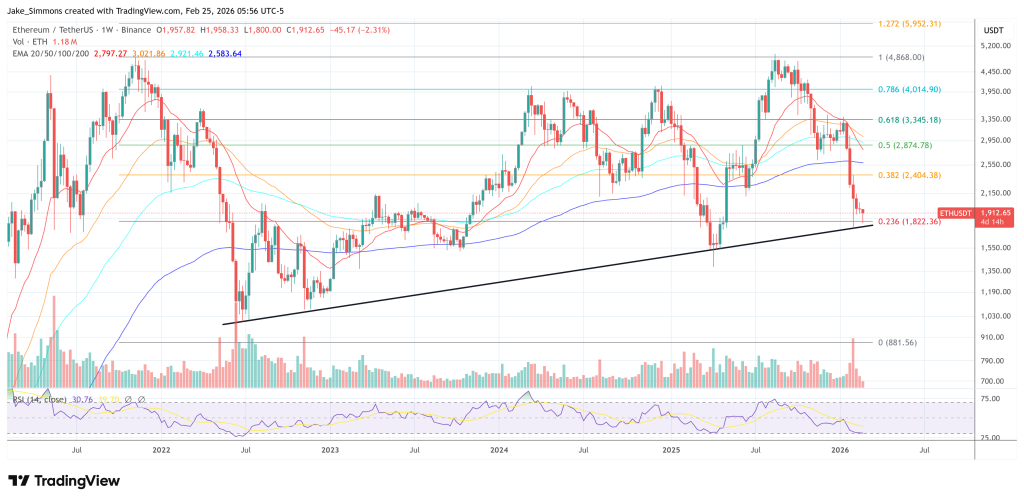
At press time, ETH traded at $1,912.
Recommended Articles


