

The Saylor Discount: Why Bitcoin Trading Below Strategy’s Realized Price is a Gift for Late-Cycle Allocators

Source Newsbtc

Bitcoin continues to struggle below the $65,000 level as persistent selling pressure weighs on market sentiment. Price action has remained fragile in recent weeks, with volatility elevated and traders showing limited conviction amid tightening liquidity conditions and broader macro uncertainty. While intermittent rebounds have occurred, they have so far failed to establish sustained upside momentum, leaving Bitcoin locked in a cautious consolidation phase below a key psychological threshold.

A recent CryptoQuant report highlights a notable structural development involving StrategyB, formerly known as MicroStrategy. It has now been more than six years since the company began its Bitcoin accumulation strategy, targeting roughly 5% of the asset’s total supply. The initiative, driven by CEO Michael Saylor — one of Bitcoin’s most vocal long-term advocates — reflects a conviction that BTC could eventually surpass the $1 million mark over time.

To pursue this objective, StrategyB has executed what many consider the largest dollar-cost averaging program in Bitcoin’s history, notably without selling any BTC since inception. Annual investment figures illustrate the scale of this effort: $1.1 billion in 2020, $2.57 billion in 2021, $276 million in 2022, $1.9 billion in 2023, $21.9 billion in 2024, $22.4 billion in 2025, and $4.1 billion so far in 2026.

StrategyB’s Aggressive Bitcoin Accumulation And Market Implications

According to the report, 2025 marked a record year for StrategyB in terms of capital deployed, with more than $22.4 billion invested into Bitcoin accumulation. The data suggests that 2026 is currently following a comparable trajectory. If this pace continues, the firm could surpass last year’s record, further consolidating its position as one of the largest institutional holders of BTC.

Strategy USD Amount Invested | Source: CryptoQuant

At present, Bitcoin is trading below StrategyB’s estimated realized price, which sits near $76,000. This metric reflects the company’s average acquisition cost across its holdings. StrategyB reportedly holds approximately 717,131 BTC, equivalent to around 3.4% of Bitcoin’s circulating supply. Such concentration highlights the scale of institutional participation now embedded in the market structure.

However, the interpretation of this data requires caution. Trading below a large holder’s realized price does not automatically imply undervaluation; realized price is a cost-basis metric, not a valuation model. Market conditions, liquidity flows, and macroeconomic variables remain dominant drivers of price direction.

Still, the broader takeaway is notable: even major institutional participants often rely on relatively simple accumulation strategies such as dollar-cost averaging. Whether that approach proves optimal in current conditions depends on individual risk tolerance, time horizon, and broader market context.

Weekly Breakdown Below Key Moving Averages Signals Structural Weakness

Bitcoin’s weekly structure has deteriorated materially over the past several sessions. After failing to sustain acceptance above the $90,000–$100,000 region, price rolled over and has now retraced toward the mid-$60,000 area. The latest weekly close near $66,000 places BTC decisively below the 50-week and 100-week moving averages, both of which are beginning to slope downward.
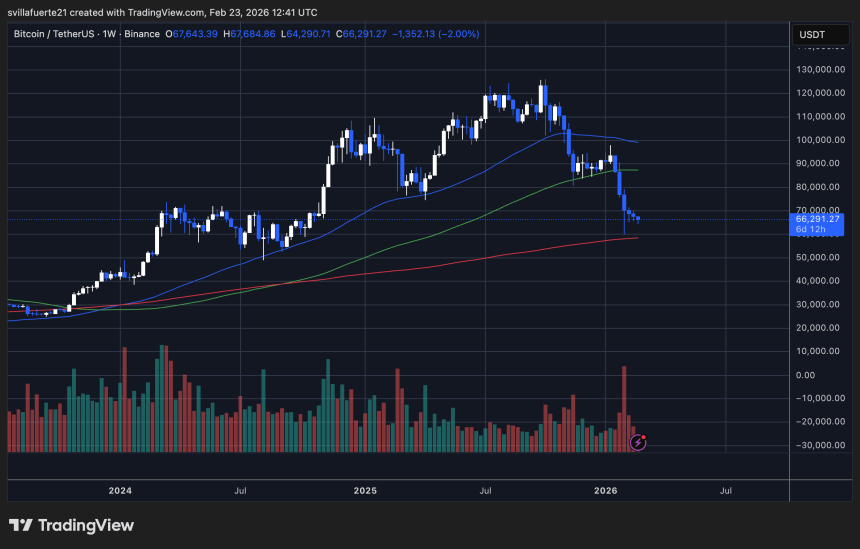
BTC testing critical demand level | Source: BTCUSDT chart on TradingView

This shift in positioning is technically significant. During the 2024–2025 advance, these moving averages acted as dynamic support, consistently absorbing pullbacks and reinforcing trend continuation. Their loss now converts them into overhead resistance, limiting upside unless reclaimed with strong volume confirmation.

The 200-week moving average, currently tracking near the mid-$50,000 zone, remains the last major structural support on this timeframe. Historically, sustained closes below the 50-week average following a cycle peak have signaled prolonged corrective phases rather than shallow consolidations.

Volume has expanded during the recent breakdown, suggesting distribution rather than simple low-liquidity drift. The sharp selloff from the $90,000 region to sub-$70,000 levels reflects decisive supply entering the market.

For bulls to regain control, BTC would need to reclaim the $75,000–$80,000 range and reestablish higher weekly highs. Until then, the weekly trend favors caution, with momentum tilted toward continued consolidation or further downside exploration.

Featured image from ChatGPT, chart from TradingView.com 

Disclaimer: For information purposes only. Past performance is not indicative of future results.
placeholder
Bitcoin CME gaps at $35,000, $27,000 and $21,000, which one gets filled first?Prioritize filling the $27,000 gap and even try higher.
Author  FXStreet
Aug 22, 2023
Prioritize filling the $27,000 gap and even try higher.
placeholder
Pinduoduo Earnings Incoming: Morgan Stanley Sees Long-Term Profit Potential​Insights – On November 21, Chinese e-commerce giant Pinduoduo (PDD) will release its Q3 2024 earnings.
Author  Mitrade
Nov 20, 2024
​Insights – On November 21, Chinese e-commerce giant Pinduoduo (PDD) will release its Q3 2024 earnings.
placeholder
Elon Musk’s xAI and Neuralink Launch New Funding Rounds​Billionaire Elon Musk recently raised funds for his two high-profile tech companies, xAI and Neuralink.
Author  Insights
Jun 03, 2025
​Billionaire Elon Musk recently raised funds for his two high-profile tech companies, xAI and Neuralink.
placeholder
Bitcoin briefly loses 2025 gains as crypto plunges over the weekend.Bitcoin experienced a sharp decline this weekend, briefly erasing its 2025 gains and dipping below its year-opening value of $93,507. The cryptocurrency fell to a low of $93,029 on Sunday, representing a 25% drop from its all-time high in October. Although it has rebounded slightly to around $94,209, the pressures on the market remain significant. The downturn occurred despite the reopening of the U.S. government on Thursday, which many had hoped would provide essential support for crypto markets. This year initially appeared promising for cryptocurrencies, particularly after the inauguration of President Donald Trump, who has established the most pro-crypto administration thus far. However, ongoing political tensions—including Trump's tariff strategies and the recent government shutdown, lasting a historic 43 days—have contributed to several rapid price pullbacks for Bitcoin throughout the year. Market dynamics are also being influenced by Bitcoin whales—investors holding large amounts of Bitcoin—who have been offloading portions of their assets, consequently stalling price rallies even as positive regulatory developments emerge. Despite these sell-offs, analysts from Glassnode argue that this behavior aligns with typical patterns seen among long-term investors during the concluding stages of bull markets, suggesting it is not indicative of a mass exodus. Notably, Bitcoin is not alone in its struggles, as Ethereum and Solana have also recorded declines of 7.95% and 28.3%, respectively, since the start of the year, while numerous altcoins have faced even steeper losses. Looking ahead, questions linger regarding the viability of the four-year cycle thesis, particularly given the increasing institutional support and regulatory frameworks now in place in the crypto landscape. Matt Hougan, chief investment officer at Bitwise, remains optimistic, suggesting a potential Bitcoin resurgence in 2026 driven by the “debasement trade” thesis and a broader trend toward increased adoption of stablecoins, tokenization, and decentralized finance. Hougan emphasized the soundness of the underlying fundamentals, pointing to a positive outlook for the sector in the longer term.
Author  Mitrade
Nov 17, 2025
Bitcoin experienced a sharp decline this weekend, briefly erasing its 2025 gains and dipping below its year-opening value of $93,507. The cryptocurrency fell to a low of $93,029 on Sunday, representing a 25% drop from its all-time high in October. Although it has rebounded slightly to around $94,209, the pressures on the market remain significant. The downturn occurred despite the reopening of the U.S. government on Thursday, which many had hoped would provide essential support for crypto markets. This year initially appeared promising for cryptocurrencies, particularly after the inauguration of President Donald Trump, who has established the most pro-crypto administration thus far. However, ongoing political tensions—including Trump's tariff strategies and the recent government shutdown, lasting a historic 43 days—have contributed to several rapid price pullbacks for Bitcoin throughout the year. Market dynamics are also being influenced by Bitcoin whales—investors holding large amounts of Bitcoin—who have been offloading portions of their assets, consequently stalling price rallies even as positive regulatory developments emerge. Despite these sell-offs, analysts from Glassnode argue that this behavior aligns with typical patterns seen among long-term investors during the concluding stages of bull markets, suggesting it is not indicative of a mass exodus. Notably, Bitcoin is not alone in its struggles, as Ethereum and Solana have also recorded declines of 7.95% and 28.3%, respectively, since the start of the year, while numerous altcoins have faced even steeper losses. Looking ahead, questions linger regarding the viability of the four-year cycle thesis, particularly given the increasing institutional support and regulatory frameworks now in place in the crypto landscape. Matt Hougan, chief investment officer at Bitwise, remains optimistic, suggesting a potential Bitcoin resurgence in 2026 driven by the “debasement trade” thesis and a broader trend toward increased adoption of stablecoins, tokenization, and decentralized finance. Hougan emphasized the soundness of the underlying fundamentals, pointing to a positive outlook for the sector in the longer term.
placeholder
Silver Price Forecast: XAG/USD falls to near $72.00 amid fading safe-haven demandSilver price (XAG/USD) continues to lose ground after registering tiny losses in the previous day, trading around $72.90 during the Asian hours on Thursday. The safe-haven demand for the precious metal fades amid rising optimism over Middle East peace.
Author  FXStreet
Apr 02, Thu
Silver price (XAG/USD) continues to lose ground after registering tiny losses in the previous day, trading around $72.90 during the Asian hours on Thursday. The safe-haven demand for the precious metal fades amid rising optimism over Middle East peace.
goTop
quote