


Crypto Braces For Impact As JPow’s Jackson Hole Speech Looms
The crypto market slid into the week in a holding pattern, with price action grinding sideways and positioning increasingly tethered to one catalyst: Federal Reserve Chair Jerome Powell’s remarks at the Jackson Hole Economic Policy Symposium. “The only big, big event is going to be this,” said analyst Josh Olszewicz in his August 18 Macro Monday stream. “Everybody’s going to be watching this, talking about this, analyzing this… What Jay says [on Friday]” will likely swing rate expectations and risk sentiment. The symposium runs August 21–23, 2025 in Wyoming, under the theme “Labor Markets in Transition: Demographics, Productivity, and Macroeconomic Policy,” a backdrop almost tailor-made for clarifying the Fed’s path into autumn.
Will JPow Jolt The Crypto Market?
Olszewicz framed the setup as seasonally and structurally tricky for crypto. Commitment of Traders (COT) positioning on CME shows commercials—the cohort he views as “normally right for any market historically”—not convincingly long, while basis trades remain attractive and open interest has crept higher across CME futures and options, including on Solana. That mix, he argued, limits upside follow-through in the absence of a macro spark. “It’s going to be harder to push higher based on what we’ve seen historically and based on this futures positioning data,” he said, adding that “when commercials are long, price tends to do better.”
Flows underscore the crosscurrent. He tallied “almost a $4 billion” net week for crypto ETPs globally—most of it in the US—with Ethereum notching “an all-time high weekly flow,” while Bitcoin’s intake looked “modest” by comparison and Solana and XRP showed a pickup. Yet he cautioned that even healthy fund flows do not erase tactically heavy positioning and the lack of a clear macro impulse ahead of Powell.
MicroStrategy’s equity policy change, which allows at-the-market issuance below a 2.5× mNAV premium, has also become a talking point in the pre-Jackson Hole chop. Olszewicz noted that MSTR’s BTC accumulation “has slowed down quite a bit,” and that the share’s mNAV premium is being actively arbitraged by traders “short MSTR, long spot [BTC],” further muting momentum when the underlying coin is directionless. In his view, “when the underlying is momentumless, there’s no reason to seek leverage,” which helps explain why MSTR “is going to have a harder time doing well” until either BTC trends or corporate accumulation re-accelerates.
Technically, he described the near-term as “a giant, giant nothing burger.” For Bitcoin, he pointed to a $120,000–$122,000 zone as the threshold for a cleaner long setup, and for MicroStrategy he flagged “anything above $410, and it’s go time,” while conceding that the stock’s momentum is “slipping away quicker and quicker.” Across crypto equities, he saw little that was “screaming” long: exchanges and brokerages looked momentumless on his cloud models; miners’ recent strength owed more to AI/HPC stories than to crypto beta; and even the prominent ETH-linked equities that surged since spring now show “record volumes” but a “more neutral” low-timeframe picture. “There’s no reason to force trades when they’re not there,” he said.
How Will Financial Markets React?
The macro guardrails he’ll watch into Powell’s speech are familiar to crypto traders. On the US dollar index, he wants continued “chop neutral” and firmly below the daily cloud—“you don’t want this above 99, 100”—because a resurgent DXY “would be very careful with longs on BTC.” On rates, the 10-year Treasury “durably below 4.25” would be a tailwind, while “above 5% everybody’s in trouble.” He also flagged plumbing dynamics: the drawdown of reverse repos toward zero and the concurrent refill of the Treasury General Account—flows that could net out, but that, at the extremes, might nudge the Fed toward a policy response if liquidity strains emerged.
All roads, however, lead back to Powell. As of Tuesday, broader markets were leaning toward a September rate cut, with futures-implied tools like CME’s FedWatch reflecting a high probability of a 25 bps move. “We’re seeing 83% for a cut at the next meeting,” Olszewicz said of the market’s starting point, adding that if expectations “shift towards no cut, I’d expect the markets to be very angry,” whereas a surprise 50 bps “is probably unlikely” but would be greeted “in a bullish, happy way.”
For now, Olszewicz is content to wait. “I would love to just wait to see what this looks like in October. I’m not expecting anything in September,” he said, consistent with his view that crypto’s Q3 seasonality is a headwind and that meaningful trend signals often re-emerge in Q4.
Between now and then, the Chair’s tone on inflation progress, labor-market cooling, and the possibility of pre-emptive easing will determine whether this week’s “nothing burger” becomes the base for a new leg higher—or a reminder that macro still has the final say at the top of crypto’s risk cascade. And with Jackson Hole’s explicit focus on labor markets this year, Powell’s framing may do more than nudge September probabilities; it could reset how investors think about the entire path of policy into 2026.
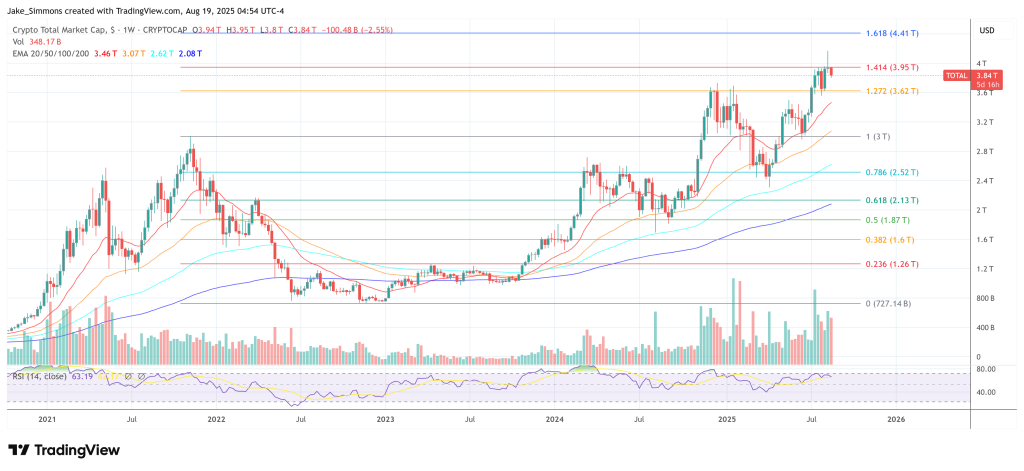
At press time, the total crypto market cap stood at $3.84 trillion.
Recommended Articles


