


Gold bid with Copper rising to record high on tariff threat
- Gold ties up with the second day of gains for this week.
- US President Trump said on Tuesday that Copper tariffs might be implemented much sooner than initially expected.
- Gold is seeing a move towards the all-time high at $3,057.
Gold’s price (XAU/USD) is heading to $3,020 at the time of writing on Wednesday and has turned this week’s performance positive after its initial move lower on Monday. The precious metal is being bought together with other precious metals as Copper pops to a new all-time high. Copper metal is in the eye of attention after United States (US) President Donald Trump mentioned on Tuesday that Copper tariffs will be implemented in the coming weeks, which is far sooner than markets were anticipating.
Meanwhile, there is also a headline risk on Ukraine, where a Black Sea ceasefire deal is on the table. Ukraine’s President Volodymyr Zelenskiy was quick to support the breakthrough and said his country was ready to adhere to it effective immediately. The Kremlin was quick to issue additional demands that would need to be met before the ceasefire deal in the Black Sea could become valid, with the request to see sanctions on banks and companies involved in agricultural exports being halted, Bloomberg reports.
Daily digest market movers: Sector moves
- The primary sticking point in talks for an acquisition of Australian miner Gold Road Resources by South Africa's Gold Fields was the price, according to the Australian company's chief executive. In an interview on Wednesday, Gold Road Resources CEO Duncan Gibbs said the company remains open to further talks with Gold Fields but noted that most of its shareholders do not support a takeover at the price its partner proposed, Dow Jones reports.
- Another reason mentioned for Gold being bought this Wednesday is because the US Conference Board Consumer Confidence dropped to the lowest level in four years in March on concerns over escalating trade wars and higher prices, Bloomberg reports.
- The CME Fedwatch Tool sees the Federal Reserve’s (Fed) policy rate unchanged in its May meeting by 87.1%. Chances for a rate cut in June are currently at 63.2%.
Technical Analysis: Not there yet though
Gold sees how the surge in Copper prices pulls up the whole precious metals complex higher. This is a good set off from the easing of the reciprocal tariffs fears seen on Monday. Expect a test of this week’s high, near $3,036, before the all-time high at $3,057 comes into play.
On the upside, the daily R1 resistance comes in at $3,034 and coincides with this week’s high for now. Further up, the R2 resistance at $3,049 roughly coincides with Friday’s high. This means this level is a heavy barrier before pointing to the current all-time high of $3,057.
On the downside, the intraday S1 support stands at $3,006, preceding the $3,000 mark, which can be perceived as a bullish sign. That means the $3,000 mark is no longer exposed and has some circuit breaking element beforehand to slow down any downmoves. Further down, the S2 support comes in at $2,992.
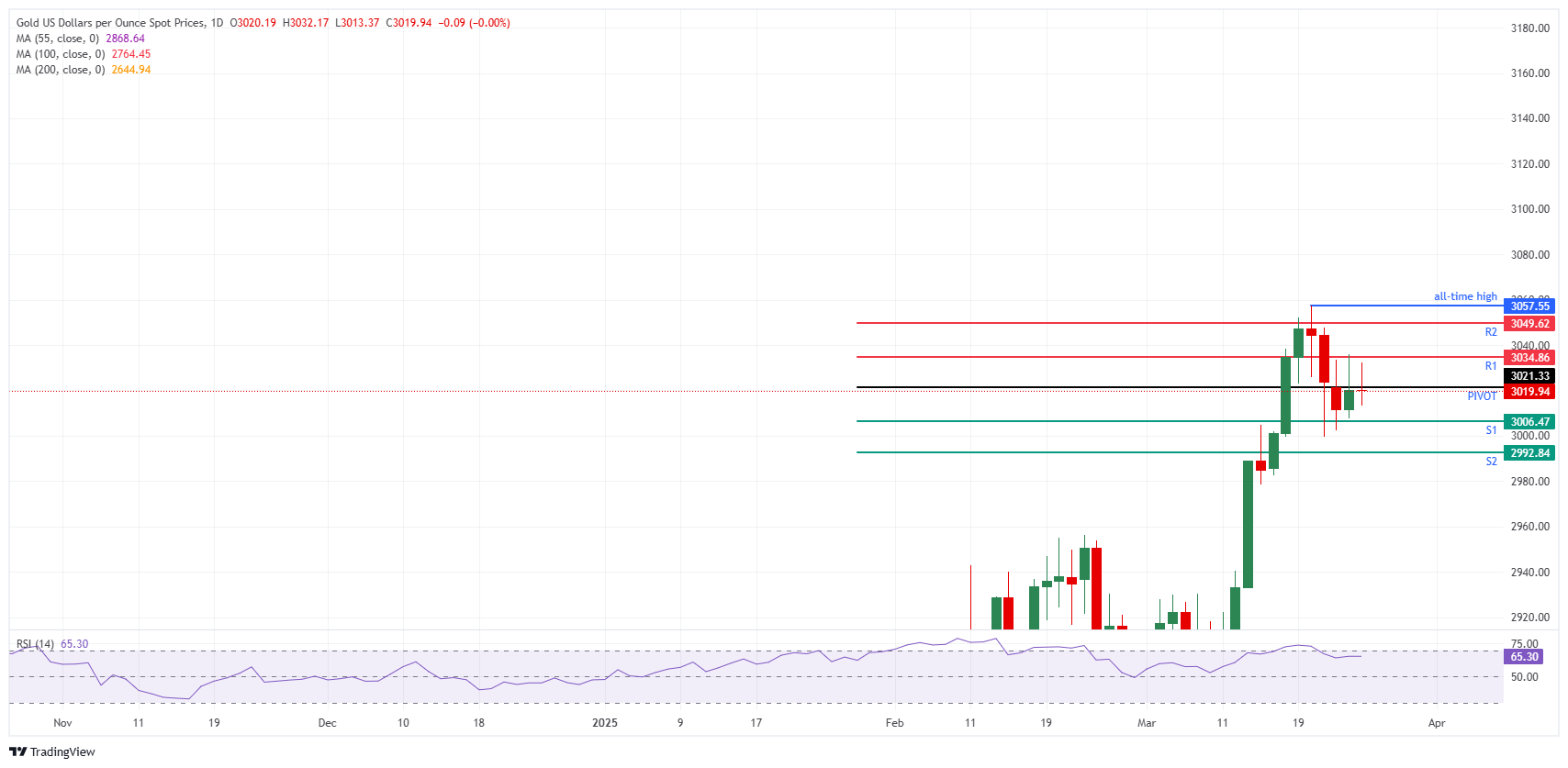
XAU/USD: Daily Chart
Gold FAQs
Gold has played a key role in human’s history as it has been widely used as a store of value and medium of exchange. Currently, apart from its shine and usage for jewelry, the precious metal is widely seen as a safe-haven asset, meaning that it is considered a good investment during turbulent times. Gold is also widely seen as a hedge against inflation and against depreciating currencies as it doesn’t rely on any specific issuer or government.
Central banks are the biggest Gold holders. In their aim to support their currencies in turbulent times, central banks tend to diversify their reserves and buy Gold to improve the perceived strength of the economy and the currency. High Gold reserves can be a source of trust for a country’s solvency. Central banks added 1,136 tonnes of Gold worth around $70 billion to their reserves in 2022, according to data from the World Gold Council. This is the highest yearly purchase since records began. Central banks from emerging economies such as China, India and Turkey are quickly increasing their Gold reserves.
Gold has an inverse correlation with the US Dollar and US Treasuries, which are both major reserve and safe-haven assets. When the Dollar depreciates, Gold tends to rise, enabling investors and central banks to diversify their assets in turbulent times. Gold is also inversely correlated with risk assets. A rally in the stock market tends to weaken Gold price, while sell-offs in riskier markets tend to favor the precious metal.
The price can move due to a wide range of factors. Geopolitical instability or fears of a deep recession can quickly make Gold price escalate due to its safe-haven status. As a yield-less asset, Gold tends to rise with lower interest rates, while higher cost of money usually weighs down on the yellow metal. Still, most moves depend on how the US Dollar (USD) behaves as the asset is priced in dollars (XAU/USD). A strong Dollar tends to keep the price of Gold controlled, whereas a weaker Dollar is likely to push Gold prices up.
Recommended Articles


