

WTI Crude Soars Back to $70. Two Major War Zones Explode on the Same Day, US-Iran Memorandum Faces Rupture Risk, and Russia's 21-Million-Ton Core Refinery Is Hit and Paralyzed.

Source Tradingkey

TradingKey - On July 7, Eastern Time, geopolitical conflicts escalated once again, with two consecutive military clashes driving a rebound in oil prices. Following Iran's launch of at least two missiles at several commercial vessels in the Strait of Hormuz, Ukraine used drones to attack Russia's largest oil refinery. These successive military conflicts have shattered the recently eased geopolitical environment.

Impacted by the two conflicts, both major crude oil futures rose. As of press time, WTI crude oil futures rose 2.74% to $70.43, while Brent crude oil futures rose 2.7% to $74.
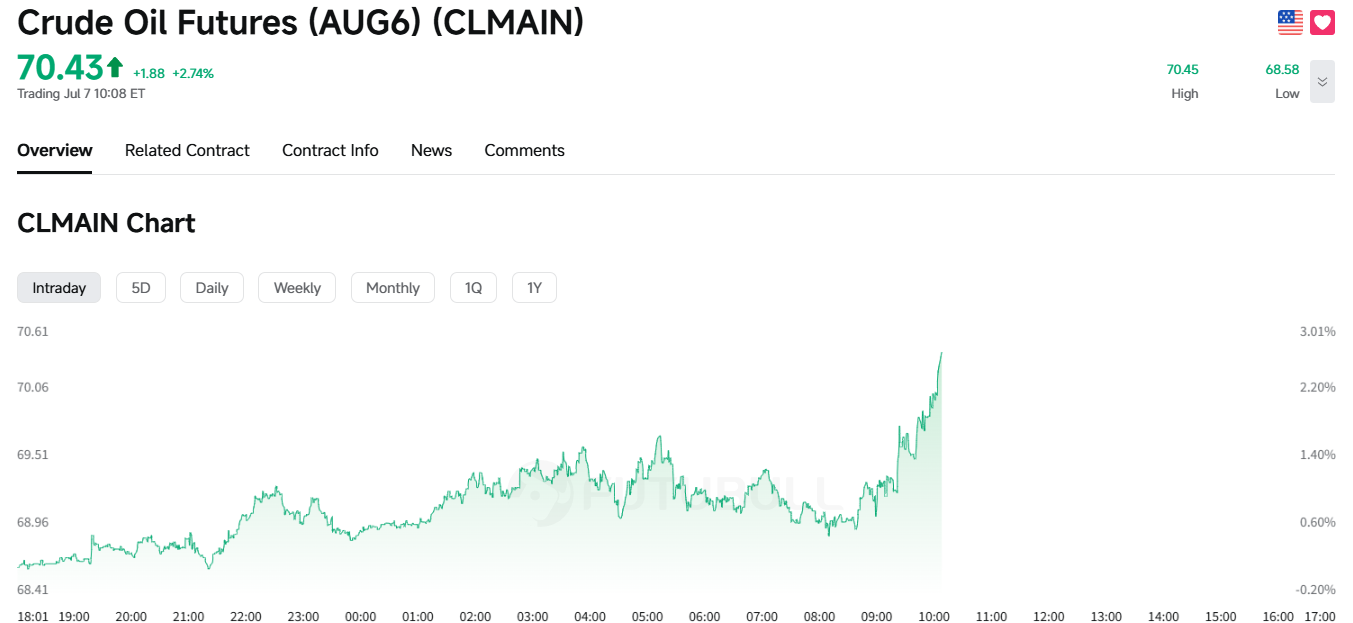
2-634e2207e6bc461cae81cc4b6a5a311b

[Source: FutuBull]

Regarding the U.S.-Iran conflict, just three weeks ago, both sides officially signed a 14-point memorandum of understanding (MoU) in Switzerland. Following the signing of the agreement, two Iranian supertankers successfully navigated through the blockade zone and departed from the Gulf of Oman, and both parties agreed to restore maritime traffic to full capacity within 30 days. This series of developments was once seen as a clear signal of the end of the U.S.-Iran conflict.

However, today's missile attacks directly violated the core commitment in the agreement regarding keeping the strait open, putting this fragile MoU at risk of complete collapse.

It is reported that the Strait of Hormuz carries a massive portion of global crude oil shipments, and whether the shipping lanes can flow smoothly profoundly impacts international oil price trends. Previously, when the U.S. and Iran reached the truce MoU and the maritime blockade was lifted, the geopolitical oil price premium quickly faded, and international crude prices fell significantly as the market stopped excessively worrying about crude supply disruptions.

But now that conflict and attacks have resumed, investors will re-evaluate the shipping safety hazards in the Strait of Hormuz. If missile attacks block shipping in the strait over the long term, or if the conflict spreads further and triggers a larger-scale war, the global crude oil supply chain will face a genuine risk of disruption.

On the other hand, Ukraine used its self-developed drones to travel nearly 2,500 kilometers to strike the Omsk Refinery in the heart of Western Siberia, setting a new record for deep strikes into Russian territory since the outbreak of the full-scale war, directly impacting Russia's core oil processing system.

It is reported that as one of Russia's largest gasoline production bases, the Omsk Refinery has an annual processing capacity of over 21 million tons and serves as a core hub for Russia's petroleum economy and fuel supply.

Disclaimer: For information purposes only. Past performance is not indicative of future results.
placeholder
Bitcoin CME gaps at $35,000, $27,000 and $21,000, which one gets filled first?Prioritize filling the $27,000 gap and even try higher.
Author  FXStreet
Aug 22, 2023
Prioritize filling the $27,000 gap and even try higher.
placeholder
Pinduoduo Earnings Incoming: Morgan Stanley Sees Long-Term Profit Potential​Insights – On November 21, Chinese e-commerce giant Pinduoduo (PDD) will release its Q3 2024 earnings.
Author  Mitrade
Nov 20, 2024
​Insights – On November 21, Chinese e-commerce giant Pinduoduo (PDD) will release its Q3 2024 earnings.
placeholder
Elon Musk’s xAI and Neuralink Launch New Funding Rounds​Billionaire Elon Musk recently raised funds for his two high-profile tech companies, xAI and Neuralink.
Author  Insights
Jun 03, 2025
​Billionaire Elon Musk recently raised funds for his two high-profile tech companies, xAI and Neuralink.
placeholder
Bitcoin briefly loses 2025 gains as crypto plunges over the weekend.Bitcoin experienced a sharp decline this weekend, briefly erasing its 2025 gains and dipping below its year-opening value of $93,507. The cryptocurrency fell to a low of $93,029 on Sunday, representing a 25% drop from its all-time high in October. Although it has rebounded slightly to around $94,209, the pressures on the market remain significant. The downturn occurred despite the reopening of the U.S. government on Thursday, which many had hoped would provide essential support for crypto markets. This year initially appeared promising for cryptocurrencies, particularly after the inauguration of President Donald Trump, who has established the most pro-crypto administration thus far. However, ongoing political tensions—including Trump's tariff strategies and the recent government shutdown, lasting a historic 43 days—have contributed to several rapid price pullbacks for Bitcoin throughout the year. Market dynamics are also being influenced by Bitcoin whales—investors holding large amounts of Bitcoin—who have been offloading portions of their assets, consequently stalling price rallies even as positive regulatory developments emerge. Despite these sell-offs, analysts from Glassnode argue that this behavior aligns with typical patterns seen among long-term investors during the concluding stages of bull markets, suggesting it is not indicative of a mass exodus. Notably, Bitcoin is not alone in its struggles, as Ethereum and Solana have also recorded declines of 7.95% and 28.3%, respectively, since the start of the year, while numerous altcoins have faced even steeper losses. Looking ahead, questions linger regarding the viability of the four-year cycle thesis, particularly given the increasing institutional support and regulatory frameworks now in place in the crypto landscape. Matt Hougan, chief investment officer at Bitwise, remains optimistic, suggesting a potential Bitcoin resurgence in 2026 driven by the “debasement trade” thesis and a broader trend toward increased adoption of stablecoins, tokenization, and decentralized finance. Hougan emphasized the soundness of the underlying fundamentals, pointing to a positive outlook for the sector in the longer term.
Author  Mitrade
Nov 17, 2025
Bitcoin experienced a sharp decline this weekend, briefly erasing its 2025 gains and dipping below its year-opening value of $93,507. The cryptocurrency fell to a low of $93,029 on Sunday, representing a 25% drop from its all-time high in October. Although it has rebounded slightly to around $94,209, the pressures on the market remain significant. The downturn occurred despite the reopening of the U.S. government on Thursday, which many had hoped would provide essential support for crypto markets. This year initially appeared promising for cryptocurrencies, particularly after the inauguration of President Donald Trump, who has established the most pro-crypto administration thus far. However, ongoing political tensions—including Trump's tariff strategies and the recent government shutdown, lasting a historic 43 days—have contributed to several rapid price pullbacks for Bitcoin throughout the year. Market dynamics are also being influenced by Bitcoin whales—investors holding large amounts of Bitcoin—who have been offloading portions of their assets, consequently stalling price rallies even as positive regulatory developments emerge. Despite these sell-offs, analysts from Glassnode argue that this behavior aligns with typical patterns seen among long-term investors during the concluding stages of bull markets, suggesting it is not indicative of a mass exodus. Notably, Bitcoin is not alone in its struggles, as Ethereum and Solana have also recorded declines of 7.95% and 28.3%, respectively, since the start of the year, while numerous altcoins have faced even steeper losses. Looking ahead, questions linger regarding the viability of the four-year cycle thesis, particularly given the increasing institutional support and regulatory frameworks now in place in the crypto landscape. Matt Hougan, chief investment officer at Bitwise, remains optimistic, suggesting a potential Bitcoin resurgence in 2026 driven by the “debasement trade” thesis and a broader trend toward increased adoption of stablecoins, tokenization, and decentralized finance. Hougan emphasized the soundness of the underlying fundamentals, pointing to a positive outlook for the sector in the longer term.
placeholder
Gold Price Forecast: XAU/USD struggles to extend recovery above 20-day EMAGold price (XAU/USD) is down 0.8% to near $4,140 during the European trading session on Monday. The precious metal faces selling pressure as the three-day rally hits a pause after failing to extend above $4,202.
Author  FXStreet
Yesterday 10: 23
Gold price (XAU/USD) is down 0.8% to near $4,140 during the European trading session on Monday. The precious metal faces selling pressure as the three-day rally hits a pause after failing to extend above $4,202.
goTop
quote