


EUR/USD falls apart on Wednesday in post-election Greenback rush
- EUR/USD plummeted nearly 2% on Wednesday as markets bid up the US Dollar.
- Fiber saw one of its worst days in years as markets struggle to find a reason to buy the Euro.
- EU economic calendar remains tepid, leaving markets to focus on Fed rate cuts.
EUR/USD plummeted during the midweek market session, falling over 1.75% into the red and tumbling back below 1.0750 for the first time since July. Markets have broadly pivoted into the Greenback following clear results from this week’s US presidential election that sees former President Donald Trump as the frontrunner.
EU-based market data remains relatively limited this week. Pan-EU Retail Sales figures are due on Thursday, with this week’s EU leaders’ summit set to wrap up on Friday and a follow-up appearance from ECB President Lagarde slated for Saturday when the market will be closed.’
The US presidential election still isn’t over, and some key battlegrounds will take some time before a final call is made, but markets are confident that the outcome has been decided, with Republican candidate and former President Donald Trump set to win 276 electoral votes. With the Republicans also set to win back both the US Senate and Congress, investors are anticipating a pro-growth environment with more deregulation as well as additional or extended business tax cuts.
Another Federal Reserve (Fed) rate call looms ahead this week. Fed Chair Jerome Powell is widely expected to deliver another quarter-point cut to interest rates on Thursday, bringing the Fed Funds Rate down 25 bps to 4.75%. The Fed Funds Rate peaked at 5.5% in July of 2023, and investors have been clamoring for a return to a low interest rate environment that has become familiar territory since US interest rates clattered to an all-time low near 0% in early 2009.
The University of Michigan’s (UoM) Consumer Sentiment Index is waiting in the wings and slated for release on Friday. Investors expect November’s UoM sentiment indicator to climb to a six-month high of 71.0 from the previous month’s 70.5.
EUR/USD price forecast
The EUR/USD daily chart reveals a considerable setback, as the currency pair faced a sharp rejection around the 50-day EMA, currently at 1.0929, and has dropped below both the 50-day and 200-day EMAs. This technical pullback reflects a cautious outlook for the euro, particularly given recent challenges faced by the eurozone economy, including concerns over slowing growth and inflation. The strong bearish candlestick observed in the latest session suggests a swift return of market caution, as the euro failed to sustain momentum above critical moving averages.
Looking at momentum indicators, the MACD line is currently above the signal line, but recent weakness has caused the histogram bars to contract, reflecting a loss of upward momentum. The MACD's proximity to the zero line hints at the potential for a shift in sentiment; should the MACD cross into negative territory, it may signal a further downturn for EUR/USD. Investors appear wary, as current price action implies that upward moves are likely to face resistance amid prevailing market uncertainties, aligning with broader risk aversion.
In the event of further weakness, traders should keep an eye on the 1.0700 level, which marks a psychological support area and could be crucial in gauging future market sentiment. If EUR/USD holds above this support, it may encourage a period of consolidation as the market assesses broader economic data and policy signals. However, a break below could amplify selling pressure, potentially drawing the currency pair toward the year’s lows around 1.0600, especially if the eurozone’s macroeconomic picture remains subdued. Conversely, for a bullish scenario to re-emerge, the euro would need to reclaim the 1.0900 level with sustained buying interest.
EUR/USD daily chart 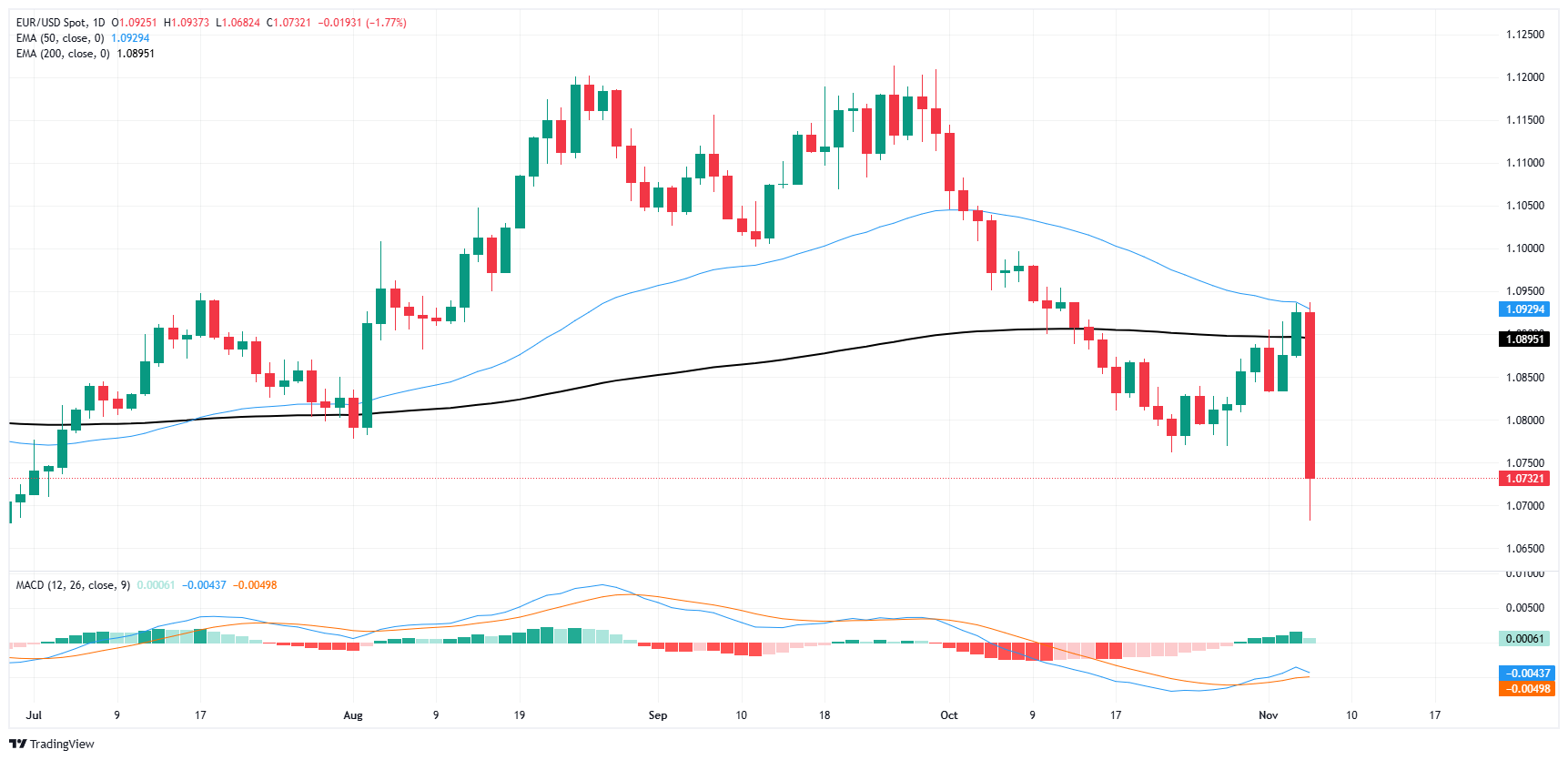
Euro FAQs
The Euro is the currency for the 19 European Union countries that belong to the Eurozone. It is the second most heavily traded currency in the world behind the US Dollar. In 2022, it accounted for 31% of all foreign exchange transactions, with an average daily turnover of over $2.2 trillion a day. EUR/USD is the most heavily traded currency pair in the world, accounting for an estimated 30% off all transactions, followed by EUR/JPY (4%), EUR/GBP (3%) and EUR/AUD (2%).
The European Central Bank (ECB) in Frankfurt, Germany, is the reserve bank for the Eurozone. The ECB sets interest rates and manages monetary policy. The ECB’s primary mandate is to maintain price stability, which means either controlling inflation or stimulating growth. Its primary tool is the raising or lowering of interest rates. Relatively high interest rates – or the expectation of higher rates – will usually benefit the Euro and vice versa. The ECB Governing Council makes monetary policy decisions at meetings held eight times a year. Decisions are made by heads of the Eurozone national banks and six permanent members, including the President of the ECB, Christine Lagarde.
Eurozone inflation data, measured by the Harmonized Index of Consumer Prices (HICP), is an important econometric for the Euro. If inflation rises more than expected, especially if above the ECB’s 2% target, it obliges the ECB to raise interest rates to bring it back under control. Relatively high interest rates compared to its counterparts will usually benefit the Euro, as it makes the region more attractive as a place for global investors to park their money.
Data releases gauge the health of the economy and can impact on the Euro. Indicators such as GDP, Manufacturing and Services PMIs, employment, and consumer sentiment surveys can all influence the direction of the single currency. A strong economy is good for the Euro. Not only does it attract more foreign investment but it may encourage the ECB to put up interest rates, which will directly strengthen the Euro. Otherwise, if economic data is weak, the Euro is likely to fall. Economic data for the four largest economies in the euro area (Germany, France, Italy and Spain) are especially significant, as they account for 75% of the Eurozone’s economy.
Another significant data release for the Euro is the Trade Balance. This indicator measures the difference between what a country earns from its exports and what it spends on imports over a given period. If a country produces highly sought after exports then its currency will gain in value purely from the extra demand created from foreign buyers seeking to purchase these goods. Therefore, a positive net Trade Balance strengthens a currency and vice versa for a negative balance.
Recommended Articles


