


The AI Trade Just Cracked. Here’s the Price at Which I’d Start Buying Nvidia.
Key Points
Jensen Huang reportedly had extramarital affairs with two Nvidia employees, as well as a business executive suspected of having ties to Chinese intelligence.
Huang resigned from his position as CEO and board member from Nvidia.
As Nvidia stock sinks, investors are also panic-selling related names in the artificial intelligence (AI) landscape.
- 10 stocks we like better than Nvidia ›
When OpenAI commercially launched ChatGPT in November 2022, few investors anticipated how dramatically artificial intelligence (AI) would reshape the stock market. Perhaps no company benefited more from this than Nvidia (NASDAQ:NVDA).
Between late 2022 and year-end 2025, Nvidia's stock price increased roughly tenfold -- transforming the semiconductor designer into one of the world's most valuable companies. The rally reflected insatiable demand for its graphics processing units (GPUs), which became critical infrastructure for training and deploying generative AI models.
Missed AI’s "Act 1"? Act 2 Could Be 15x Bigger. Most investors think they missed the AI boat because they didn't buy Nvidia in 2005. But according to our analysts, we’re only at the end of "Act 1"—the R&D phase. "Act 2" is the global rollout. Continue »
However, 2026 has presented an entirely different story. After notching a record high of roughly $243 per share in October, Nvidia has experienced a seismic sell-off. On Nov. 12, Nvidia stock briefly fell below $150 following the resignation of CEO Jensen Huang.
The question now is whether Nvidia's scandals signal the beginning of a broader collapse in AI stocks. While I think investors should prepare for additional volatility, I also see the sell-off as an attractive long-term buying opportunity.

Image source: Getty Images.
Nvidia's meteoric rise gave birth to the AI revolution
Nvidia's evolution from a gaming GPU manufacturer into an AI infrastructure leader is historic. The company's chips became the preferred hardware for training generative AI models, while its CUDA software platform established a powerful competitive advantage by keeping developers locked into its ecosystem.
As demand accelerated, Nvidia introduced successive generations of computing architectures, including Hopper, Blackwell, and Vera Rubin. This rapid pace of innovation helped drive continued spending commitments from hyperscalers like Microsoft, Amazon, Alphabet, Meta Platforms, and Oracle.
Nvidia wasn't the only beneficiary of rising demand for AI chips. Broadcom and Advanced Micro Devices have also attracted investors seeking additional exposure to AI semiconductor stocks. Furthermore, cloud computing providers have benefited from the demand for AI infrastructure and services, while enterprise software companies like Palantir Technologies have become well positioned to capitalize on sovereign AI adoption.
Beyond the technology industry, utilities, energy producers, and electrical equipment manufacturers also attract attention as data centers require increasingly large amounts of power. In other words, Nvidia ignited an investment theme extending across multiple industries. That interconnectedness is precisely why the recent sell-off matters.
Why Nvidia's problems could spread across the broader market
Over the last few days, scandals involving Huang and his personal relationships have intensified. On Nov. 12, Nvidia announced that Huang resigned as CEO and that CFO Colette Kress would assume the chief executive role in the interim.
The development undoubtedly introduces uncertainty about the company's strategy, customer relationships, and future execution. However, Nvidia was already facing pressure.
Investors have been questioning whether hyperscalers can generate adequate returns on their AI infrastructure investments. Meanwhile, the midterm elections also introduced uncertainty surrounding potential regulation of data center construction and electricity costs.
These concerns could have implications beyond Nvidia, considering the "Magnificent Seven" account for nearly one-third of the S&P 500's (SNPINDEX:^GSPC) total market capitalization. If investors begin to reassess AI-related growth assumptions across big tech, the resulting selling pressure could drag major indexes lower.
The price I'd pay for Nvidia stock
Despite the current narrative surrounding Nvidia, its valuation has become interesting. As of Nov. 12, the company's forward price-to-earnings (P/E) ratio hovered around 11 -- a steep discount to its historical valuation.
Nvidia is substantially larger and more profitable today than it was during earlier phases of the AI revolution. Huang's departure poses a legitimate succession risk, while decelerating hyperscaler spending could erode future earnings.
However, I would become particularly interested in Nvidia around $155 to $160 per share. Based on Wall Street's fiscal 2028 earnings per share (EPS) estimate of $15.91, this price range implies a valuation of 9.7-10.1 times earnings.
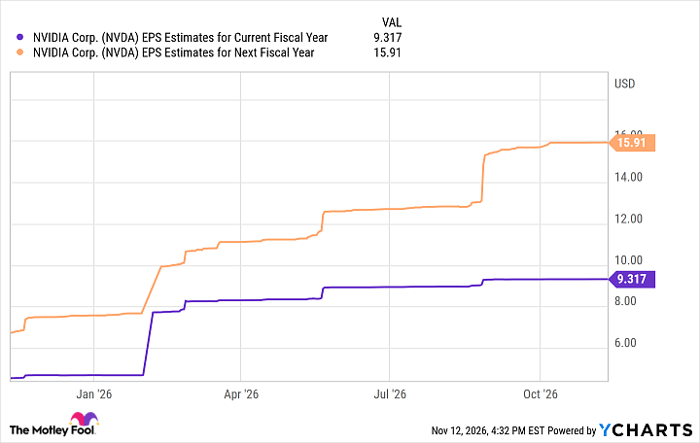
NVDA EPS Estimates for Current Fiscal Year data by YCharts
Ultimately, smart investors can distinguish between deteriorating business fundamentals and changing market sentiment. While the AI trade will likely experience short-term turbulence, Nvidia's long-term investment thesis remains compelling for now. If Nvidia continues compounding its earnings growth, today's uncertainty could wind up looking like an attractive opportunity to buy the dip for patient investors.
Should you buy stock in Nvidia right now?
Before you buy stock in Nvidia, consider this:
The Motley Fool Stock Advisor analyst team just identified what they believe are the 10 best stocks for investors to buy now… and Nvidia wasn’t one of them. The 10 stocks that made the cut could produce monster returns in the coming years.
Consider when Netflix made this list on December 17, 2004... if you invested $1,000 at the time of our recommendation, you’d have $348,060!* Or when Nvidia made this list on April 15, 2005... if you invested $1,000 at the time of our recommendation, you’d have $1,067,492!*
Now, it’s worth noting Stock Advisor’s total average return is 849% — a market-crushing outperformance compared to 210% for the S&P 500. Don't miss the latest top 10 list, available with Stock Advisor, and join an investing community built by individual investors for individual investors.
See the 10 stocks »
*Stock Advisor returns as of November 13, 2026.
Adam Spatacco has positions in Alphabet, Amazon, Microsoft, Nvidia, and Palantir Technologies. The Motley Fool has positions in and recommends Advanced Micro Devices, Alphabet, Amazon, Broadcom, Meta Platforms, Microsoft, Nvidia, Oracle, and Palantir Technologies. The Motley Fool has a disclosure policy.
Recommended Articles


