


Pound Sterling dips amid increased speculation for BoE rate cuts
- The Pound Sterling falls against the US Dollar as BoE rate-cut bets surge.
- Weak UK Retail Sales lift bets supporting BoE rate cuts in August.
- Investors await the preliminary US/UK S&P Global PMI data for July.
The Pound Sterling (GBP) continues to hold the key support level of 1.2900 against the US Dollar (USD) in Tuesday’s London session. The GBP/USD pair edges down but remains inside the tight range of 1.2900-1.2940 as the recovery move in the US Dollar (USD), driven by growing speculation of Donald Trump winning the United States (US) presidential elections in November, appears to have stalled with focus on a slew of economic data this week.
The US Dollar Index (DXY), which tracks the Greenback’s value, against six major currencies, hovers near 104.30.
This week, investors will focus on the US preliminary S&P Global Purchasing Managers Index (PMI) for July, Q2 Gross Domestic Product (GDP), and Durable Goods Orders and Personal Consumption Expenditures Price Index (PCE) data for June. The economic data could provide fresh cues about when the US Federal Reserve (Fed) will start reducing interest rates this year.
Economists expect the Manufacturing PMI, scheduled on Wednesday, to have expanded at a nominal pace to 51.7 from June’s reading of 51.6. The Services PMI, a measure of activities in the service sector, is estimated to have expanded at a slower pace to 54.4 from the prior release of 55.3.
According to the CME FedWatch tool, 30-day Federal Fund futures show the central bank beginning to lower its key borrowing rates from their current levels in the September meeting. The Fed is also expected to cut interest rates again in November or December.
Daily digest market movers: Pound Sterling drops against its major peers
- The Pound Sterling weakens against its major peers, except the Australian Dollar (AUD) and the New Zealand Dollar (NZD) amid improved speculation that the Bank of England (BoE) will start cutting its key interest rates from the August meeting. Asia-Pacific currencies have been beaten hard due to their strong linkage with China’s economic outlook. Investors have raised concerns over the economic outlook of the world’s second-largest nation due to weaker-than-expected Q2 Gross Domestic Product (GDP) growth.
- The expectations for the BoE to pivot to policy normalization increase as higher interest rates have narrowed pockets of individuals. The recent UK Retail Sales report for June showed that receipts at retail stores unexpectedly contracted by 0.2% year-over-year, which were expected to have grown at a similar pace. Monthly Retail Sales declined at a faster-than-expected pace by 1.2%.
- Meanwhile, expected deceleration in Average Earnings, a key measure of wage growth momentum that prompts inflation in the service sector, has also boosted expectations of BoE rate cuts. Though the wage growth measure has slowed, as expected, in three months ending in May, it is still higher than what needs to be consistent to propel officials’ confidence for rate cuts.
- Going forward, the major trigger for the Pound Sterling will be the UK preliminary S&P Global/CIPS PMI data for July, which will be published on Wednesday. The report is expected to show that the Manufacturing PMI expanded at a faster pace of 51.1 from the former release of 50.9. The Composite PMI is estimated to have increased to 52.6 from 52.3 in May.
Technical Analysis: Pound Sterling hovers near 1.2900
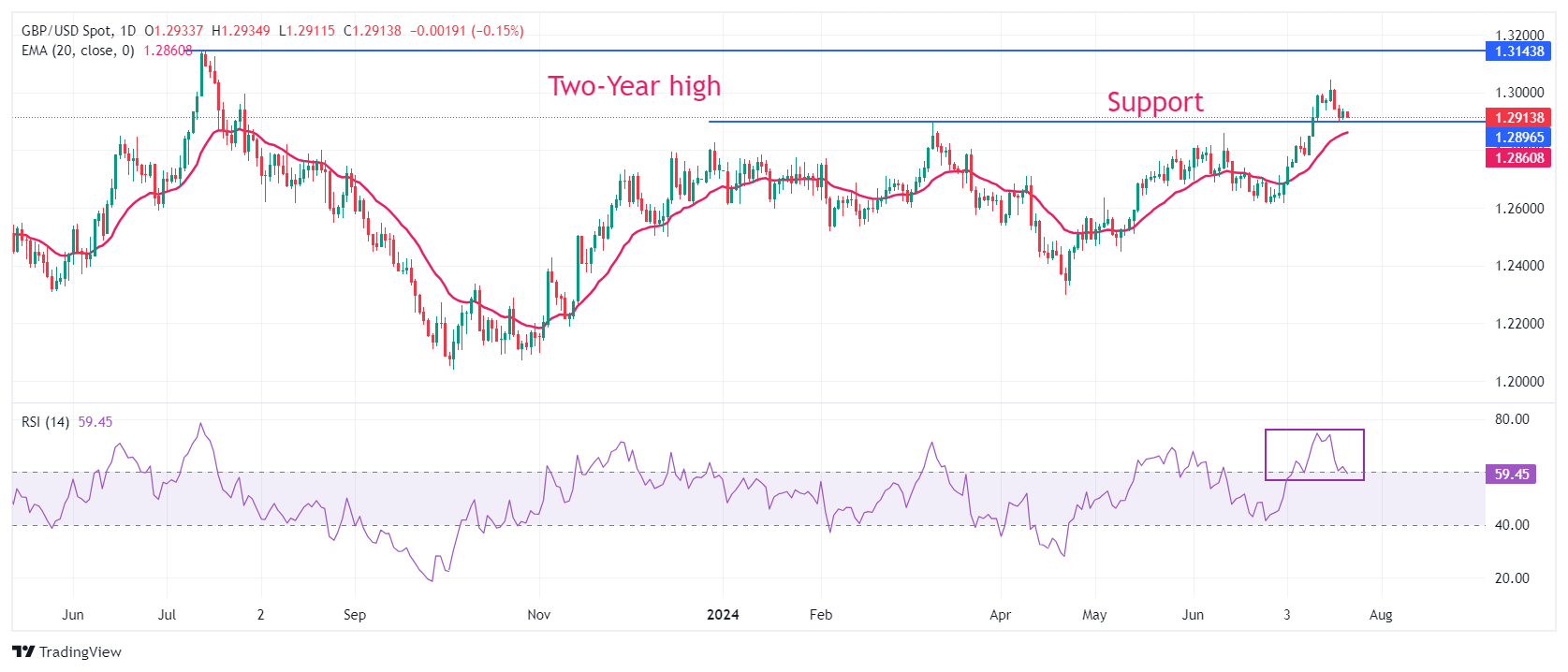
The Pound Sterling oscillates in a tight range above the round-level support of 1.2900 against the US Dollar. The GBP/USD pair weakened after facing a sell-off from a fresh annual high of 1.3044 last Wednesday.
The upward-sloping 20-day Exponential Moving Average (EMA) near 1.2860 suggests that the uptrend is intact. The 14-day Relative Strength Index (RSI) declines after turning slightly overbought and is expected to find a cushion near 60.00.
On the upside, a two-year high near 1.3140 will be a key resistance zone for the Cable. On the other hand, the March 8 high near 1.2900 will be a key support for the Pound Sterling bull.
Pound Sterling FAQs
The Pound Sterling (GBP) is the oldest currency in the world (886 AD) and the official currency of the United Kingdom. It is the fourth most traded unit for foreign exchange (FX) in the world, accounting for 12% of all transactions, averaging $630 billion a day, according to 2022 data. Its key trading pairs are GBP/USD, aka ‘Cable’, which accounts for 11% of FX, GBP/JPY, or the ‘Dragon’ as it is known by traders (3%), and EUR/GBP (2%). The Pound Sterling is issued by the Bank of England (BoE).
The single most important factor influencing the value of the Pound Sterling is monetary policy decided by the Bank of England. The BoE bases its decisions on whether it has achieved its primary goal of “price stability” – a steady inflation rate of around 2%. Its primary tool for achieving this is the adjustment of interest rates. When inflation is too high, the BoE will try to rein it in by raising interest rates, making it more expensive for people and businesses to access credit. This is generally positive for GBP, as higher interest rates make the UK a more attractive place for global investors to park their money. When inflation falls too low it is a sign economic growth is slowing. In this scenario, the BoE will consider lowering interest rates to cheapen credit so businesses will borrow more to invest in growth-generating projects.
Data releases gauge the health of the economy and can impact the value of the Pound Sterling. Indicators such as GDP, Manufacturing and Services PMIs, and employment can all influence the direction of the GBP. A strong economy is good for Sterling. Not only does it attract more foreign investment but it may encourage the BoE to put up interest rates, which will directly strengthen GBP. Otherwise, if economic data is weak, the Pound Sterling is likely to fall.
Another significant data release for the Pound Sterling is the Trade Balance. This indicator measures the difference between what a country earns from its exports and what it spends on imports over a given period. If a country produces highly sought-after exports, its currency will benefit purely from the extra demand created from foreign buyers seeking to purchase these goods. Therefore, a positive net Trade Balance strengthens a currency and vice versa for a negative balance.
Recommended Articles


