


Indian Rupee hits fresh two-week high against US Dollar
- The Indian Rupee rallies further against the US Dollar as the latter continues to underperform.
- Investors doubt whether the Fed will hike interest rates to lower inflation.
- The RBI is expected to keep policy rates steady next week.
The Indian Rupee (INR) extends the week-long rally against the US Dollar (USD) on Friday. The USD/INR pair slides to a fresh over two-week low near 95.30 due to the overnight slump in the US Dollar amid growing doubts regarding whether the Federal Reserve (Fed) is seriously committed to bringing the United States (US) inflation down.
At press time, the US Dollar Index (DXY), which tracks the Greenback’s value against six major currencies, trades 0.27% higher to near 100.23; however, it fell almost 0.9% on Thursday to near 99.86.
Investors doubt Warsh will consider rate hikes to tame inflation
According to analysts at ING, "Looking at the market’s reaction [to the Fed’s press conference], the conclusion was that the Fed was not going to be as tough on fighting inflation as initially thought."
In the policy conference, Fed Chair Kevin Warsh maintained the rhetoric and refused to provide so-called "forward-guidance" on interest rates. However, Warsh said that the central bank will do necessary monetary policy adjustments to combat hot inflation. “Committee remains resolute to deliver price stability, and we will not hesitate to act,” Warsh said.
Elevated oil prices could limit INR’s upside
Oil prices remain higher due to ongoing exchange of attacks between the US and Iran are expected to limit the upside in the Indian Rupee.
The war between both nations is unlikely to pause anytime soon as Iran continues to demand the recognition of its authority on the Strait of Hormuz. Meanwhile, Iran-aligned Houthis’ intentions to monetize the Bab el-Mandeb Strait, a key link between the southern Red Sea and the Gulf of Aden, are also worsening Middle East tensions.
Currencies from economies, such as India, which rely heavily on oil imports to meet their energy needs, tend to underperform in a high oil price environment.
RBI’s policy awaited next week
Going forward, the major trigger for the Indian currency will be the Reserve Bank of India’s monetary policy announcement on August 5.
Analysts at Commerzbank expect the Reserve Bank of India to maintain a steady policy stance at its upcoming meeting, noting that the RBI is “expected to leave the benchmark repurchase rate unchanged at 5.25% at its next meeting on 5 August.” They acknowledge that “inflation risks remain tilted to the upside due to higher global commodity prices and a weaker monsoon season,” but point out that the latest June CPI print “rose 4.4% yoy, which was within RBI's 2-6% target range,” reinforcing the case for policy continuity.
Technical Analysis: USD/INR stabilizes below 20-day EMA
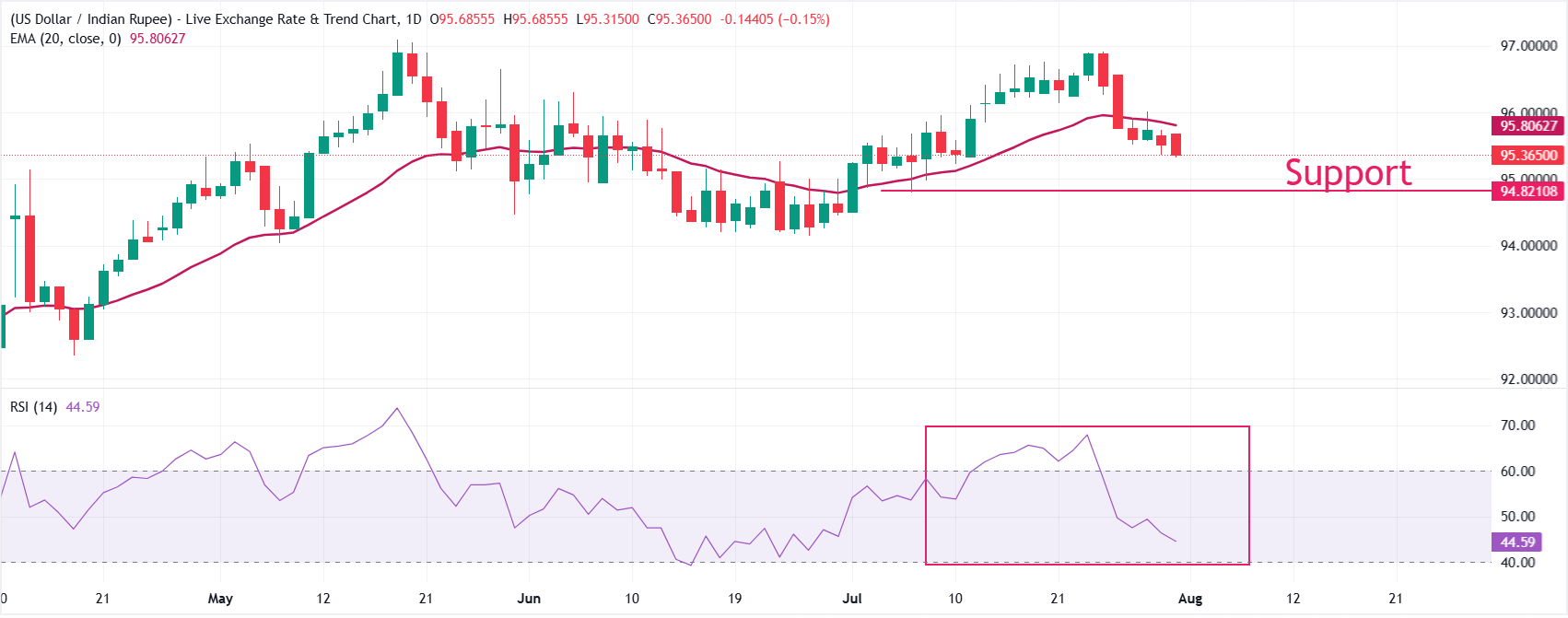
USD/INR extends the decline to near 95.30 on Friday, maintaining a bearish near-term tone as it holds below the 20-day Exponential Moving Average (EMA) at 95.81.
The pair’s inability to reclaim this dynamic resistance suggests rallies remain capped for now, while the Relative Strength Index (RSI) near 44 hints at weakening momentum after the recent advance, reinforcing the risk of further consolidation or downside probes.
On the topside, initial resistance is defined by the 20-day EMA around 95.81, and a daily close above this barrier would be needed to reclaim the 96.00 level. On the downside, the pair is expected to extend the decline toward the July 7 low at 94.80.
(The technical analysis of this story was written with the help of an AI tool. Know more.)
Indian Rupee FAQs
The Indian Rupee (INR) is one of the most sensitive currencies to external factors. The price of Crude Oil (the country is highly dependent on imported Oil), the value of the US Dollar – most trade is conducted in USD – and the level of foreign investment, are all influential. Direct intervention by the Reserve Bank of India (RBI) in FX markets to keep the exchange rate stable, as well as the level of interest rates set by the RBI, are further major influencing factors on the Rupee.
The Reserve Bank of India (RBI) actively intervenes in forex markets to maintain a stable exchange rate, to help facilitate trade. In addition, the RBI tries to maintain the inflation rate at its 4% target by adjusting interest rates. Higher interest rates usually strengthen the Rupee. This is due to the role of the ‘carry trade’ in which investors borrow in countries with lower interest rates so as to place their money in countries’ offering relatively higher interest rates and profit from the difference.
Macroeconomic factors that influence the value of the Rupee include inflation, interest rates, the economic growth rate (GDP), the balance of trade, and inflows from foreign investment. A higher growth rate can lead to more overseas investment, pushing up demand for the Rupee. A less negative balance of trade will eventually lead to a stronger Rupee. Higher interest rates, especially real rates (interest rates less inflation) are also positive for the Rupee. A risk-on environment can lead to greater inflows of Foreign Direct and Indirect Investment (FDI and FII), which also benefit the Rupee.
Higher inflation, particularly, if it is comparatively higher than India’s peers, is generally negative for the currency as it reflects devaluation through oversupply. Inflation also increases the cost of exports, leading to more Rupees being sold to purchase foreign imports, which is Rupee-negative. At the same time, higher inflation usually leads to the Reserve Bank of India (RBI) raising interest rates and this can be positive for the Rupee, due to increased demand from international investors. The opposite effect is true of lower inflation.
Recommended Articles


