


USD/JPY Price Forecast: Likely extend decline below 158.00
- USD/JPY surrenders some of its early gains, but remains positive at around 160.30.
- The US Dollar underperforms due to confusion over the Fed’s policy outlook.
- The BoJ leaves interest rates unchanged at 1%, but retains a hawkish stance.
The US Dollar (USD) gives back some of its early gains against the Japanese Yen (JPY), but is still 0.5% higher at around 160.30 during the European trading session on Friday. The USD/JPY pair performed positively in the opening session after a juggernaut decline the previous day, as the US Dollar rebounded.
The pair fell like a house of cards on Thursday due to weakness in the US Dollar amid ambiguity over the Federal Reserve’s (Fed) monetary policy outlook, and an intervention from Japan to support the Japanese Yen.
In the Fed’s policy announcement on Wednesday, the Fed left interest rates unchanged in the range of 3.50%-3.75%, warned of upside inflation risks, and retained its position on “no forward-looking guidance”.
Yen intervention underscores Japan’s concern over currency weakness
Commerzbank’s analysts note that “the stage was set” for official action, with yesterday’s intervention in the foreign exchange market by Japan’s Ministry of Finance “clearly” demonstrating that the government is worried about the Japanese Yen being “too weak.” They add that explicit “support from the US Treasury Department” signaled the move would “likely be met with a favorable response internationally,” reinforcing the sense that Tokyo’s efforts to stabilize the currency have backing from key international partners.
Meanwhile, the Bank of Japan (BoJ) has left interest rates unchanged at 1%, and has reiterated a hawkish monetary policy guidance, while warning that risks to inflation remain tilted to the upside. BoJ Governor Kazuo Ueda also said in the press conference, “Here is risk that underlying CPI will deviate upward to level above 2% price stability target,” Ueda said.
USD/JPY technical analysis
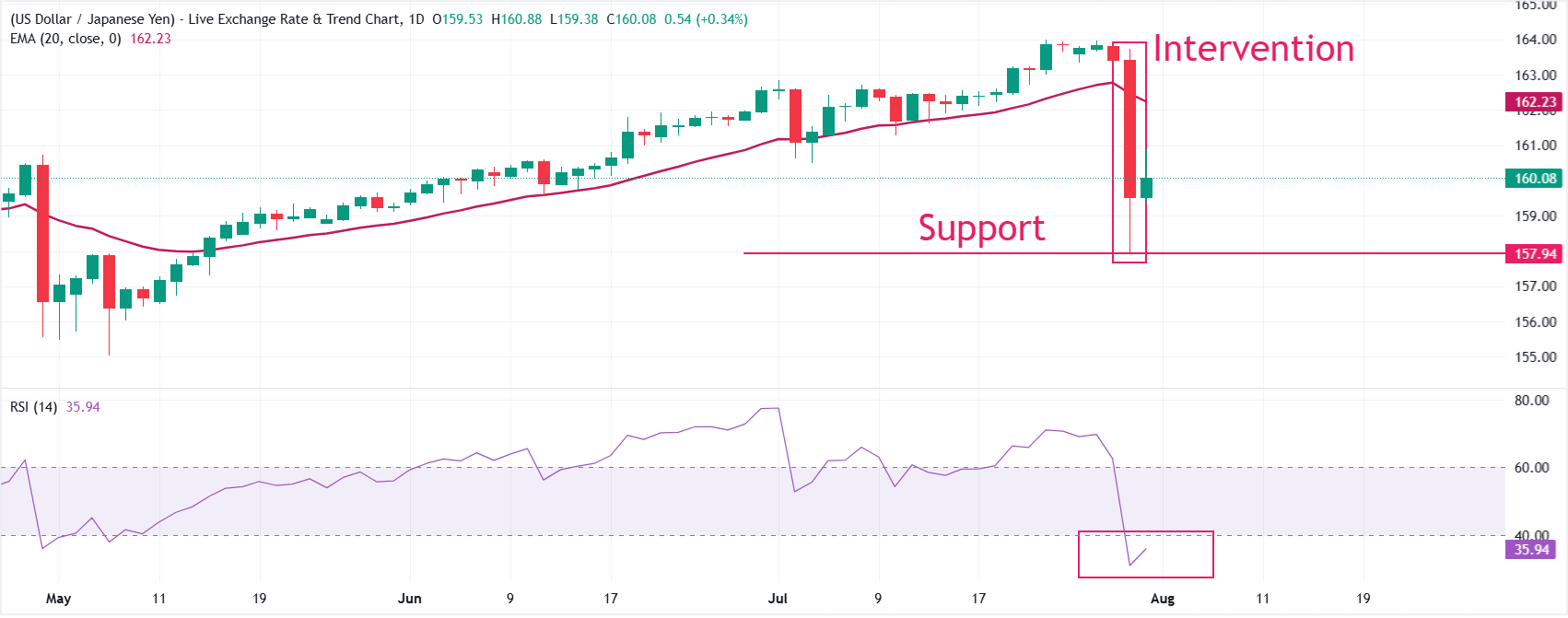
USD/JPY trades higher at around 160.30, but is keeping a bearish near-term tone as spot holds below the 20-period exponential moving average (EMA) at 162.23.
The pair has retreated sharply from recent highs, and the Relative Strength Index (RSI) at 35.94 hovers just above oversold territory, suggesting downside momentum remains in place even if short-term selling pressure is starting to ease.
On the topside, the 20-day EMA at 162.23 stands as immediate resistance and the first pivot that bulls would need to reclaim to alleviate the current downside bias. Looking down, Thursday's low at 158.00 is the key support level; a break below the same would expose it to 157.00.
(The technical analysis of this story was written with the help of an AI tool. Know more.)
Bank of Japan FAQs
The Bank of Japan (BoJ) is the Japanese central bank, which sets monetary policy in the country. Its mandate is to issue banknotes and carry out currency and monetary control to ensure price stability, which means an inflation target of around 2%.
The Bank of Japan embarked in an ultra-loose monetary policy in 2013 in order to stimulate the economy and fuel inflation amid a low-inflationary environment. The bank’s policy is based on Quantitative and Qualitative Easing (QQE), or printing notes to buy assets such as government or corporate bonds to provide liquidity. In 2016, the bank doubled down on its strategy and further loosened policy by first introducing negative interest rates and then directly controlling the yield of its 10-year government bonds. In March 2024, the BoJ lifted interest rates, effectively retreating from the ultra-loose monetary policy stance.
The Bank’s massive stimulus caused the Yen to depreciate against its main currency peers. This process exacerbated in 2022 and 2023 due to an increasing policy divergence between the Bank of Japan and other main central banks, which opted to increase interest rates sharply to fight decades-high levels of inflation. The BoJ’s policy led to a widening differential with other currencies, dragging down the value of the Yen. This trend partly reversed in 2024, when the BoJ decided to abandon its ultra-loose policy stance.
A weaker Yen and the spike in global energy prices led to an increase in Japanese inflation, which exceeded the BoJ’s 2% target. The prospect of rising salaries in the country – a key element fuelling inflation – also contributed to the move.
Recommended Articles


