


Swiss Franc's rebound runs on empty
- USD/CHF ticked higher again on Tuesday, with the Swiss side of the calendar completely empty.
- The Franc's rebound off its 14-year low has been grudging, and haven demand keeps fading.
- The SNB sits pinned at zero and ready to intervene, capping Franc strength from above.
There is a certain honesty to a currency with nothing to say for itself, and the Swiss Franc spent Tuesday doing exactly that. With not one Swiss data release on the calendar this week, the Franc has no story of its own, leaving USD/CHF to drift on whatever the Dollar side of the tape serves up. The pair ground fractionally higher, extending a 2026 recovery off April's 14-year low near 0.7750 that has been shallow and wholly borrowed from abroad.
Borrowed direction from the Fed
The only real pulse in USD/CHF this week comes from across the Atlantic. The Federal Reserve (Fed) has spent a month convincing markets it is likelier to hike than cut: June's hold was a fourth straight, but the projections dropped the old easing bias and left half the committee pencilling in a 2026 hike, keeping the Dollar firm.
The awkward part for Dollar bulls is that the data has begun to undercut the rhetoric. Softer US labour readings have trimmed the odds of another hike, and CME FedWatch now prices the July 29 meeting as a hold with better than seven-in-ten confidence, up from nearer three-in-five a fortnight ago. Fed speakers dot the week, tested against a cooling jobs picture.
A haven that keeps leaking
Whatever the Franc cannot earn from Swiss fundamentals it usually collects in a crisis, and here too the picture has turned. The safe-haven premium that poured in during the Middle East conflict has drained since the guns fell quiet, leaving the Franc close to five percent weaker than before the fighting. Renewed regional flare-ups buy only a brief bid that fades fast.
More damaging is that when investors did reach for shelter this year, they bought Dollars, not Francs. The Fed's hawkish tilt handed the Dollar a yield edge the Franc, stuck at a zero policy rate, cannot match, and a haven paying nothing loses to one paying three and a half percent. The Franc's reputation is intact; its monopoly is not.
The SNB's thumb on the scale
Standing over all of this is a central bank that would rather the Franc did not rally at all. The Swiss National Bank (SNB) has held at zero for a fourth straight meeting and says plainly it will sell Francs whenever the currency threatens to appreciate too far, guidance traders ignore at their peril. With Swiss Consumer Price Index (CPI) inflation down to 0.5% in June and the International Monetary Fund (IMF) flagging eventual rate cuts, nothing domestic pushes the other way.
The result is a Franc squeezed from both sides: nothing in the data lets it strengthen, and the moment it tries, the SNB leans against it. For USD/CHF the downside is quietly defended even when the Dollar goes nowhere, which is much of why the pair keeps drifting higher on days when nothing should be happening.
What the minutes might stir
The one scheduled event with the power to move USD/CHF this week is not Swiss at all. The minutes of the June Federal Open Market Committee (FOMC) meeting land Wednesday at 18:00 GMT, and with the hawkish turn sitting awkwardly against softer jobs data, traders will read them for how real the appetite for a 2026 hike is. A hawkish record lifts the Dollar and presses the Franc lower; a softer one takes the pressure off. US jobless claims Thursday are the only other release worth watching.
Levels to watch
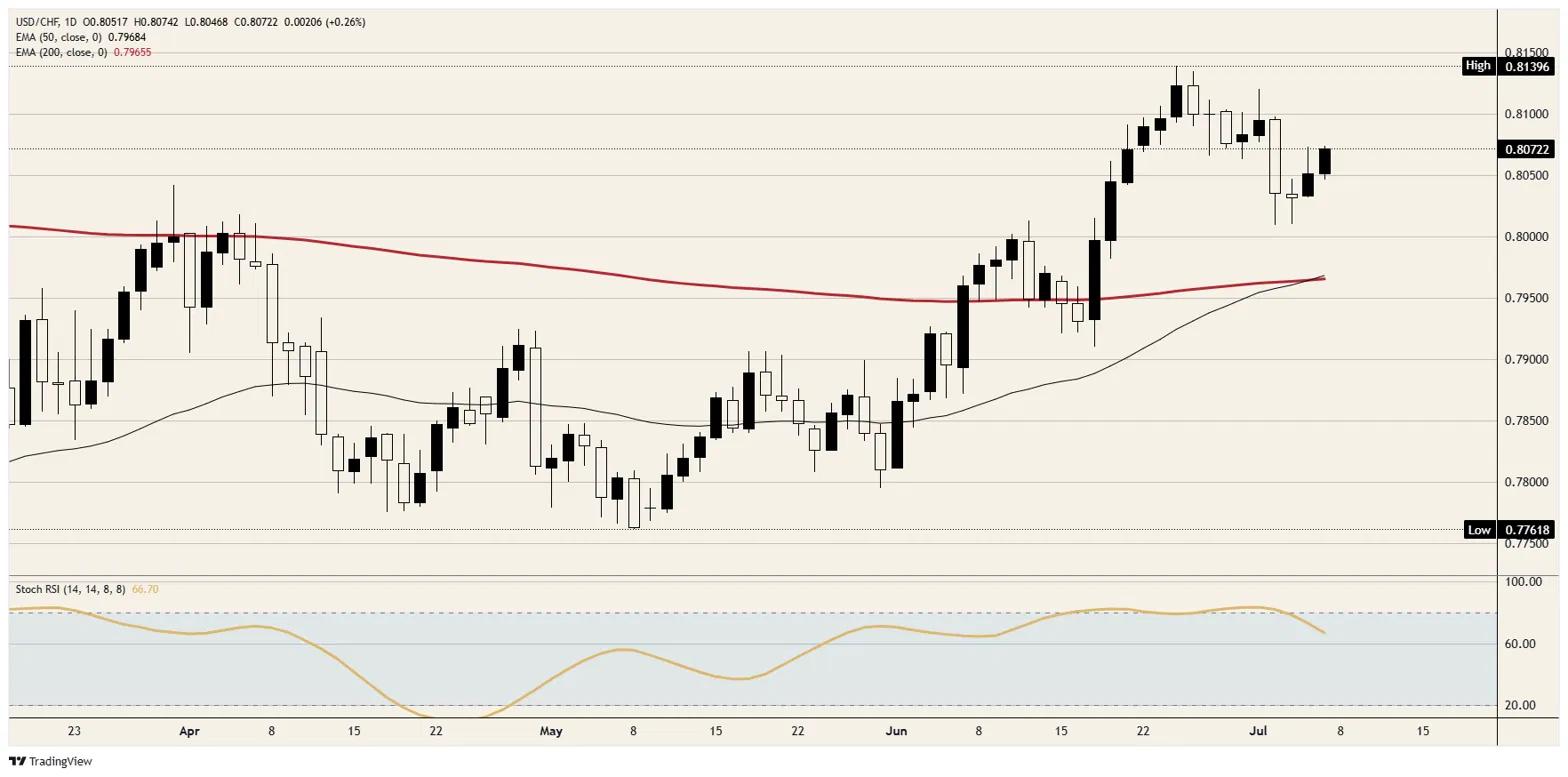
Resistance: The 0.8100 handle is the first hurdle, where the pair has stalled repeatedly through late June and again this week. Above it, the June high near 0.8150 caps the entire 2026 recovery, and a close through there is the first real sign the Franc's grudging slide has further to run.
Support: The 0.8050 area is the nearest floor, with the 0.8000 handle the more important shelf below. The rising 50-day and 200-day Exponential Moving Averages (EMA) now sit stacked just under 0.8000, the line between a shallow pullback and a genuine Franc recovery.
Bias: The path of least resistance stays higher, if grudgingly, with a hawkish Fed and a central bank defending the Franc's downside both arguing for USD/CHF to grind toward 0.8100 while it holds 0.8000. An intraday Stochastic Relative Strength Index (Stoch RSI) already overbought argues the next leg waits for a shallow dip, and a decisive break below 0.8000, most likely on a haven scare or dovish minutes, would mark the Franc finally finding a reason of its own to rally.
USD/CHF daily chart
Swiss Franc FAQs
The Swiss Franc (CHF) is Switzerland’s official currency. It is among the top ten most traded currencies globally, reaching volumes that well exceed the size of the Swiss economy. Its value is determined by the broad market sentiment, the country’s economic health or action taken by the Swiss National Bank (SNB), among other factors. Between 2011 and 2015, the Swiss Franc was pegged to the Euro (EUR). The peg was abruptly removed, resulting in a more than 20% increase in the Franc’s value, causing a turmoil in markets. Even though the peg isn’t in force anymore, CHF fortunes tend to be highly correlated with the Euro ones due to the high dependency of the Swiss economy on the neighboring Eurozone.
The Swiss Franc (CHF) is considered a safe-haven asset, or a currency that investors tend to buy in times of market stress. This is due to the perceived status of Switzerland in the world: a stable economy, a strong export sector, big central bank reserves or a longstanding political stance towards neutrality in global conflicts make the country’s currency a good choice for investors fleeing from risks. Turbulent times are likely to strengthen CHF value against other currencies that are seen as more risky to invest in.
The Swiss National Bank (SNB) meets four times a year – once every quarter, less than other major central banks – to decide on monetary policy. The bank aims for an annual inflation rate of less than 2%. When inflation is above target or forecasted to be above target in the foreseeable future, the bank will attempt to tame price growth by raising its policy rate. Higher interest rates are generally positive for the Swiss Franc (CHF) as they lead to higher yields, making the country a more attractive place for investors. On the contrary, lower interest rates tend to weaken CHF.
Macroeconomic data releases in Switzerland are key to assessing the state of the economy and can impact the Swiss Franc’s (CHF) valuation. The Swiss economy is broadly stable, but any sudden change in economic growth, inflation, current account or the central bank’s currency reserves have the potential to trigger moves in CHF. Generally, high economic growth, low unemployment and high confidence are good for CHF. Conversely, if economic data points to weakening momentum, CHF is likely to depreciate.
As a small and open economy, Switzerland is heavily dependent on the health of the neighboring Eurozone economies. The broader European Union is Switzerland’s main economic partner and a key political ally, so macroeconomic and monetary policy stability in the Eurozone is essential for Switzerland and, thus, for the Swiss Franc (CHF). With such dependency, some models suggest that the correlation between the fortunes of the Euro (EUR) and the CHF is more than 90%, or close to perfect.
Recommended Articles


