


WTI Crude Oil Price Forecast: OPEC Production Increase Combined With Hormuz Strait Navigation May Drag Prices Down to $60.

 Trending Articles
- Gold Price Forecast: US Non-Farm Payrolls Miss Expectations, Gold Surges Over $100, Can the Bull Run Continue?
- Iran insists on control of Hormuz amid reports of US talks
- Gold gains momentum above $4,100 after weak US NFP data
- June Non-Farm Payrolls Preview: Did White House Economic Advisor Give an Early Hint? How Will US Stocks, Dollar and Gold React?
- WTI slips below $68.00 as supply concerns ease
- Bitcoin Price Trend Forecast: Continued ETF Outflows Limit Bitcoin Price Rebound Space, $58,000 Becomes Key Level for Bulls and Bears

TradingKey - As of the Asian session on July 6, WTI ( USOIL) crude oil prices extended last Friday's rebound during intraday trading, peaking at $69.26 before consolidating around $68.60. From a technical perspective, oil prices have recovered after falling to a near four-month low, but the strength of the rebound remains limited. This is primarily due to the ongoing transit through the Strait of Hormuz and OPEC's production increase measures.
Oil prices suppressed by resumption of shipping in Strait of Hormuz and OPEC+ production hikes, but Middle East risks have not fully dissipated
From a fundamental perspective, WTI crude oil prices rebounded before paring gains today. The core reason is that while short-term prices rebounded due to previous oversold conditions and some Middle East uncertainties, the medium-term supply side is releasing more bearish signals.
First, the gradual recovery of transit through the Strait of Hormuz is a key factor suppressing the upward movement of oil prices. Previously, conflicts involving the U.S., Israel, and Iran briefly led to increased shipping risks in the Gulf, causing some tankers to reroute or delay transit through critical waterways, which drove up the oil price risk premium on fears of disrupted Middle East crude exports. However, the latest updates indicate that while some tankers still took unusual detours on Saturday, the main shipping lanes of the Strait of Hormuz had returned to near-normal by Sunday.
For WTI, the restoration of transit through the Strait of Hormuz directly eroded the geopolitical risk premium. Previously, oil prices were able to find some support at lower levels primarily due to market concerns over Middle East supply disruptions. Once the critical transport corridor recovered, traders shifted their focus back to actual supply and demand rather than continuing to bet on a war premium.
Second, the latest OPEC+ decision to increase output has further heightened oversupply concerns. OPEC+ has approved a production hike of 188,000 barrels per day for next month, driven mainly by Saudi Arabia and Russia.
In addition, the potential return of Iranian exports is putting further pressure on oil prices. The latest reports indicate that Iran has begun discussions with Japanese companies to resume crude oil sales under a temporary U.S. sanctions waiver framework. The waiver is valid for 60 days and will run until August 21. If Japanese buyers ultimately resume purchasing Iranian crude, it would mark a significant shift since 2019 and suggest that Iranian crude could reopen parts of the Asian market outside of China.
WTI Crude Oil Price Analysis: $70 Marks Key Resistance for Bulls, Downside Target Eyes $60
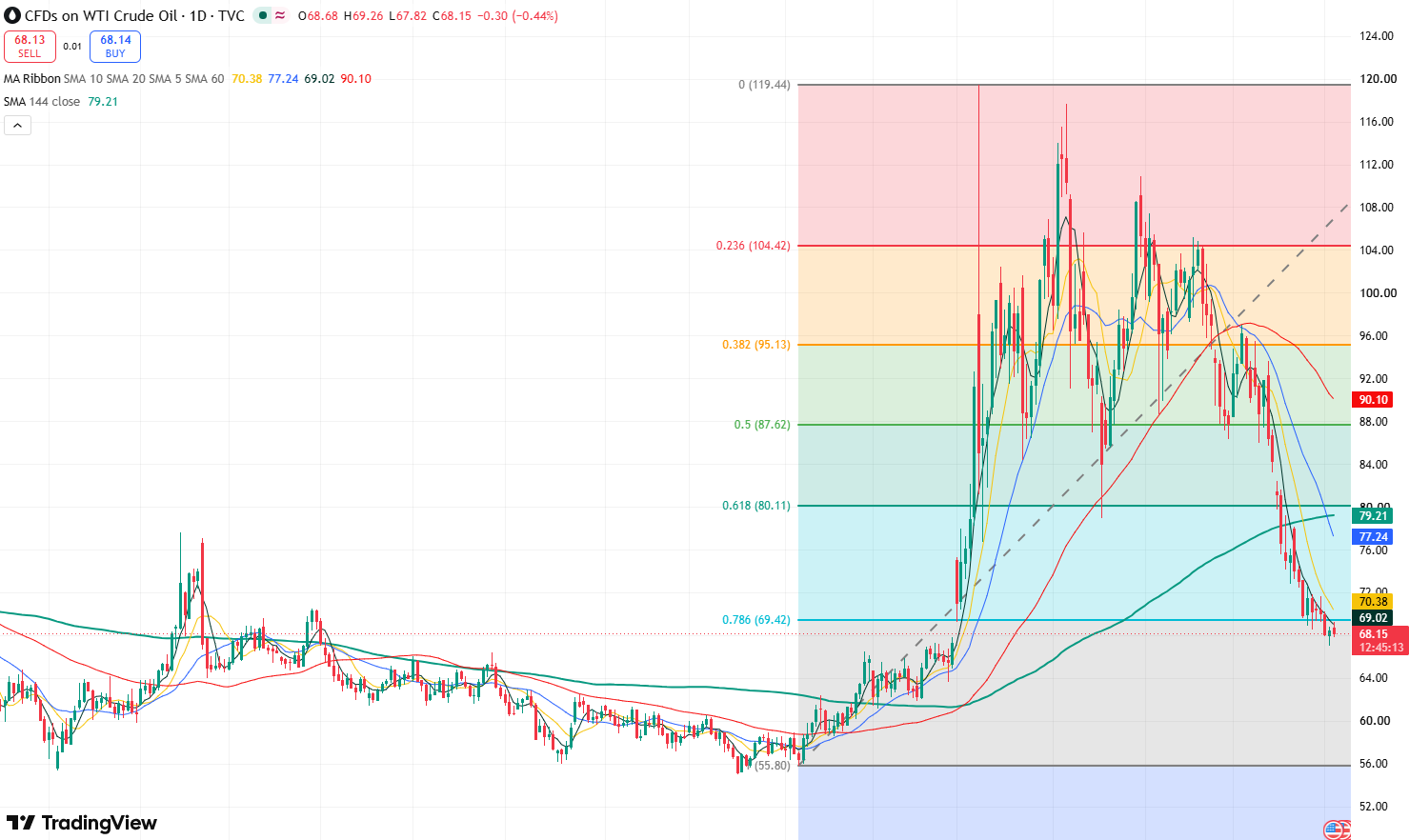
WTI crude oil daily chart, Source: TradingView
Looking at the daily chart of WTI crude oil, although today's oil price continued last week's rebound at the open and briefly surged above $69 during the session, it fell back to around $68 intraday. This indicates heavy upward pressure on market bulls, with market sentiment leaning more towards the bears. Meanwhile, the recent K-line movement of oil prices has remained below the 5-day Simple Moving Average (SMA5), further proving that market sentiment is tilted to the bearish side.
Currently, as oil prices have broken below the $70 psychological level and the Fibonacci 0.786 retracement level of $69.40, the downside space for oil prices has opened up further. The primary target will be to test the $60 psychological level on the downside. If oil prices fail to hold $60, they will fall further toward the Fibonacci 1.0 retracement level near $56.
On the upside, key resistance levels above to watch are $69.40-$70. Only if oil prices can establish a firm foothold above $70 will the upside space be opened, with the potential to test $73 on the upside, and further up, watch $78.
Read more
* The content presented above, whether from a third party or not, is considered as general advice only. This article should not be construed as containing investment advice, investment recommendations, an offer of or solicitation for any transactions in financial instruments.


