

AUD/USD Price Forecast: Finds support below 61.8% Fibo retracement at 0.7000

Source Fxstreet
  • AUD/USD rises to near 0.7007 as the US Dollar faces slight selling pressure.
  • The US CPI cools down on a monthly basis, but rose expectedly on an annualized basis in May.
  • Investors await the RBA’s monetary policy announcement on Tuesday.

The AUD/USD pair trades 0.14% higher to near 0.7007 during the European trading session on Thursday. The Aussie pair gains as the US Dollar (USD) ticks lower after the release of the softer monthly United States (US) Consumer Price Index (CPI) data for May.

As of writing, the US Dollar Index (DXY), which tracks the Greenback’s value against six major currencies, trades 0.1% lower to near 99.97.

On Wednesday, the US monthly headline CPI arrived lower at 0.5%, as expected, against the previous reading of 0.6%. Month-on-month core CPI – which excludes volatile food and energy items – growth cooled down to 0.2% from the previous reading of 0.4%. Meanwhile, Year-on-Year (YoY) headline and core CPI accelerated to 4.2% and 2.9%, as expected.

However, the broader outlook of the US Dollar appears to be firm as the next monetary policy adjustment by the Federal Reserve (Fed) appears to be on the upside. According to the CME FedWatch tool, the odds of the Fed delivering at least one interest rate hike this year are almost 71%.

On the Aussie front, investors await the Reserve Bank of Australia’s (RBA) monetary policy announcement on Tuesday, in which it is expected to leave interest rates unchanged.

AUD/USD technical analysis
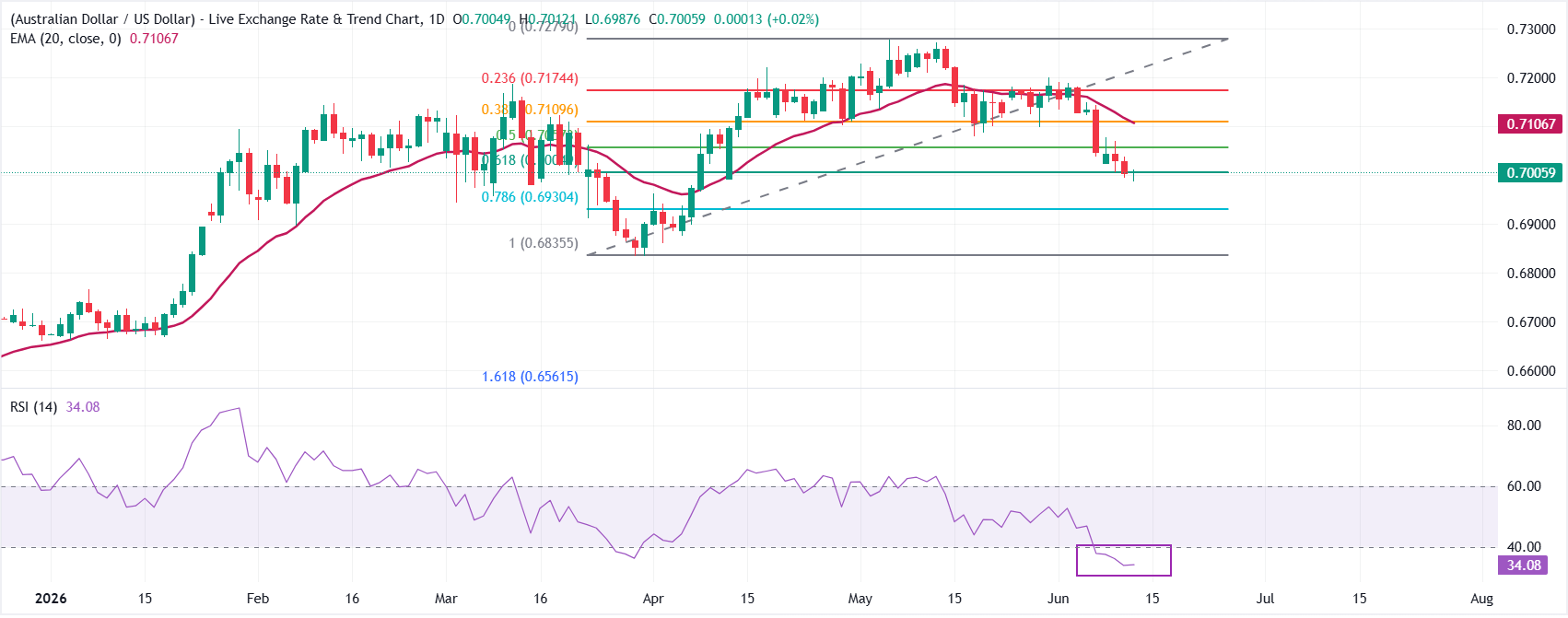
AUD/USD trades marginally higher at around 0.7007 at press time. However, the pair maintains a bearish near-term tone as spot holds beneath the 20-day exponential moving average (EMA) at 0.7107 and a dense Fibonacci resistance band starting at the 50.0% retracement around 0.7057.

The Relative Strength Index (14) hovers near 34, indicating persistent downside pressure but not yet extreme oversold, which suggests sellers remain in control while leaving room for further losses before a more meaningful corrective bounce.

On the downside, immediate support aligns with the 61.8% Fibonacci retracement at 0.7005, a break of which would expose the 78.6% level at 0.6930 ahead of the prior swing low area marked by the 100.0% retracement at 0.6836. On the topside, initial resistance is seen at the 50.0% retracement near 0.7057, followed by a tight cluster formed by the 20-day EMA at 0.7107 and the 38.2% retracement at 0.7110, with further recovery attempts likely capped while the pair trades below the 23.6% retracement at 0.7174.

(The technical analysis of this story was written with the help of an AI tool.)

Economic Indicator

RBA Interest Rate Decision

The Reserve Bank of Australia (RBA) announces its interest rate decision at the end of its eight scheduled meetings per year. If the RBA is hawkish about the inflationary outlook of the economy and raises interest rates it is usually bullish for the Australian Dollar (AUD). Likewise, if the RBA has a dovish view on the Australian economy and keeps interest rates unchanged, or cuts them, it is seen as bearish for AUD.

Read more.

Next release: Tue Jun 16, 2026 04:30

Frequency: Irregular

Consensus: -

Previous: 4.35%

Source: Reserve Bank of Australia

Disclaimer: For information purposes only. Past performance is not indicative of future results.
placeholder
Natural Gas sinks to pivotal level as China’s demand slumpsNatural Gas price (XNG/USD) edges lower and sinks to $2.56 on Monday, extending its losing streak for the fifth day in a row. The move comes on the back of China cutting its Liquified Natural Gas (LNG) imports after prices rose above $3.0 in June. It
Author  FXStreet
Jul 01, 2024
Natural Gas price (XNG/USD) edges lower and sinks to $2.56 on Monday, extending its losing streak for the fifth day in a row. The move comes on the back of China cutting its Liquified Natural Gas (LNG) imports after prices rose above $3.0 in June. It
placeholder
Bitcoin briefly loses 2025 gains as crypto plunges over the weekend.Bitcoin experienced a sharp decline this weekend, briefly erasing its 2025 gains and dipping below its year-opening value of $93,507. The cryptocurrency fell to a low of $93,029 on Sunday, representing a 25% drop from its all-time high in October. Although it has rebounded slightly to around $94,209, the pressures on the market remain significant. The downturn occurred despite the reopening of the U.S. government on Thursday, which many had hoped would provide essential support for crypto markets. This year initially appeared promising for cryptocurrencies, particularly after the inauguration of President Donald Trump, who has established the most pro-crypto administration thus far. However, ongoing political tensions—including Trump's tariff strategies and the recent government shutdown, lasting a historic 43 days—have contributed to several rapid price pullbacks for Bitcoin throughout the year. Market dynamics are also being influenced by Bitcoin whales—investors holding large amounts of Bitcoin—who have been offloading portions of their assets, consequently stalling price rallies even as positive regulatory developments emerge. Despite these sell-offs, analysts from Glassnode argue that this behavior aligns with typical patterns seen among long-term investors during the concluding stages of bull markets, suggesting it is not indicative of a mass exodus. Notably, Bitcoin is not alone in its struggles, as Ethereum and Solana have also recorded declines of 7.95% and 28.3%, respectively, since the start of the year, while numerous altcoins have faced even steeper losses. Looking ahead, questions linger regarding the viability of the four-year cycle thesis, particularly given the increasing institutional support and regulatory frameworks now in place in the crypto landscape. Matt Hougan, chief investment officer at Bitwise, remains optimistic, suggesting a potential Bitcoin resurgence in 2026 driven by the “debasement trade” thesis and a broader trend toward increased adoption of stablecoins, tokenization, and decentralized finance. Hougan emphasized the soundness of the underlying fundamentals, pointing to a positive outlook for the sector in the longer term.
Author  Mitrade
Nov 17, 2025
Bitcoin experienced a sharp decline this weekend, briefly erasing its 2025 gains and dipping below its year-opening value of $93,507. The cryptocurrency fell to a low of $93,029 on Sunday, representing a 25% drop from its all-time high in October. Although it has rebounded slightly to around $94,209, the pressures on the market remain significant. The downturn occurred despite the reopening of the U.S. government on Thursday, which many had hoped would provide essential support for crypto markets. This year initially appeared promising for cryptocurrencies, particularly after the inauguration of President Donald Trump, who has established the most pro-crypto administration thus far. However, ongoing political tensions—including Trump's tariff strategies and the recent government shutdown, lasting a historic 43 days—have contributed to several rapid price pullbacks for Bitcoin throughout the year. Market dynamics are also being influenced by Bitcoin whales—investors holding large amounts of Bitcoin—who have been offloading portions of their assets, consequently stalling price rallies even as positive regulatory developments emerge. Despite these sell-offs, analysts from Glassnode argue that this behavior aligns with typical patterns seen among long-term investors during the concluding stages of bull markets, suggesting it is not indicative of a mass exodus. Notably, Bitcoin is not alone in its struggles, as Ethereum and Solana have also recorded declines of 7.95% and 28.3%, respectively, since the start of the year, while numerous altcoins have faced even steeper losses. Looking ahead, questions linger regarding the viability of the four-year cycle thesis, particularly given the increasing institutional support and regulatory frameworks now in place in the crypto landscape. Matt Hougan, chief investment officer at Bitwise, remains optimistic, suggesting a potential Bitcoin resurgence in 2026 driven by the “debasement trade” thesis and a broader trend toward increased adoption of stablecoins, tokenization, and decentralized finance. Hougan emphasized the soundness of the underlying fundamentals, pointing to a positive outlook for the sector in the longer term.
placeholder
When is the BoJ rate decision and how could it affect USD/JPY?The Bank of Japan (BoJ) will announce its interest rate decision between 03.30 and 05.00 GMT, followed by Governor Kazuo Ueda's press conference at 06.30 GMT.
Author  FXStreet
Dec 19, 2025
The Bank of Japan (BoJ) will announce its interest rate decision between 03.30 and 05.00 GMT, followed by Governor Kazuo Ueda's press conference at 06.30 GMT.
placeholder
ECB Policy Outlook for 2026: What It Could Mean for the Euro’s Next MoveWith the ECB likely holding rates steady at 2.15% and the Fed potentially extending cuts into 2026, EUR/USD may test 1.20 if Eurozone growth proves resilient, but weaker growth and an ECB pivot could pull the pair back toward 1.13 and potentially 1.10.
Author  Mitrade
Dec 26, 2025
With the ECB likely holding rates steady at 2.15% and the Fed potentially extending cuts into 2026, EUR/USD may test 1.20 if Eurozone growth proves resilient, but weaker growth and an ECB pivot could pull the pair back toward 1.13 and potentially 1.10.
placeholder
Gold Price Forecast: Oil Price Breaking $100 Fuels Inflation Concerns, Will Gold Prices Fall Further?As of the Asian session on July 24, gold prices ( XAUUSD) fell continuously during intraday trading, briefly approaching the $4,000 mark. Looking at the chart, gold prices rebounded this
Author  TradingKey
Jul 24, Fri
As of the Asian session on July 24, gold prices ( XAUUSD) fell continuously during intraday trading, briefly approaching the $4,000 mark. Looking at the chart, gold prices rebounded this
Related Instrument
goTop
quote