


GBP/USD surges toward 1.3400 as Iran ceasefire deflates the US Dollar
- GBP/USD jumped to a session high near 1.3400 after Trump announced a two-week suspension of military operations against Iran.
- UK services PMI was revised sharply lower to 50.5, the weakest reading in eleven months, as the war in the Middle East crushed business optimism.
- The Bank of England (BoE) meets on April 30 with rate expectations in flux, markets had been pricing hikes before the ceasefire shifted the calculus.
- FOMC Minutes, Core Personal Consumption Expenditures (PCE), and US Consumer Price Index (CPI) data all land this week and could dictate the next leg.
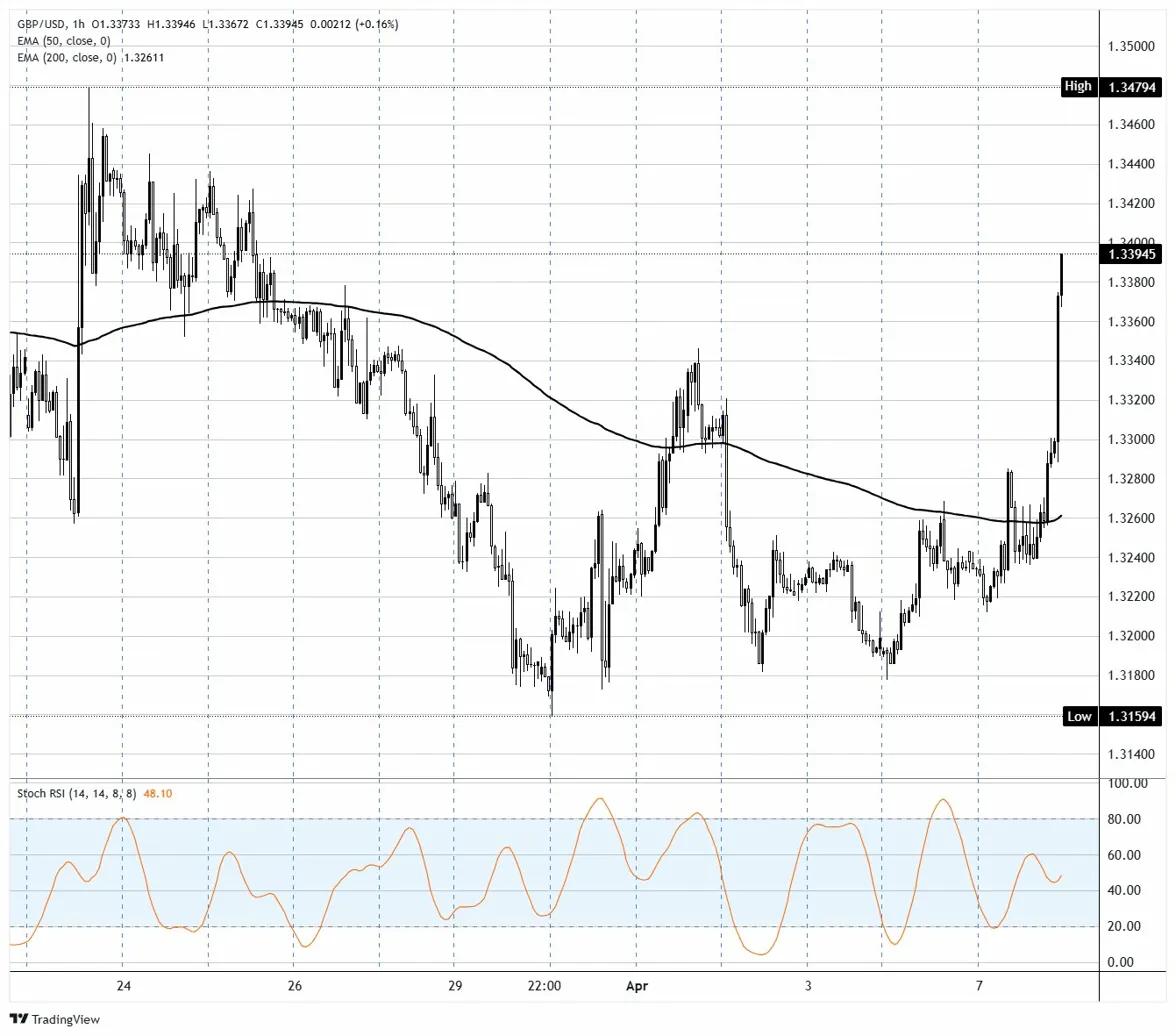
GBP/USD ripped higher on Tuesday as the US Dollar buckled under a wave of risk-on positioning triggered by President Trump's announcement of a two-week ceasefire with Iran. The pair surged from the low 1.3200s into the upper 1.3300s, reclaiming ground above both the 50 and 200-period hourly moving averages in the process.
The move was almost entirely a Dollar story. WTI Crude Oil cratered from above $106 to below $90 per barrel as traders, who had already been fading Trump's deadline rhetoric throughout the session, piled into the selloff once the Truth Social post confirmed the pause. S&P 500 futures jumped over 1%, and the US Dollar Index (DXY) slid back toward 100.00 as the haven bid that had propped up the Greenback for weeks started to unwind.
Can the Pound actually hold these levels?
That is the uncomfortable question. Sterling's rally on Tuesday was a function of Dollar weakness, not Pound strength. The UK's own fundamentals look increasingly fragile. Final March services Purchasing Managers Index (PMI) data released earlier on Tuesday came in at 50.5, revised down from a flash estimate of 51.2 and a sharp drop from February's 53.9. The composite reading fell to 50.3. S&P Global flagged the slowest services expansion in eleven months, with new work declining for the first time since November 2025 and input cost inflation hitting an eleven-month high on surging fuel and transportation bills.
In short, the UK is flashing stagflation signals. Growth is stalling while costs are accelerating, and the Middle East conflict is the primary driver of both trends.
The BoE's impossible trade-off just got more complicated
The BoE has held rates at 3.75% since December 2025, voting unanimously to stay put at the March meeting. Before the Iran war erupted, markets were pricing two to three cuts in 2026. That expectation was obliterated by the energy shock. By late March, swaps markets had flipped to pricing four quarter-point hikes by year-end, reflecting the passthrough of surging Oil and gas prices into UK inflation.
Tuesday's ceasefire throws a wrench into that repricing. If the pause holds and Oil continues to slide, the inflationary impulse weakens and the BoE gets room to resume easing. JP Morgan's Allan Monks had flagged the April 30 meeting as the natural window for a hike if inflation continued to be validated by incoming data, but a sustained drop in energy prices would undercut that thesis. ING's James Smith had already noted that rapid de-escalation could bring the next cut forward to April.
The problem is that this is Trump's fourth deadline extension. Markets sold Oil aggressively on each of the prior three pauses, only to buy it all back when diplomacy collapsed. Iran publicly rejected the temporary ceasefire just hours before Trump's announcement and has been demanding a permanent end to hostilities plus sanctions relief. The gap between the two sides remains wide, and Polymarket odds as of Monday put the probability of a lasting ceasefire by end of April at just 22.5%.
What to watch this week
Wednesday brings the Federal Open Market Committee (FOMC) Minutes from the March meeting (18:00 GMT), along with remarks from Fed officials Daly and Waller. Traders will be parsing the minutes for any discussion of how the Iran conflict is shaping the Federal Reserve's (Fed) inflation outlook. Thursday delivers Core PCE for February (12:30 GMT), the Fed's preferred inflation gauge, alongside Gross Domestic Product (GDP) revisions and initial jobless claims. Friday is the big one: March CPI lands at 12:30 GMT with consensus at 3.3% YoY, down from the prior 2.4% reading. Core CPI is expected at 2.7% YoY versus 2.5% prior.
On the UK side, Halifax House Prices and the construction PMI on Wednesday, followed by the BoE Credit Conditions Survey on Thursday, will offer a read on how the domestic economy is absorbing the energy shock. The RICS Housing Price Balance is also due Wednesday night, with consensus at -18% suggesting continued pressure on the property market.
The technical picture
GBP/USD is trading near 1.3400 after Tuesday's surge, reclaiming territory it last held in late March. The pair is well above the 200-period EMA at 1.3261 and the Stochastic RSI has room to run before hitting overbought territory. Resistance sits at the recent swing high near 1.3480, while a failure to hold above 1.3300 would suggest the ceasefire rally is fading. The broader range since late March has been defined by the 1.3160 low and the 1.3480 high, and which side breaks first will likely depend on whether this two-week pause produces anything different from the last four.
The bottom line
GBP/USD is riding a ceasefire wave, but the pair is caught between a weakening Dollar and a UK economy that is barely growing. If this pause collapses like the others, the haven bid returns, Oil spikes, and the pair gives back Tuesday's gains in a hurry. If it holds, the BoE gets breathing room, the energy premium unwinds further, and Cable has a genuine shot at retesting 1.3480 and beyond. The next 48 hours of data, starting with the FOMC Minutes and ending with CPI, will tell traders whether the macro backdrop supports a sustained move or whether this is just another head-fake in the ceasefire cycle.
GBP/USD 1-hour chart
Pound Sterling FAQs
The Pound Sterling (GBP) is the oldest currency in the world (886 AD) and the official currency of the United Kingdom. It is the fourth most traded unit for foreign exchange (FX) in the world, accounting for 12% of all transactions, averaging $630 billion a day, according to 2022 data. Its key trading pairs are GBP/USD, also known as ‘Cable’, which accounts for 11% of FX, GBP/JPY, or the ‘Dragon’ as it is known by traders (3%), and EUR/GBP (2%). The Pound Sterling is issued by the Bank of England (BoE).
The single most important factor influencing the value of the Pound Sterling is monetary policy decided by the Bank of England. The BoE bases its decisions on whether it has achieved its primary goal of “price stability” – a steady inflation rate of around 2%. Its primary tool for achieving this is the adjustment of interest rates. When inflation is too high, the BoE will try to rein it in by raising interest rates, making it more expensive for people and businesses to access credit. This is generally positive for GBP, as higher interest rates make the UK a more attractive place for global investors to park their money. When inflation falls too low it is a sign economic growth is slowing. In this scenario, the BoE will consider lowering interest rates to cheapen credit so businesses will borrow more to invest in growth-generating projects.
Data releases gauge the health of the economy and can impact the value of the Pound Sterling. Indicators such as GDP, Manufacturing and Services PMIs, and employment can all influence the direction of the GBP. A strong economy is good for Sterling. Not only does it attract more foreign investment but it may encourage the BoE to put up interest rates, which will directly strengthen GBP. Otherwise, if economic data is weak, the Pound Sterling is likely to fall.
Another significant data release for the Pound Sterling is the Trade Balance. This indicator measures the difference between what a country earns from its exports and what it spends on imports over a given period. If a country produces highly sought-after exports, its currency will benefit purely from the extra demand created from foreign buyers seeking to purchase these goods. Therefore, a positive net Trade Balance strengthens a currency and vice versa for a negative balance.
Recommended Articles


