


Australian Dollar remains subdued following RBA Bullock’s comments
- Australian Dollar remains weaker after RBA Governor Bullock cited tighter-than-expected capacity constraints behind the OCR hike.
- Markets see a chance of a May hike and price roughly 40 basis points of further tightening this year.
- The US Dollar may rebound as markets price a slower pace of potential Fed rate cuts.
The Australian Dollar (AUD) extends its losses for the third successive session against the US Dollar (USD) on Friday following the Reserve Bank of Australia (RBA) Governor Michele Bullock’s comments, saying that the board lifted the Official Cash Rate (OCR) because the economy is more capacity constrained than previously judged, meaning policy needed to be tighter. Bullock added that the RBA needs to dampen demand growth unless supply capacity can expand faster.
Australia’s Trade Balance data showed on Thursday that the trade surplus widened to AUD 3,373M in December 2025, up from a downwardly revised AUD 2,597M in November and slightly above market expectations of AUD 3,300M. Meanwhile, Exports grew 1.0% month-on-month (MoM) in December, rebounding from an upwardly revised 4.0% drop in November, largely driven by metal ores and minerals. Imports fell 0.8% MoM, steeper than the downwardly revised 0.2% decline previously, weighed down by other merchandise goods.
The Reserve Bank of Australia (RBA) raised the Official Cash Rate (OCR) by 25 basis points (bps) to 3.85% on Tuesday, citing stronger-than-expected growth and a sticky inflation outlook. As the tightening cycle begins, markets have lifted the probability of a May hike to 80% and now price in roughly 40 bps of further tightening over the rest of the year.
US Dollar declines after two days of gains
- The US Dollar Index (DXY), which measures the value of the US Dollar against six major currencies, declines after two days of gains and is trading near 97.90 at the time of writing. The Greenback may regain as markets price in a slower pace of potential Federal Reserve (Fed) rate cuts.
- Fed Governor Lisa Cook said she would not back another cut without clearer evidence that inflation is easing, stressing greater concern over stalled disinflation than labor market weakness.
- Investors also weighed the implications of Kevin Warsh’s nomination as Fed chair, citing his preference for a smaller balance sheet and a less aggressive approach to rate reductions. Meanwhile, US President Donald Trump said he would not have nominated Warsh if he favored rate hikes. Trump further stated that there was “not much” doubt the US central bank would lower rates because “we’re way high in interest,” but now “we’re a rich country again.”
- ADP Employment Change showed private payrolls increased by just 22K in January, well below market expectations for a stronger 48K reading and 37K (revised from 41K) prior. The weak print carried extra weight given the postponement of official government data.
- China's Services Purchasing Managers' Index (PMI) rose to 52.3 in January from 52.0 in December. This figure came in stronger than the expectations of 51.8. China is a key trading partner of Australia, so any changes in the Chinese economy could impact the AUD.
- Australia’s S&P Global Composite PMI rose to 55.7 in January from 51.0 in December. The expansion was the strongest in 45 months. Meanwhile, Services PMI climbed to 56.3 from 51.1, marking its highest level since February 2022. The reading beat the flash estimate of 56.0 and remained above the 50.0 threshold, extending the run of expanding services activity to two years.
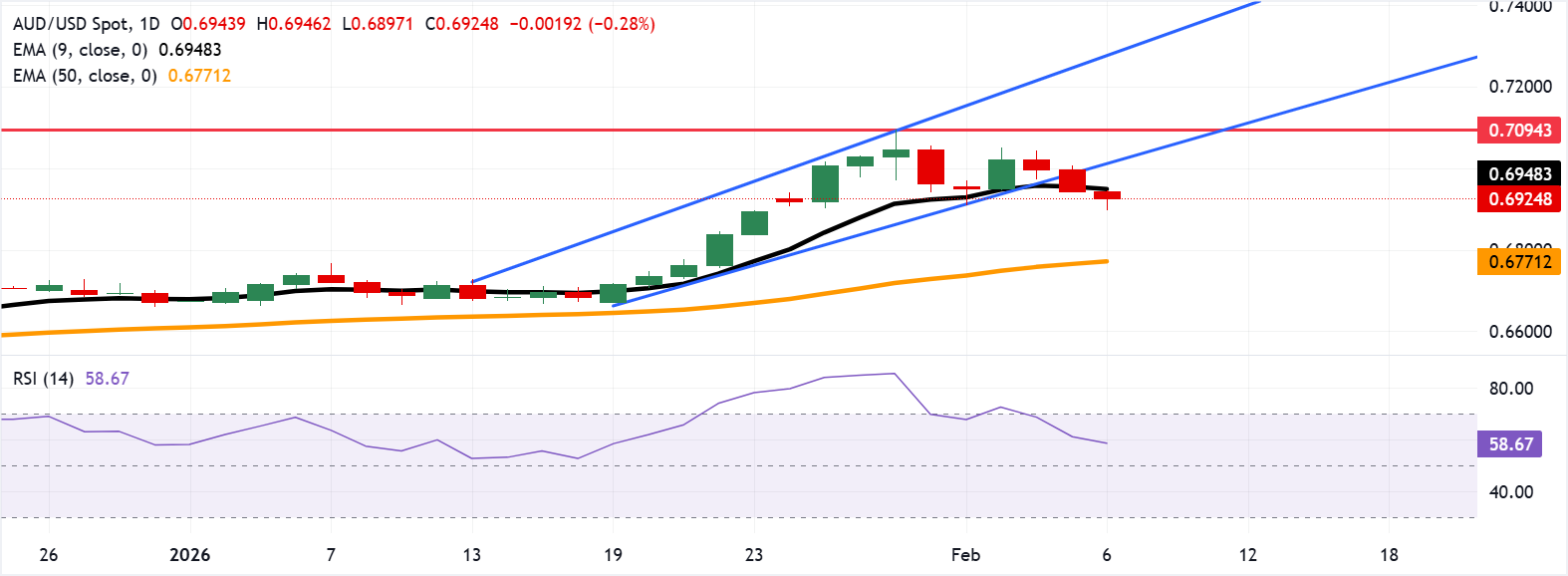
Australian Dollar falls to near 0.6900 after breaking below nine-day EMA
The AUD/USD pair is trading around 0.6910 on Friday. Daily chart analysis indicates that the pair is positioned below the ascending channel pattern, indicating a potential for a bearish reversal. However, the 14-day Relative Strength Index (RSI) is at 57; signals an ongoing bullish momentum.
The AUD/USD pair may test the immediate barrier at the nine-day Exponential Moving Average (EMA) of 0.6946. A rebound within the ascending channel would strengthen the bullish bias and target 0.7094, the highest level since February 2023, which was recorded on January 29. A break above this level would support the pair to test the upper ascending channel boundary around 0.7270. On the downside, the primary support lies at the 50-day EMA at 0.6771.
Australian Dollar Price Today
The table below shows the percentage change of Australian Dollar (AUD) against listed major currencies today. Australian Dollar was the weakest against the Japanese Yen.
| USD | EUR | GBP | JPY | CAD | AUD | NZD | CHF | |
|---|---|---|---|---|---|---|---|---|
| USD | -0.03% | 0.03% | -0.28% | 0.08% | 0.25% | 0.17% | -0.12% | |
| EUR | 0.03% | 0.06% | -0.26% | 0.12% | 0.28% | 0.20% | -0.09% | |
| GBP | -0.03% | -0.06% | -0.30% | 0.05% | 0.23% | 0.14% | -0.15% | |
| JPY | 0.28% | 0.26% | 0.30% | 0.38% | 0.54% | 0.45% | 0.17% | |
| CAD | -0.08% | -0.12% | -0.05% | -0.38% | 0.17% | 0.08% | -0.20% | |
| AUD | -0.25% | -0.28% | -0.23% | -0.54% | -0.17% | -0.09% | -0.37% | |
| NZD | -0.17% | -0.20% | -0.14% | -0.45% | -0.08% | 0.09% | -0.29% | |
| CHF | 0.12% | 0.09% | 0.15% | -0.17% | 0.20% | 0.37% | 0.29% |
The heat map shows percentage changes of major currencies against each other. The base currency is picked from the left column, while the quote currency is picked from the top row. For example, if you pick the Australian Dollar from the left column and move along the horizontal line to the US Dollar, the percentage change displayed in the box will represent AUD (base)/USD (quote).
Australian Dollar FAQs
One of the most significant factors for the Australian Dollar (AUD) is the level of interest rates set by the Reserve Bank of Australia (RBA). Because Australia is a resource-rich country another key driver is the price of its biggest export, Iron Ore. The health of the Chinese economy, its largest trading partner, is a factor, as well as inflation in Australia, its growth rate and Trade Balance. Market sentiment – whether investors are taking on more risky assets (risk-on) or seeking safe-havens (risk-off) – is also a factor, with risk-on positive for AUD.
The Reserve Bank of Australia (RBA) influences the Australian Dollar (AUD) by setting the level of interest rates that Australian banks can lend to each other. This influences the level of interest rates in the economy as a whole. The main goal of the RBA is to maintain a stable inflation rate of 2-3% by adjusting interest rates up or down. Relatively high interest rates compared to other major central banks support the AUD, and the opposite for relatively low. The RBA can also use quantitative easing and tightening to influence credit conditions, with the former AUD-negative and the latter AUD-positive.
China is Australia’s largest trading partner so the health of the Chinese economy is a major influence on the value of the Australian Dollar (AUD). When the Chinese economy is doing well it purchases more raw materials, goods and services from Australia, lifting demand for the AUD, and pushing up its value. The opposite is the case when the Chinese economy is not growing as fast as expected. Positive or negative surprises in Chinese growth data, therefore, often have a direct impact on the Australian Dollar and its pairs.
Iron Ore is Australia’s largest export, accounting for $118 billion a year according to data from 2021, with China as its primary destination. The price of Iron Ore, therefore, can be a driver of the Australian Dollar. Generally, if the price of Iron Ore rises, AUD also goes up, as aggregate demand for the currency increases. The opposite is the case if the price of Iron Ore falls. Higher Iron Ore prices also tend to result in a greater likelihood of a positive Trade Balance for Australia, which is also positive of the AUD.
The Trade Balance, which is the difference between what a country earns from its exports versus what it pays for its imports, is another factor that can influence the value of the Australian Dollar. If Australia produces highly sought after exports, then its currency will gain in value purely from the surplus demand created from foreign buyers seeking to purchase its exports versus what it spends to purchase imports. Therefore, a positive net Trade Balance strengthens the AUD, with the opposite effect if the Trade Balance is negative.
Recommended Articles


