




EUR/USD rallies above 1.1740 as Trump drops tariff threats, Dollar slips
- EUR/USD climbs over 0.5% as improved risk appetite fuels Dollar selling despite solid US growth data.
- Markets fully price a Fed hold in January, while year-end easing bets are sharply reduced.
- ECB minutes reinforce confidence in inflation returning to target, supporting the shared currency.
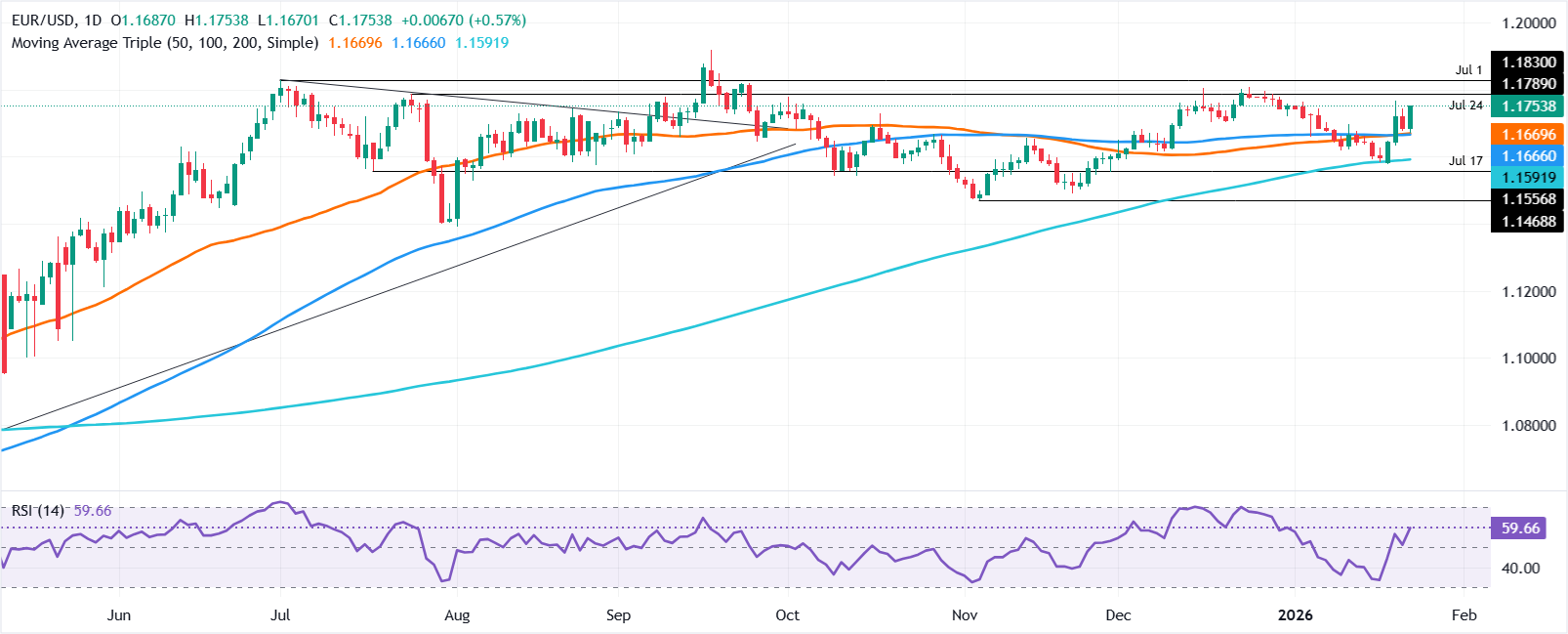
EUR/USD climbs for the second day in the week up by over 0.50% as the Dollar slides despite solid US economic data was released in the day. An improvement in risk appetite sponsored by US President Donald Trump dropping tariffs threats on Europe, underpins the shared currency. At the time of writing, the pair trades at 1.1743 after bouncing off daily lows of 1.1670.
Euro extends gains as easing US–Europe trade tensions outweigh strong US data and pressure the Dollar
Wall Street is poised to end Thursday’s session with gains bolstered by strong Gross Domestic Product (GDP) figures in the third quarter of 2025. Jobs data released at the same time and a slightly steady inflation print erased the chances of a rate cut by the Federal Reserve at the January meeting.
Data from Prime Market Terminal indicates that money markets expect the Fed to hold rates unchanged, with odds standing at 95%. Towards the year’s end, investors expect 42 basis points of rate cuts, below the 60 expected on January 7.
In Europe, the European Central Bank (ECB) unveiled its latest meeting monetary policy minutes in which members broadly agreed with the assessment on the economy and that underlying inflation indicators remain consistent with the central bank’s 2% medium-term goal.
Also, members of the European Union plan to unfreeze the trade dieal with the US and vote on ratification, revealed Bloomberg.
Economic schedule for January 23
The EU economic docket will feature HCOB Flash PMIs for France, Germany and the bloc. Also, the ECB President Christine Lagarde will cross the wires. In the US, traders focus will be on S&P Global Flash PMIs and the final print of the University of Michigan Consumer Sentiment.
Euro Price This week
The table below shows the percentage change of Euro (EUR) against listed major currencies this week. Euro was the strongest against the Japanese Yen.
| USD | EUR | GBP | JPY | CAD | AUD | NZD | CHF | |
|---|---|---|---|---|---|---|---|---|
| USD | -1.44% | -1.11% | 0.41% | -0.88% | -2.48% | -3.03% | -1.47% | |
| EUR | 1.44% | 0.33% | 1.84% | 0.55% | -1.07% | -1.61% | -0.04% | |
| GBP | 1.11% | -0.33% | 1.28% | 0.22% | -1.39% | -1.95% | -0.37% | |
| JPY | -0.41% | -1.84% | -1.28% | -1.28% | -2.86% | -3.39% | -1.86% | |
| CAD | 0.88% | -0.55% | -0.22% | 1.28% | -1.58% | -2.14% | -0.59% | |
| AUD | 2.48% | 1.07% | 1.39% | 2.86% | 1.58% | -0.56% | 1.04% | |
| NZD | 3.03% | 1.61% | 1.95% | 3.39% | 2.14% | 0.56% | 1.61% | |
| CHF | 1.47% | 0.04% | 0.37% | 1.86% | 0.59% | -1.04% | -1.61% |
The heat map shows percentage changes of major currencies against each other. The base currency is picked from the left column, while the quote currency is picked from the top row. For example, if you pick the Euro from the left column and move along the horizontal line to the US Dollar, the percentage change displayed in the box will represent EUR (base)/USD (quote).
Daily digest market movers: Traders ignore upbeat US data, drive Euro higher
- The US Department of Commerce reported that the Fed’s preferred inflation gauge, Core Personal Consumption Expenditures (PCE), rose 2.7% YoY in October and accelerated slightly to 2.8% in November, broadly in line with expectations.
- The US Bureau of Economic Analysis showed that Q3 2025 GDP grew 4.4% YoY, topping forecasts of 4.3% and improving markedly from Q2’s 3.8% pace. The expansion was driven by stronger exports and a smaller drag from inventories.
- Initial Jobless Claims for the week ending January 17 edged up to 200K from a revised 199K, but still came in well below expectations of 212K, according to data from the US Department of Labor.
- The ECB last meeting minutes struck a dovish language with policymakers acknowledging that growth remains resilient but exposed to geopolitical risks that could weigh on sentiment, tilting markets risk averse. Inflation is seen anchored near the 2% goal. Policymakers reiterated that policy is not on a preset path, maintaining their data-dependent stance.
- The US Dollar Index (DXY), which tracks the American currency's performance versus six peers, dives 0.50% down at 98.29.
Technical outlook: EUR/USD poised to challenge 1.1800 in the near-term
The EUR/USD has turned slightly neutral to upward biased after bouncing of 1.1576, near the 200-day Simple Moving Average (SMA) At 1.1590, which exacerbated the shared currency advance past 1.1600, on its way towards 1.1700.
The Relative Strength Index (RSI) shows that bulls are gathering steam. Hence, in the short-term, they have the upper hand.
For a bullish continuation, buyers must clear the December 24 peak at 1.1807. Once surpassed, the next stop would be 1.1850, followed by last year’s cycle high at 1.1918. For a bearish reversal, the EUR/USD must tumble below 1.1700, and clear key support levels like the 20-, 50- and 100-day SMAs, each at 1.11693, 1.1663 and 1.1660 respectively. If surpassed, bulls’ last line of defense would be the 200-day SMA.
Euro FAQs
The Euro is the currency for the 20 European Union countries that belong to the Eurozone. It is the second most heavily traded currency in the world behind the US Dollar. In 2022, it accounted for 31% of all foreign exchange transactions, with an average daily turnover of over $2.2 trillion a day. EUR/USD is the most heavily traded currency pair in the world, accounting for an estimated 30% off all transactions, followed by EUR/JPY (4%), EUR/GBP (3%) and EUR/AUD (2%).
The European Central Bank (ECB) in Frankfurt, Germany, is the reserve bank for the Eurozone. The ECB sets interest rates and manages monetary policy. The ECB’s primary mandate is to maintain price stability, which means either controlling inflation or stimulating growth. Its primary tool is the raising or lowering of interest rates. Relatively high interest rates – or the expectation of higher rates – will usually benefit the Euro and vice versa. The ECB Governing Council makes monetary policy decisions at meetings held eight times a year. Decisions are made by heads of the Eurozone national banks and six permanent members, including the President of the ECB, Christine Lagarde.
Eurozone inflation data, measured by the Harmonized Index of Consumer Prices (HICP), is an important econometric for the Euro. If inflation rises more than expected, especially if above the ECB’s 2% target, it obliges the ECB to raise interest rates to bring it back under control. Relatively high interest rates compared to its counterparts will usually benefit the Euro, as it makes the region more attractive as a place for global investors to park their money.
Data releases gauge the health of the economy and can impact on the Euro. Indicators such as GDP, Manufacturing and Services PMIs, employment, and consumer sentiment surveys can all influence the direction of the single currency. A strong economy is good for the Euro. Not only does it attract more foreign investment but it may encourage the ECB to put up interest rates, which will directly strengthen the Euro. Otherwise, if economic data is weak, the Euro is likely to fall. Economic data for the four largest economies in the euro area (Germany, France, Italy and Spain) are especially significant, as they account for 75% of the Eurozone’s economy.
Another significant data release for the Euro is the Trade Balance. This indicator measures the difference between what a country earns from its exports and what it spends on imports over a given period. If a country produces highly sought after exports then its currency will gain in value purely from the extra demand created from foreign buyers seeking to purchase these goods. Therefore, a positive net Trade Balance strengthens a currency and vice versa for a negative balance.
Recommended Articles


