




EUR/USD holds losses as Trump softens its tone against Europe
- EUR/USD consolidates below 1.1700 after bouncing from 1.1670.
- Trump's Davos speech, with a softer tone towards Europe, has eased the "Sell America" trade.
- US PCE Prices Index and the GDP data release might drive the US Dollar on Thursday.
EUR/USD is trading a few pips below the 1.1700 level at the time of writing on Thursday, practically flat on the daily chart, after pulling back from highs near 1.1770 on Tuesday. US President Donald Trump toned down his threats against its European partners at the World Economic Forum in Davos, triggering a relief rally and allowing the US Dollar to regain some of the ground lost earlier this week.
Trump stepped back on his threat to impose tariffs on European countries opposing his plans to annex Greenland and ruled out military action to take the island. Later on, he announced the framework of a deal with NATO on his social media account. The US president did not provide any details of the agreement, but the announcement helped ease tensions with Europe.
As some calm returns to the markets, investors will shift their focus back to the macroeconomic data domain, where the US Personal Consumption Expenditures (PCE) Price Index and the Q3 Gross Domestic Product (GDP) figures might provide further insight into the path of the US Federal Reserve's (Fed) monetary policy.
In Europe, the European Central Bank's (ECB) Monetary Policy Meeting Accounts and the German Bundesbank Monthly Report might provide some guidance to the Euro on Thursday.
Euro Price Today
The table below shows the percentage change of Euro (EUR) against listed major currencies today. Euro was the strongest against the Japanese Yen.
| USD | EUR | GBP | JPY | CAD | AUD | NZD | CHF | |
|---|---|---|---|---|---|---|---|---|
| USD | -0.01% | -0.01% | 0.27% | -0.07% | -0.66% | -0.24% | -0.07% | |
| EUR | 0.01% | -0.00% | 0.28% | -0.05% | -0.64% | -0.23% | -0.05% | |
| GBP | 0.01% | 0.00% | 0.28% | -0.06% | -0.65% | -0.23% | -0.06% | |
| JPY | -0.27% | -0.28% | -0.28% | -0.33% | -0.90% | -0.51% | -0.32% | |
| CAD | 0.07% | 0.05% | 0.06% | 0.33% | -0.58% | -0.17% | -0.00% | |
| AUD | 0.66% | 0.64% | 0.65% | 0.90% | 0.58% | 0.43% | 0.58% | |
| NZD | 0.24% | 0.23% | 0.23% | 0.51% | 0.17% | -0.43% | 0.17% | |
| CHF | 0.07% | 0.05% | 0.06% | 0.32% | 0.00% | -0.58% | -0.17% |
The heat map shows percentage changes of major currencies against each other. The base currency is picked from the left column, while the quote currency is picked from the top row. For example, if you pick the Euro from the left column and move along the horizontal line to the US Dollar, the percentage change displayed in the box will represent EUR (base)/USD (quote).
Daily Digest Market Movers: US Dollar bounces up as Trump eases tensions with Europe
- Trump has taken off the table the option of a military confrontation between NATO members and the threat of additional tariffs on EU countries, and the market has sighed with relief. The US Dollar has regained some ground lost in previous days, and the Euro has pulled back.
- The transatlantic relationship is still far from its best moment, though. ECB President Christine Lagarde walked out abruptly of an invitation-only dinner – hosted by BlackRock CEO Larry Fink at Davos – after US Commerce Secretary Howard Lutnick criticized the European Union during a speech.
- The focus on Thursday is on the release of the delayed US Personal Consumption Expenditures Price Indexes for October and November. PCE inflation is expected to have remained at growing levels significantly above the Fed's 2% target in November.
- At the same time, the US Bureau of Economic Analysis will release the final reading of the Q3 GDP, which is expected to confirm that economic growth accelerated to 4.3% annualized, from 3.8% in the previous quarter. All in all, data reflecting healthy growth and sticky inflation levels, adding to the case of a Fed monetary pause.
Technical Analysis: EUR/USD is looking for direction halfway through the monthly range
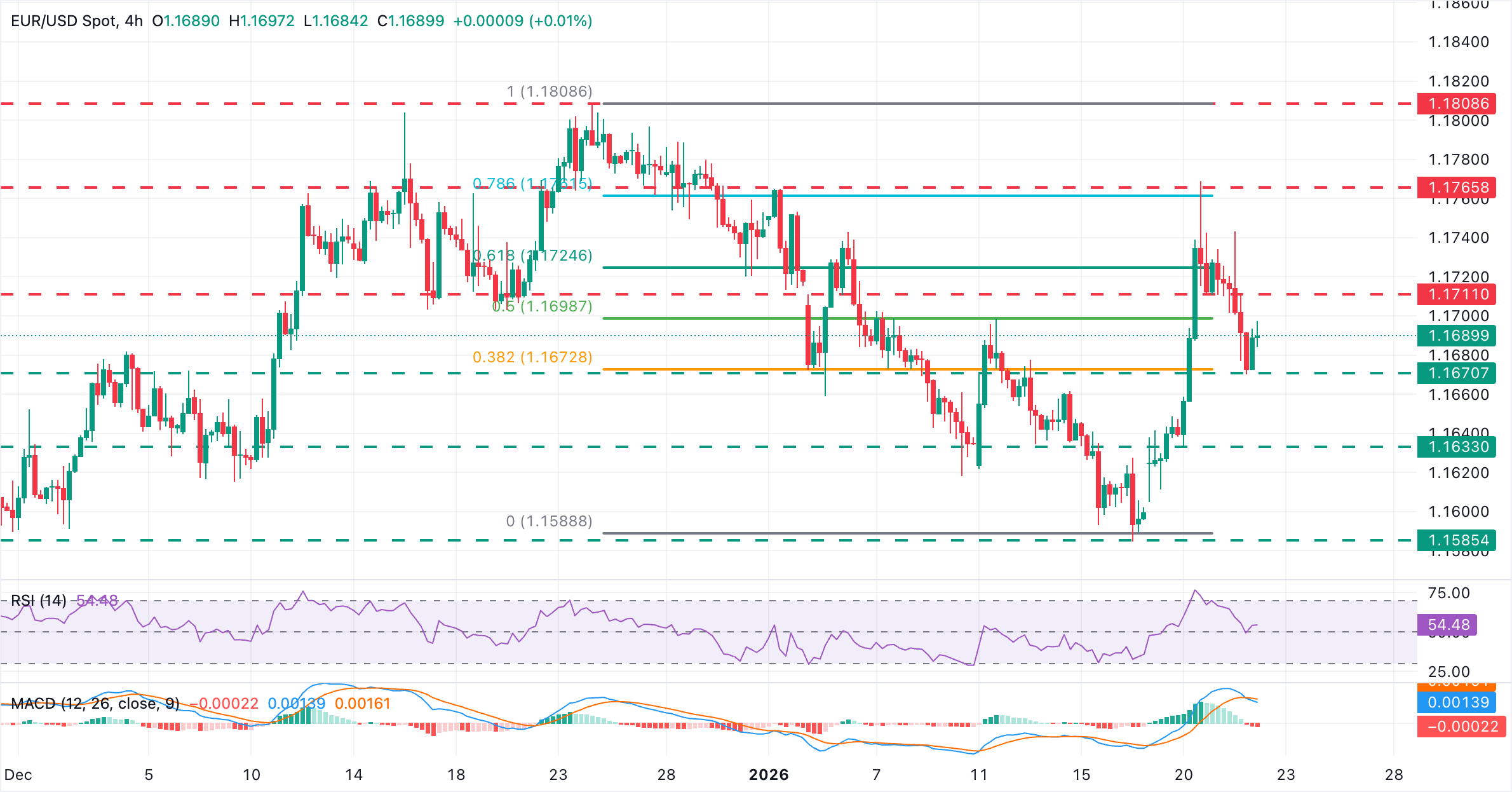
The EUR/USD recovery was capped at 1.1770, and the pair is now looking for direction, halfway through the recent range. The Moving Average Convergence Divergence (MACD) has turned marginally negative on the 4-hour chart, and the MACD line is attempting to cross below the signal line, a bearish sign. The Relative Strength Index (RSI) holds right above 50, showing a neutral level.
Bears have been contained at Wednesday's low of 1.1670, but the pair is struggling to bounce up. A break of that level would increase bearish pressure towards the intraday support in the area of 1.1630. To the upside, previous support at 1.1710 (intraday level) might offer some resistance ahead of the January 2 and 20 highs, in the area of 1.1770
(The technical analysis of this story was written with the help of an AI tool.)
Risk sentiment FAQs
In the world of financial jargon the two widely used terms “risk-on” and “risk off'' refer to the level of risk that investors are willing to stomach during the period referenced. In a “risk-on” market, investors are optimistic about the future and more willing to buy risky assets. In a “risk-off” market investors start to ‘play it safe’ because they are worried about the future, and therefore buy less risky assets that are more certain of bringing a return, even if it is relatively modest.
Typically, during periods of “risk-on”, stock markets will rise, most commodities – except Gold – will also gain in value, since they benefit from a positive growth outlook. The currencies of nations that are heavy commodity exporters strengthen because of increased demand, and Cryptocurrencies rise. In a “risk-off” market, Bonds go up – especially major government Bonds – Gold shines, and safe-haven currencies such as the Japanese Yen, Swiss Franc and US Dollar all benefit.
The Australian Dollar (AUD), the Canadian Dollar (CAD), the New Zealand Dollar (NZD) and minor FX like the Ruble (RUB) and the South African Rand (ZAR), all tend to rise in markets that are “risk-on”. This is because the economies of these currencies are heavily reliant on commodity exports for growth, and commodities tend to rise in price during risk-on periods. This is because investors foresee greater demand for raw materials in the future due to heightened economic activity.
The major currencies that tend to rise during periods of “risk-off” are the US Dollar (USD), the Japanese Yen (JPY) and the Swiss Franc (CHF). The US Dollar, because it is the world’s reserve currency, and because in times of crisis investors buy US government debt, which is seen as safe because the largest economy in the world is unlikely to default. The Yen, from increased demand for Japanese government bonds, because a high proportion are held by domestic investors who are unlikely to dump them – even in a crisis. The Swiss Franc, because strict Swiss banking laws offer investors enhanced capital protection.
Recommended Articles


