


USD/MXN (USDMXN) Moved Sharply on Oct 21: Are Central Bank Expectations Shifting?
USD/MXN (USDMXN) is up 0.51% at Oct 21 03:35(ET), now at $18.50104, with a 7-day up of 0.11%.
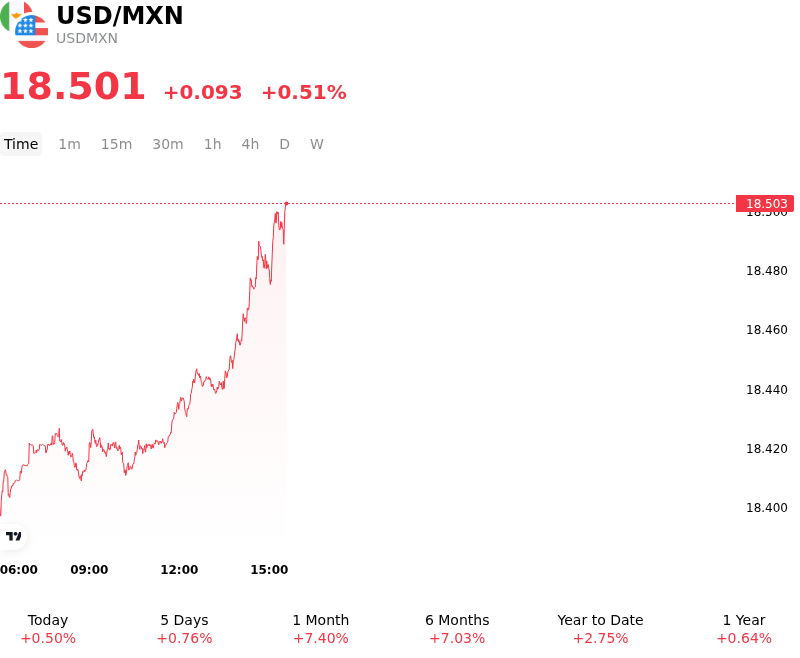
What is driving USD/MXN (USDMXN)’s stock price up today?
The advance in USDMXN reflects a combination of sustained U.S. Dollar support driven by elevated U.S. Treasury yields and underlying pressure on the Mexican Peso due to shifting rate differential expectations. Investors continue to price in a relatively hawkish trajectory for the Federal Reserve, supported by sticky U.S. inflation readings and broader economic resilience. This environment has kept short-to-medium-term U.S. yields elevated, maintaining upward momentum in the greenback across Latin American currency pairs as markets evaluate the Fed's upcoming monetary policy decision.
On the Mexican side, the Peso's underperformance stems from growing market focus on the narrowing monetary policy gap between the Federal Reserve and Banco de México. With Banxico keeping its target benchmark rate steady at 6.50% alongside signs of moderating domestic economic activity, enthusiasm for Mexican carry trades has tempered. Furthermore, persistent trade policy uncertainties, including stalled progress on bilateral trade discussions and tariff concerns, have injected an additional risk premium into Mexican assets, encouraging institutional investors to reduce local currency exposure.
Overall, the movement in the currency pair is supported by broader macroeconomic trends rather than an isolated technical move. The interplay of firming U.S. rate expectations, a compressing carry advantage for the Peso, and unresolved trade friction creates a constructive backdrop for USDMXN. In the near term, institutional market participants will remain focused on upcoming U.S. growth indicators, Mexican mid-month inflation releases, and central bank guidance to gauge the durability of this exchange rate adjustment.
Technical Analysis of USD/MXN (USDMXN)
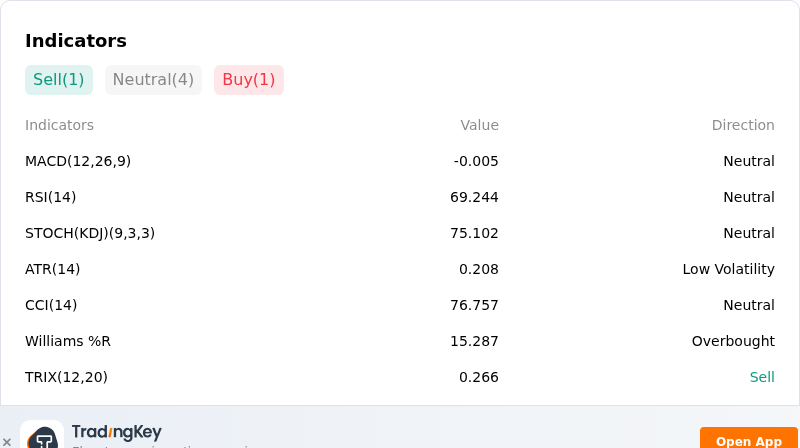
Technically, USD/MXN (USDMXN) shows a MACD (12,26,9) value of -0.005, indicating a neutral signal. The RSI at 69.244 suggests neutral condition and the Williams %R at 15.287 suggests overbought condition. Please monitor closely.
More details about USD/MXN (USDMXN)
Recent Events and Risks:
- Narrowing Interest Rate Differential and Carry Unwind: Hawkish Federal Reserve rate expectations paired with elevated U.S. Treasury yields are compressing the yield advantage between Mexico's 6.50% reference rate and the U.S. Fed funds rate, eroding the Mexican peso's carry-trade appeal and exposing USD/MXN to sharp intraday upside volatility.
- Dovish Banxico Policy Signals: Recent central bank minutes indicating that several Banxico governing board members remain open to future interest rate cuts—despite persistent headline inflation concerns—have weakened institutional demand for local high-yield debt, driving capital reallocation toward the U.S. dollar.
- Bilateral Trade Friction and Tariff Uncertainty: Heightened policy uncertainty surrounding US-Mexico tariff negotiations and U.S. pressure regarding Mexican state energy assets (Pemex) creates recurring downside risk for MXN, sparking sudden intraday liquidity shocks and exchange rate spikes.
- Broader Risk-Off Sentiment and Safe-Haven USD Flows: Persistent geopolitical tensions in the Middle East and rising benchmark U.S. Treasury yields continue to suppress global market risk appetite, discouraging flows into high-beta emerging market currencies and reinforcing defensive demand for the U.S. dollar.
Recommended Articles


