


NZD/USD (NZDUSD) Is down 0.55% on Sep 16: What Is Driving the Move?
NZD/USD (NZDUSD) is down 0.55% at Sep 16 14:50(ET), now at $0.57239, with a 7-day down of 1.93%.
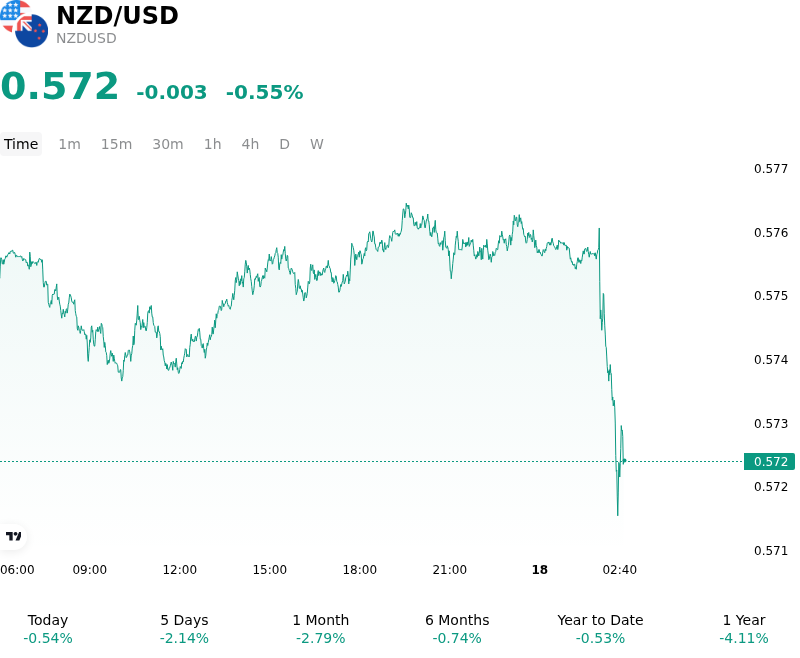
What is driving NZD/USD (NZDUSD)’s stock price down today?
The downward pressure on NZDUSD was primarily driven by a strengthening U.S. dollar, backed by a firming Federal Reserve policy stance and elevated U.S. Treasury yields. As the Federal Reserve delivered an interest rate hike and signaled the potential for continued monetary tightening to combat persistent inflation, fixed-income markets adjusted to a higher terminal rate path. The resultant rise in U.S. bond yields widened short- and medium-term yield differentials against New Zealand debt, driving capital flows toward dollar-denominated assets and curtailing demand for the base currency.
On the domestic front, the New Zealand dollar encountered policy uncertainty that weakened institutional support. News of the upcoming departure of Reserve Bank of New Zealand Assistant Governor Karen Silk, widely regarded as a key hawkish voice on the Monetary Policy Committee, created ambiguity surrounding the central bank's medium-term tightening trajectory. This leadership transition risk emerged alongside market expectations for a marked slowdown in domestic economic growth, limiting the RBNZ's ability to maintain a hawkish stance relative to the Federal Reserve.
Broader macro sentiment also favored the quote currency, as elevated global energy costs and persistent price pressures dampened risk appetite across international financial markets. As a pro-cyclical currency sensitive to global trade and commodity trends, the New Zealand dollar underperformed in an environment defined by risk-off asset allocation. Institutional investors continue to monitor upcoming domestic growth indicators and Federal Reserve policy signals to assess whether the shift in interest-rate expectations will sustain a broader downward trend in the pair.
Technical Analysis of NZD/USD (NZDUSD)
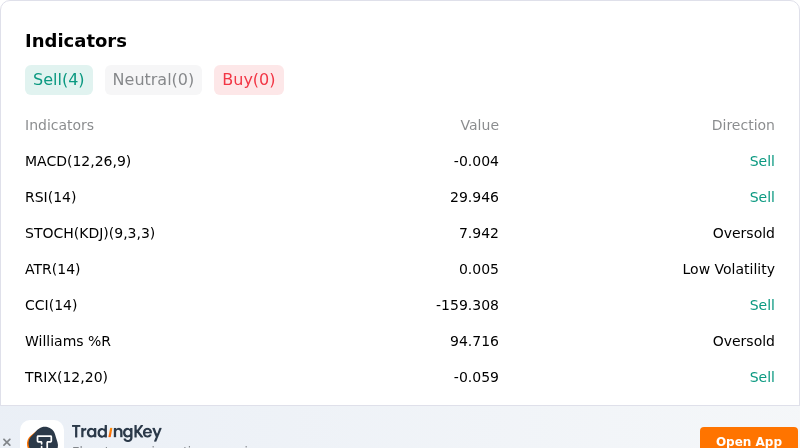
Technically, NZD/USD (NZDUSD) shows a MACD (12,26,9) value of -0.004, indicating a sell signal. The RSI at 29.946 suggests sell condition and the Williams %R at 94.716 suggests oversold condition. Please monitor closely.
More details about NZD/USD (NZDUSD)
Recent Events and Risks:
- RBNZ Hawkish Policy Shift Drag: The announced departure of RBNZ Assistant Governor Karen Silk—a leading hawkish voice on the Monetary Policy Committee—has created policy uncertainty and eroded market confidence in the central bank's medium-term tightening trajectory.
- Federal Reserve Rate Expectations and US Yield Pressure: Elevated US Treasury yields and strong market pricing for an upcoming Federal Reserve interest rate hike to a 3.75%–4.00% range continue to strengthen the US Dollar and widen yield differentials against the Kiwi.
- Imminent Domestic Growth Deceleration: Investor anxiety is mounting ahead of New Zealand's Q2 GDP data release, with forecasts pointing to a sharp slowdown in quarterly expansion to 0.1% from 0.8%, exposing the pair to downside macroeconomic shock risks.
- Chinese Trade Exposure and Global Risk-Off Sentiment: Weaker-than-expected economic data from China—New Zealand's key export destination—alongside persistent global inflation worries driven by elevated energy prices, is suppressing risk appetite and weighing heavily on growth-sensitive currencies.
Recommended Articles


