


NZD/USD (NZDUSD) Drops on Aug 5: What Are the Key Reasons?
NZD/USD (NZDUSD) is down 0.50% at Aug 5 04:50(ET), now at $0.5861, with a 7-day up of 1.16%.
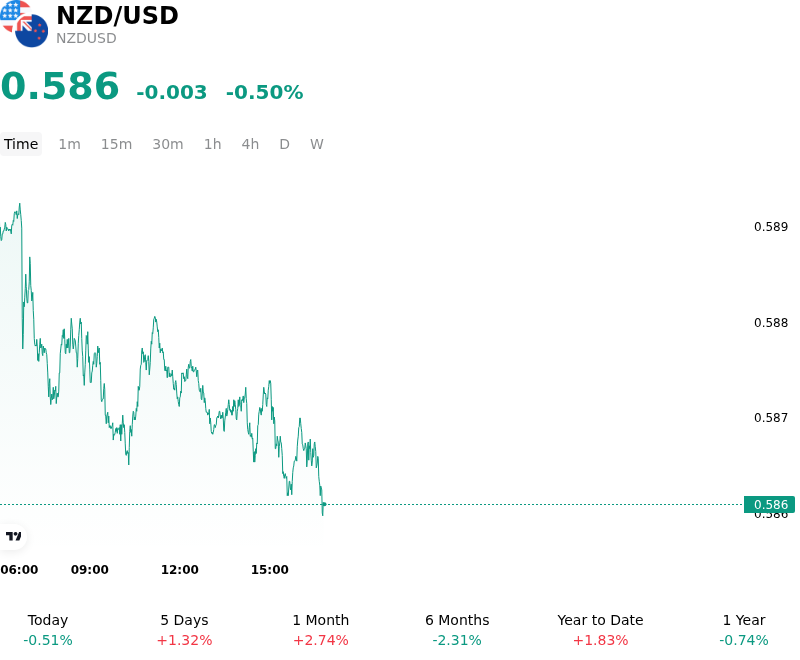
What is driving NZD/USD (NZDUSD)’s stock price down today?
The downward pressure on the New Zealand Dollar against the U.S. Dollar is primarily driven by a significant shift in domestic interest rate expectations following the release of softer-than-anticipated labor market data for the second quarter. The rise in the unemployment rate and a cooling in wage growth indicators suggest that the Reserve Bank of New Zealand’s restrictive monetary policy is effectively dampening domestic demand and easing inflationary pressures. This data has led institutional investors to pull forward expectations for the commencement of a rate-cutting cycle, narrowing the interest rate differential that had previously supported the kiwi.
Simultaneously, the U.S. Dollar has found renewed strength as market participants recalibrate the path of Federal Reserve policy. While the RBNZ faces growing pressure to pivot toward easing to prevent a hard landing, the U.S. economy continues to exhibit resilience, particularly in the services sector. This divergence in economic momentum has reinforced the greenback's appeal, as U.S. Treasury yields remain elevated relative to their New Zealand counterparts, attracting capital flows into dollar-denominated assets.
Broader risk sentiment is also playing a critical role in the pair’s trajectory. As a high-beta currency closely tied to global growth and commodity cycles, the New Zealand Dollar is sensitive to fluctuations in market volatility. Recent headwinds in the Chinese economy—New Zealand’s largest trading partner—have weighed heavily on the outlook for commodity exports. Softening manufacturing data from East Asia has diminished the appeal of pro-cyclical currencies, prompting a rotation into the safe-haven U.S. Dollar as investors hedge against global macro uncertainty.
From a positioning standpoint, the break below key technical support levels has triggered systematic selling, exacerbating the intraday decline. Institutional desks are monitoring whether the shift in labor market dynamics marks a definitive turning point for RBNZ policy. If inflation prints continue to trend toward the target band alongside weakening employment, the fundamental case for a lower NZDUSD exchange rate strengthens, as the carry-trade advantage that once favored the New Zealand Dollar continues to erode in favor of the Greenback’s liquidity and yield profile.
Technical Analysis of NZD/USD (NZDUSD)
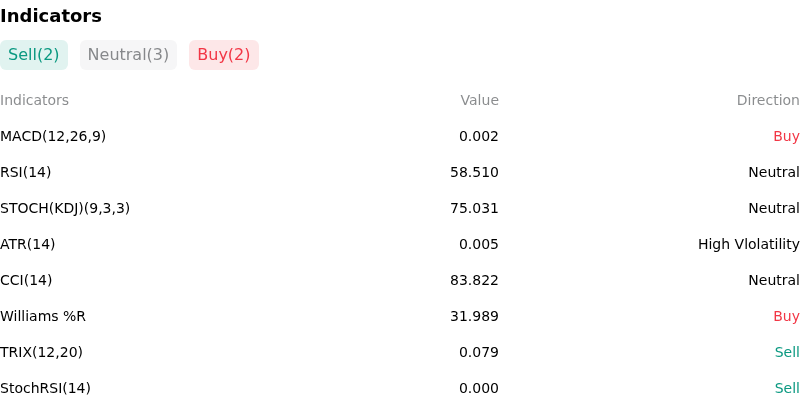
Technically, NZD/USD (NZDUSD) shows a MACD (12,26,9) value of 0.002, indicating a buy signal. The RSI at 58.510 suggests neutral condition and the Williams %R at 31.989 suggests buy condition. Please monitor closely.
More details about NZD/USD (NZDUSD)
Recent Events and Risks:
- Hawkish FOMC Minutes and Yield Divergence: The release of the latest FOMC minutes indicated that US policymakers are prepared to maintain restrictive rates for longer than previously anticipated, or even hike if inflation stalls. This has triggered a surge in US Treasury yields, exerting immediate downward pressure on the NZDUSD pair as the interest rate differential favors the Greenback.
- China Economic Growth Concerns: As a primary proxy for Chinese economic health, the NZD has faced selling pressure following recent data showing a continued slump in the Chinese property sector and underwhelming retail performance. Market participants are concerned that New Zealand's export demand, particularly for dairy and logs, will remain subdued, undermining the currency's fundamental support.
- RBNZ Policy Sustainability Risks: Despite the Reserve Bank of New Zealand's recent hawkish rhetoric, institutional analysts are increasingly worried about the impact of "higher for longer" rates on the domestic economy. Concerns that the RBNZ might over-tighten and trigger a deep recession are leading traders to hedge against a potential sudden dovish pivot later this year.
- Global Risk-Off Sentiment: Recent volatility in global equity markets and heightened geopolitical tensions in the Middle East have decreased investor appetite for high-beta currencies. This flight-to-safety trend disproportionately affects the NZD, as liquidity moves toward defensive havens like the USD and JPY during periods of macroeconomic uncertainty.
Recommended Articles


