

NZD/USD (NZDUSD) Surges on Jul 9: Was It the Dollar, Rates, or Data?

Source Tradingkey

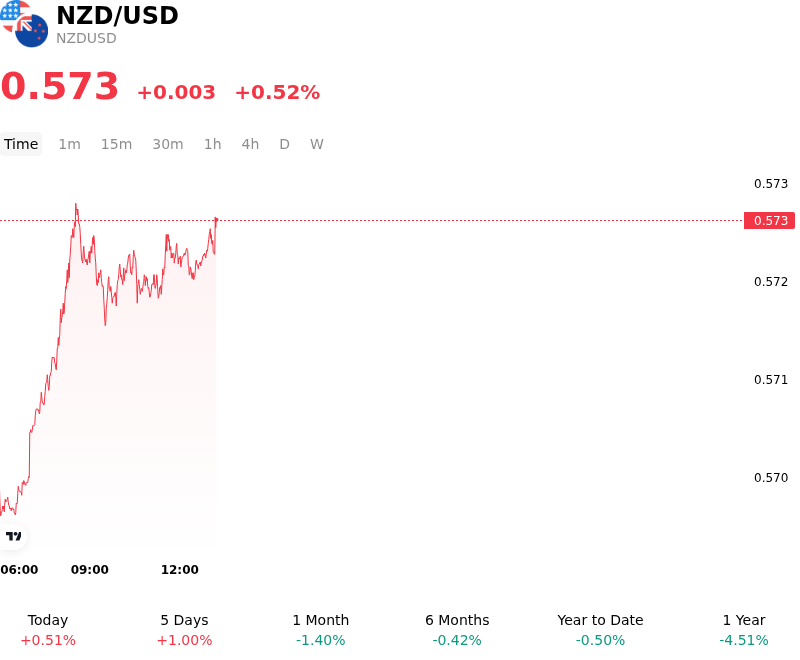
NZD/USD (NZDUSD) is up 0.52% at Jul 9 01:15(ET), now at $0.57265, with a 7-day up of 0.58%.
SummaryOverview

What is driving NZD/USD (NZDUSD)’s stock price up today?

The New Zealand Dollar advanced against the US Dollar, driven primarily by a shift in relative monetary policy expectations following a hawkish policy pivot by the Reserve Bank of New Zealand (RBNZ) and cooling sentiment around the Federal Reserve's rate path.

The primary catalyst for the New Zealand Dollar's strength was the RBNZ’s monetary policy decision. The central bank unexpectedly raised its Official Cash Rate by 25 basis points to 2.50%, representing its first interest rate hike in three years. Unlike the previous meeting, which saw a deeply divided committee, this decision was reached by consensus, signaling a unified commitment to curb persistent domestic price pressures. In its accompanying statement, the RBNZ emphasized that because inflation remains above the target midpoint and economic activity is expected to strengthen, further reductions in monetary stimulus are likely to be required.

This hawkish forward guidance prompted market participants to reprice the path of New Zealand’s monetary policy. Investors pushed up local short-term bond yields as expectations grew that the central bank will deliver subsequent rate hikes before the end of the year, possibly lifting the benchmark rate toward 3.00%. The widening of interest rate differentials in favor of the New Zealand Dollar bolstered the currency's yield appeal, attracting foreign capital flows.

The US Dollar, on the other hand, faced downward pressure following the release of the Federal Reserve's latest meeting minutes. The minutes revealed that Fed policymakers remain deeply divided over the trajectory of inflation and future interest rates. While some participants suggested rates could conclude the year lower, others argued for further tightening. This internal division, combined with recent softer US macroeconomic data, tempered near-term expectations for aggressive Federal Reserve policy, leading to a broader softening of the greenback.

Even as neighboring economic indicators pointed to slowing regional momentum—exemplified by softer-than-expected inflation data from China—the New Zealand Dollar held its ground and extended its gains. The combination of a hawkish domestic interest rate shock and a split Federal Reserve outlook has established a supportive macroeconomic backdrop for the currency pair, suggesting the move is backed by structural shifts in policy expectations rather than temporary risk sentiment alone.

Technical Analysis of NZD/USD (NZDUSD)

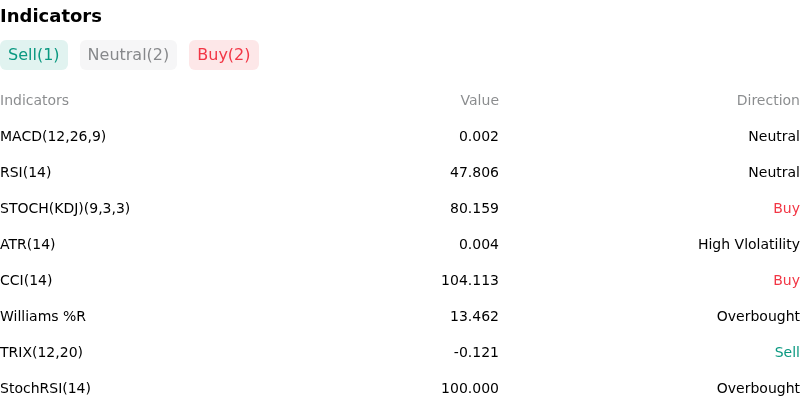
Technically, NZD/USD (NZDUSD) shows a MACD (12,26,9) value of 0.002, indicating a neutral signal. The RSI at 47.806 suggests neutral condition and the Williams %R at 13.462 suggests overbought condition. Please monitor closely.
IndicatorAnalysis

More details about NZD/USD (NZDUSD)

Recent Events and Risks:

  • Dovish Undercurrents in RBNZ Policy Decision: Although the RBNZ raised the Official Cash Rate by 25 basis points to 2.50%, the policy committee expressed mixed views. Four out of six committee members (including Governor Anna Breman) assessed that the balance of medium-term inflation risks is "broadly balanced". This creates downside risk for the Kiwi dollar if subsequent economic prints trigger a sharp dovish repricing toward a "one-off" insurance hike scenario.
  • Cooling Inflation Projections and Oil Slump: The RBNZ revised its inflation forecast downward, projecting that headline inflation peaked at 3.9% in the June quarter and will fall to 3.3% in September. This decline is heavily driven by a global slide in oil and petrochemical prices following the partial reopening of the Strait of Hormuz. Because lower oil prices relieve headline inflation pressures, the fundamental justification for sustained aggressive rate hikes is rapidly diminishing.
  • Sluggish Domestic Growth and Wobbly Recovery: RBNZ policymakers acknowledged that New Zealand’s economic recovery lost momentum during the second quarter as recent energy shocks weighed on growth. If upcoming domestic activity data reveals prolonged economic weakness, companies will struggle to pass on costs to consumers. This structural demand deficit poses a direct downside risk to the kiwi by limiting the central bank’s ability to implement further rate hikes.
  • Spillover from Softer Chinese Inflation: China's June CPI rose just 1.0% year-over-year, missing market expectations of 1.1% and signaling persistent domestic demand weakness in New Zealand's key trading partner. Continued deflationary pressures and cooling growth dynamics in China limit the export outlook for New Zealand’s commodity sector, capping potential gains for the high-beta NZD.
Disclaimer: For information purposes only. Past performance is not indicative of future results.
placeholder
Bitcoin CME gaps at $35,000, $27,000 and $21,000, which one gets filled first?Prioritize filling the $27,000 gap and even try higher.
Author  FXStreet
Aug 22, 2023
Prioritize filling the $27,000 gap and even try higher.
placeholder
Pinduoduo Earnings Incoming: Morgan Stanley Sees Long-Term Profit Potential​Insights – On November 21, Chinese e-commerce giant Pinduoduo (PDD) will release its Q3 2024 earnings.
Author  Mitrade
Nov 20, 2024
​Insights – On November 21, Chinese e-commerce giant Pinduoduo (PDD) will release its Q3 2024 earnings.
placeholder
Elon Musk’s xAI and Neuralink Launch New Funding Rounds​Billionaire Elon Musk recently raised funds for his two high-profile tech companies, xAI and Neuralink.
Author  Insights
Jun 03, 2025
​Billionaire Elon Musk recently raised funds for his two high-profile tech companies, xAI and Neuralink.
placeholder
Bitcoin briefly loses 2025 gains as crypto plunges over the weekend.Bitcoin experienced a sharp decline this weekend, briefly erasing its 2025 gains and dipping below its year-opening value of $93,507. The cryptocurrency fell to a low of $93,029 on Sunday, representing a 25% drop from its all-time high in October. Although it has rebounded slightly to around $94,209, the pressures on the market remain significant. The downturn occurred despite the reopening of the U.S. government on Thursday, which many had hoped would provide essential support for crypto markets. This year initially appeared promising for cryptocurrencies, particularly after the inauguration of President Donald Trump, who has established the most pro-crypto administration thus far. However, ongoing political tensions—including Trump's tariff strategies and the recent government shutdown, lasting a historic 43 days—have contributed to several rapid price pullbacks for Bitcoin throughout the year. Market dynamics are also being influenced by Bitcoin whales—investors holding large amounts of Bitcoin—who have been offloading portions of their assets, consequently stalling price rallies even as positive regulatory developments emerge. Despite these sell-offs, analysts from Glassnode argue that this behavior aligns with typical patterns seen among long-term investors during the concluding stages of bull markets, suggesting it is not indicative of a mass exodus. Notably, Bitcoin is not alone in its struggles, as Ethereum and Solana have also recorded declines of 7.95% and 28.3%, respectively, since the start of the year, while numerous altcoins have faced even steeper losses. Looking ahead, questions linger regarding the viability of the four-year cycle thesis, particularly given the increasing institutional support and regulatory frameworks now in place in the crypto landscape. Matt Hougan, chief investment officer at Bitwise, remains optimistic, suggesting a potential Bitcoin resurgence in 2026 driven by the “debasement trade” thesis and a broader trend toward increased adoption of stablecoins, tokenization, and decentralized finance. Hougan emphasized the soundness of the underlying fundamentals, pointing to a positive outlook for the sector in the longer term.
Author  Mitrade
Nov 17, 2025
Bitcoin experienced a sharp decline this weekend, briefly erasing its 2025 gains and dipping below its year-opening value of $93,507. The cryptocurrency fell to a low of $93,029 on Sunday, representing a 25% drop from its all-time high in October. Although it has rebounded slightly to around $94,209, the pressures on the market remain significant. The downturn occurred despite the reopening of the U.S. government on Thursday, which many had hoped would provide essential support for crypto markets. This year initially appeared promising for cryptocurrencies, particularly after the inauguration of President Donald Trump, who has established the most pro-crypto administration thus far. However, ongoing political tensions—including Trump's tariff strategies and the recent government shutdown, lasting a historic 43 days—have contributed to several rapid price pullbacks for Bitcoin throughout the year. Market dynamics are also being influenced by Bitcoin whales—investors holding large amounts of Bitcoin—who have been offloading portions of their assets, consequently stalling price rallies even as positive regulatory developments emerge. Despite these sell-offs, analysts from Glassnode argue that this behavior aligns with typical patterns seen among long-term investors during the concluding stages of bull markets, suggesting it is not indicative of a mass exodus. Notably, Bitcoin is not alone in its struggles, as Ethereum and Solana have also recorded declines of 7.95% and 28.3%, respectively, since the start of the year, while numerous altcoins have faced even steeper losses. Looking ahead, questions linger regarding the viability of the four-year cycle thesis, particularly given the increasing institutional support and regulatory frameworks now in place in the crypto landscape. Matt Hougan, chief investment officer at Bitwise, remains optimistic, suggesting a potential Bitcoin resurgence in 2026 driven by the “debasement trade” thesis and a broader trend toward increased adoption of stablecoins, tokenization, and decentralized finance. Hougan emphasized the soundness of the underlying fundamentals, pointing to a positive outlook for the sector in the longer term.
placeholder
Gold declines as Trump scraps Iran memorandum, markets await Fed minutesGold (XAU/USD) trades around $4,050 on Wednesday, down 1.40% on the day at the time of writing, as investors favor the US Dollar (USD) following a fresh deterioration in tensions between the United States (US) and Iran.
Author  FXStreet
20 hours ago
Gold (XAU/USD) trades around $4,050 on Wednesday, down 1.40% on the day at the time of writing, as investors favor the US Dollar (USD) following a fresh deterioration in tensions between the United States (US) and Iran.
goTop
quote