

Palladium (XPDUSD) Is up 2.12% on Jul 9: Why It Happened

Source Tradingkey

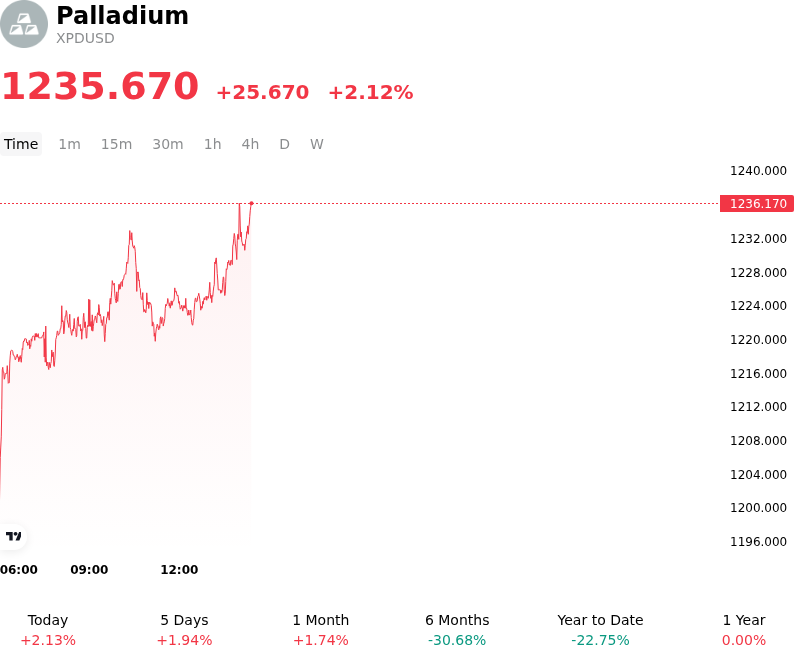
Palladium (XPDUSD) is up 2.12% at Jul 9 02:25(ET), now at $1235.67, with a 7-day down of 1.97%.
SummaryOverview

What is driving Palladium (XPDUSD)’s stock price up today?

The upward intraday movement in spot palladium (XPDUSD) was primarily driven by a technical rebound from oversold conditions and tactical short-covering, following a sharp sell-off in the preceding sessions. This price behavior highlights the characteristic volatility of the thin palladium futures market, where low liquidity frequently amplifies price swings when short positions are unwound.

From a macroeconomic perspective, precious metals and industrial commodities faced a complex environment characterized by geopolitical escalation and shifting central bank expectations. A major flare-up in U.S.-Iran hostilities near the Strait of Hormuz led to a spike in crude oil prices. The threat of energy-driven inflation subsequently raised market expectations for a more hawkish Federal Reserve interest-rate path. This geopolitical and macroeconomic backdrop initially boosted the U.S. dollar, which normally exerts downward pressure on dollar-denominated commodities. However, the sharp drop in palladium spot prices during the prior session pushed the asset into deep technically oversold territory, prompting traders to step in and cover short positions, fueling the intraday advance.

On the supply-demand front, the physical market is undergoing a structural transition that continues to influence investor sentiment. Key industry updates, including those from major producer Norilsk Nickel, have pointed to a shift from structural deficits toward a global surplus of several hundred thousand ounces. This surplus projection has been exacerbated by the decision of U.S. regulators against imposing punitive tariffs on Russian palladium imports, ensuring a steady and uninterrupted flow of global supply. Simultaneously, the long-term demand outlook remains constrained by the automotive sector’s transition toward battery electric vehicles, which do not require the palladium-rich catalytic converters used in gasoline and hybrid cars.

While the intraday move reflects a temporary technical correction and risk-premium adjustments in a highly volatile market, the broader structural trend for palladium remains heavily capped by these supply surpluses and weak industrial demand. Investors continue to closely monitor global auto manufacturing data, hybrid vehicle production schedules, and ongoing geopolitical developments in major supply hubs to gauge future market balance.

Technical Analysis of Palladium (XPDUSD)

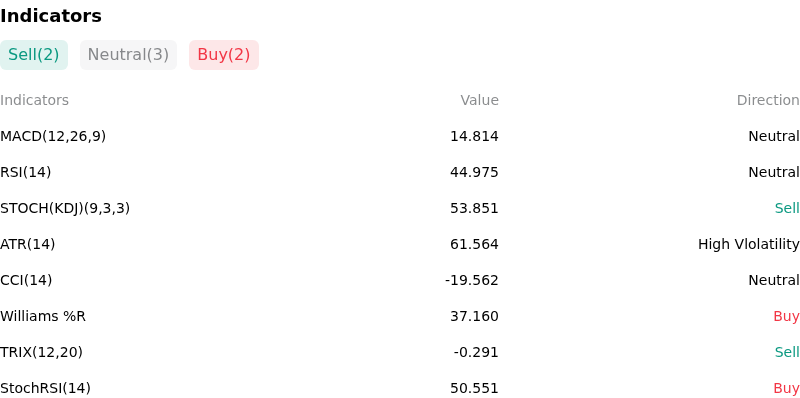
Technically, Palladium (XPDUSD) shows a MACD (12,26,9) value of 14.814, indicating a neutral signal. The RSI at 44.975 suggests neutral condition and the Williams %R at 37.160 suggests buy condition. Please monitor closely.
IndicatorAnalysis

More details about Palladium (XPDUSD)

Recent Events and Risks:

  • Accelerating Structural Demand Deterioration: In the wake of a persistent transition from internal combustion engines to battery-electric vehicles (BEVs), the automotive sector—which accounts for roughly 85% of global palladium fabrication—continues to experience sharp structural demand roll-overs. Furthermore, ongoing automaker substitution of cheaper platinum in autocatalyst production is steadily compounding the erosion of palladium's demand base.
  • Transition to Market Surplus: Institutional commodity strategists at major financial institutions, including UBS and Heraeus, warn that the palladium market is shifting into a structural oversupply. Strong investment demand that previously absorbed supply is dry up, with declining ETF holdings and rising automotive recycling scrap rates expected to widen this surplus and drive prices toward key pivot targets near $1,150 to $1,000 per ounce.
  • Severe Illiquidity and Heightened Volatility Risk: Palladium remains the least liquid of the major precious metals on COMEX and NYMEX, holding the lowest open interest and daily trading volumes. During macro risk-off shifts or geopolitical swings, this lack of market depth drastically amplifies downward spikes, leaving futures vulnerable to sudden, severe intraday selloffs.
  • Macro Risk-Off Pressures: Renewed hawkishness from the Federal Reserve, elevated interest rates, and lingering global recessionary concerns continue to act as major macroeconomic headwinds. A rising U.S. dollar index directly suppresses international investment demand for dollar-denominated spot palladium, exerting intense pressure on the metal's price curve.
Disclaimer: For information purposes only. Past performance is not indicative of future results.
placeholder
Bitcoin CME gaps at $35,000, $27,000 and $21,000, which one gets filled first?Prioritize filling the $27,000 gap and even try higher.
Author  FXStreet
Aug 22, 2023
Prioritize filling the $27,000 gap and even try higher.
placeholder
Pinduoduo Earnings Incoming: Morgan Stanley Sees Long-Term Profit Potential​Insights – On November 21, Chinese e-commerce giant Pinduoduo (PDD) will release its Q3 2024 earnings.
Author  Mitrade
Nov 20, 2024
​Insights – On November 21, Chinese e-commerce giant Pinduoduo (PDD) will release its Q3 2024 earnings.
placeholder
Elon Musk’s xAI and Neuralink Launch New Funding Rounds​Billionaire Elon Musk recently raised funds for his two high-profile tech companies, xAI and Neuralink.
Author  Insights
Jun 03, 2025
​Billionaire Elon Musk recently raised funds for his two high-profile tech companies, xAI and Neuralink.
placeholder
Bitcoin briefly loses 2025 gains as crypto plunges over the weekend.Bitcoin experienced a sharp decline this weekend, briefly erasing its 2025 gains and dipping below its year-opening value of $93,507. The cryptocurrency fell to a low of $93,029 on Sunday, representing a 25% drop from its all-time high in October. Although it has rebounded slightly to around $94,209, the pressures on the market remain significant. The downturn occurred despite the reopening of the U.S. government on Thursday, which many had hoped would provide essential support for crypto markets. This year initially appeared promising for cryptocurrencies, particularly after the inauguration of President Donald Trump, who has established the most pro-crypto administration thus far. However, ongoing political tensions—including Trump's tariff strategies and the recent government shutdown, lasting a historic 43 days—have contributed to several rapid price pullbacks for Bitcoin throughout the year. Market dynamics are also being influenced by Bitcoin whales—investors holding large amounts of Bitcoin—who have been offloading portions of their assets, consequently stalling price rallies even as positive regulatory developments emerge. Despite these sell-offs, analysts from Glassnode argue that this behavior aligns with typical patterns seen among long-term investors during the concluding stages of bull markets, suggesting it is not indicative of a mass exodus. Notably, Bitcoin is not alone in its struggles, as Ethereum and Solana have also recorded declines of 7.95% and 28.3%, respectively, since the start of the year, while numerous altcoins have faced even steeper losses. Looking ahead, questions linger regarding the viability of the four-year cycle thesis, particularly given the increasing institutional support and regulatory frameworks now in place in the crypto landscape. Matt Hougan, chief investment officer at Bitwise, remains optimistic, suggesting a potential Bitcoin resurgence in 2026 driven by the “debasement trade” thesis and a broader trend toward increased adoption of stablecoins, tokenization, and decentralized finance. Hougan emphasized the soundness of the underlying fundamentals, pointing to a positive outlook for the sector in the longer term.
Author  Mitrade
Nov 17, 2025
Bitcoin experienced a sharp decline this weekend, briefly erasing its 2025 gains and dipping below its year-opening value of $93,507. The cryptocurrency fell to a low of $93,029 on Sunday, representing a 25% drop from its all-time high in October. Although it has rebounded slightly to around $94,209, the pressures on the market remain significant. The downturn occurred despite the reopening of the U.S. government on Thursday, which many had hoped would provide essential support for crypto markets. This year initially appeared promising for cryptocurrencies, particularly after the inauguration of President Donald Trump, who has established the most pro-crypto administration thus far. However, ongoing political tensions—including Trump's tariff strategies and the recent government shutdown, lasting a historic 43 days—have contributed to several rapid price pullbacks for Bitcoin throughout the year. Market dynamics are also being influenced by Bitcoin whales—investors holding large amounts of Bitcoin—who have been offloading portions of their assets, consequently stalling price rallies even as positive regulatory developments emerge. Despite these sell-offs, analysts from Glassnode argue that this behavior aligns with typical patterns seen among long-term investors during the concluding stages of bull markets, suggesting it is not indicative of a mass exodus. Notably, Bitcoin is not alone in its struggles, as Ethereum and Solana have also recorded declines of 7.95% and 28.3%, respectively, since the start of the year, while numerous altcoins have faced even steeper losses. Looking ahead, questions linger regarding the viability of the four-year cycle thesis, particularly given the increasing institutional support and regulatory frameworks now in place in the crypto landscape. Matt Hougan, chief investment officer at Bitwise, remains optimistic, suggesting a potential Bitcoin resurgence in 2026 driven by the “debasement trade” thesis and a broader trend toward increased adoption of stablecoins, tokenization, and decentralized finance. Hougan emphasized the soundness of the underlying fundamentals, pointing to a positive outlook for the sector in the longer term.
placeholder
Gold declines as Trump scraps Iran memorandum, markets await Fed minutesGold (XAU/USD) trades around $4,050 on Wednesday, down 1.40% on the day at the time of writing, as investors favor the US Dollar (USD) following a fresh deterioration in tensions between the United States (US) and Iran.
Author  FXStreet
21 hours ago
Gold (XAU/USD) trades around $4,050 on Wednesday, down 1.40% on the day at the time of writing, as investors favor the US Dollar (USD) following a fresh deterioration in tensions between the United States (US) and Iran.
goTop
quote