

NZD/USD (NZDUSD) Is up 0.53% on Jul 8: Why It Happened

Source Tradingkey

NZD/USD (NZDUSD) is up 0.53% at Jul 8 00:25(ET), now at $0.5706, with a 7-day up of 0.64%.
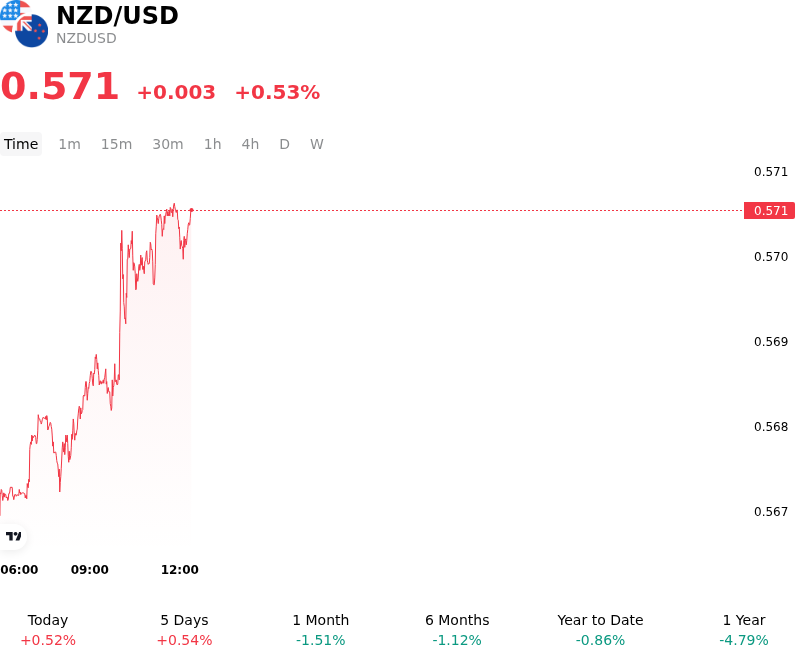
SummaryOverview

What is driving NZD/USD (NZDUSD)’s stock price up today?

The primary driver behind the intraday recovery in the NZDUSD currency pair was the Reserve Bank of New Zealand’s policy decision, which saw the central bank deliver a highly anticipated interest-rate hike. This policy-driven move successfully shifted interest-rate expectations in favor of the New Zealand dollar, lifting the pair relative to the US dollar.

The Reserve Bank of New Zealand raised its Official Cash Rate by 25 basis points to 2.50%. Although major commercial banks and economists were split heading into the meeting—largely due to a recent collapse in global oil prices that eased near-term headline inflation pressures—the central bank opted for what was widely characterized as a preventive insurance hike. The policy committee determined that domestic financial conditions had eased too much following recent declines in wholesale yields and the depreciation of the local currency. Delivering the rate hike allowed the central bank to prevent an unwarranted easing of monetary conditions and anchor medium-term inflation expectations, which remain vulnerable to persistent underlying domestic cost pressures.

Adding to the upward pressure on the New Zealand dollar, the central bank’s policy review indicated that additional tightening remains on the table. While the committee noted that the timing of future moves remains highly uncertain, the policy statement explicitly flagged that further reductions in monetary stimulus will likely be required to guide inflation back toward the midpoint of its target range. This hawkish forward guidance compelled market participants to bring forward their expectations for the peak policy rate, reinforcing a widening yield differential in favor of the Kiwi.

Meanwhile, the US dollar’s performance was influenced by a mix of opposing forces. On one hand, persistent geopolitical tensions in the Middle East—specifically renewed hostilities affecting oil transport routes and the resulting bounce in global energy prices—lent some safe-haven support to the greenback and capped the upside potential for risk-sensitive currencies like the New Zealand dollar. These developments also revived broader US inflation concerns. On the other hand, recent softer US labor data and divergent paths in global central bank policies kept the US dollar’s broader momentum in check.

The advance in NZDUSD appears to be part of a broader macro trend driven by monetary policy divergence. The RBNZ’s willingness to raise rates despite a cooling energy sector signals that domestic core inflation and financial conditions remain the primary drivers of its policy path. Investors will continue to monitor global risk sentiment, commodity price trends, and upcoming Federal Reserve communications to assess the durability of the New Zealand dollar’s recovery.

Technical Analysis of NZD/USD (NZDUSD)

Technically, NZD/USD (NZDUSD) shows a MACD (12,26,9) value of 0.001, indicating a neutral signal. The RSI at 43.754 suggests neutral condition and the Williams %R at 43.149 suggests buy condition. Please monitor closely.
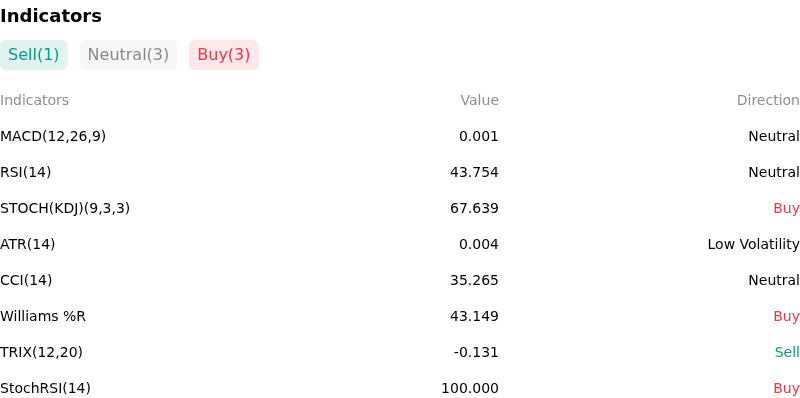
IndicatorAnalysis

More details about NZD/USD (NZDUSD)

Recent Events and Risks:

  • Dovish Details in RBNZ Hike: Although the RBNZ raised the Official Cash Rate by 25 basis points to 2.50%, Governor Anna Breman noted that weak demand is limiting companies' ability to pass on costs, and four out of six committee members viewed the balance of inflation risks as "broadly balanced". Strategists warn that this creates high risk of a "one-off" insurance hike, paving the way for a sharp dovish repricing if future meetings reveal a policy pause.
  • Slumping Commodity Prices: The New Zealand Dollar is facing intense fundamental pressure after the June ANZ World Commodity Price Index dropped by 1.0%. Collapsing global oil and raw material prices are directly eroding New Zealand's export-reliant trade balance, significantly weakening the Kiwi's underlying commodity support.
  • Geopolitical Safe-Haven Shifts: Fresh intraday volatility has been triggered by a sharp escalation in geopolitical tensions, including renewed U.S. military strikes against Iran and the revocation of Iranian oil licenses. This sudden deterioration in global risk appetite is driving safe-haven capital directly into the US Dollar at the expense of highly beta-sensitive currencies like the New Zealand Dollar.
  • Divergent Federal Reserve Outlook: Despite softer private employment indicators, hawkish commentary from Federal Reserve officials—emphasizing that U.S. economic growth remains steady and inflation remains elevated—keeps the greenback well-supported. This persistent "higher-for-longer" Fed outlook limits the NZD/USD pair’s recovery potential by keeping the key 0.5700 level as a strong technical ceiling.
Disclaimer: For information purposes only. Past performance is not indicative of future results.
placeholder
Bitcoin CME gaps at $35,000, $27,000 and $21,000, which one gets filled first?Prioritize filling the $27,000 gap and even try higher.
Author  FXStreet
Aug 22, 2023
Prioritize filling the $27,000 gap and even try higher.
placeholder
Pinduoduo Earnings Incoming: Morgan Stanley Sees Long-Term Profit Potential​Insights – On November 21, Chinese e-commerce giant Pinduoduo (PDD) will release its Q3 2024 earnings.
Author  Mitrade
Nov 20, 2024
​Insights – On November 21, Chinese e-commerce giant Pinduoduo (PDD) will release its Q3 2024 earnings.
placeholder
Elon Musk’s xAI and Neuralink Launch New Funding Rounds​Billionaire Elon Musk recently raised funds for his two high-profile tech companies, xAI and Neuralink.
Author  Insights
Jun 03, 2025
​Billionaire Elon Musk recently raised funds for his two high-profile tech companies, xAI and Neuralink.
placeholder
Bitcoin briefly loses 2025 gains as crypto plunges over the weekend.Bitcoin experienced a sharp decline this weekend, briefly erasing its 2025 gains and dipping below its year-opening value of $93,507. The cryptocurrency fell to a low of $93,029 on Sunday, representing a 25% drop from its all-time high in October. Although it has rebounded slightly to around $94,209, the pressures on the market remain significant. The downturn occurred despite the reopening of the U.S. government on Thursday, which many had hoped would provide essential support for crypto markets. This year initially appeared promising for cryptocurrencies, particularly after the inauguration of President Donald Trump, who has established the most pro-crypto administration thus far. However, ongoing political tensions—including Trump's tariff strategies and the recent government shutdown, lasting a historic 43 days—have contributed to several rapid price pullbacks for Bitcoin throughout the year. Market dynamics are also being influenced by Bitcoin whales—investors holding large amounts of Bitcoin—who have been offloading portions of their assets, consequently stalling price rallies even as positive regulatory developments emerge. Despite these sell-offs, analysts from Glassnode argue that this behavior aligns with typical patterns seen among long-term investors during the concluding stages of bull markets, suggesting it is not indicative of a mass exodus. Notably, Bitcoin is not alone in its struggles, as Ethereum and Solana have also recorded declines of 7.95% and 28.3%, respectively, since the start of the year, while numerous altcoins have faced even steeper losses. Looking ahead, questions linger regarding the viability of the four-year cycle thesis, particularly given the increasing institutional support and regulatory frameworks now in place in the crypto landscape. Matt Hougan, chief investment officer at Bitwise, remains optimistic, suggesting a potential Bitcoin resurgence in 2026 driven by the “debasement trade” thesis and a broader trend toward increased adoption of stablecoins, tokenization, and decentralized finance. Hougan emphasized the soundness of the underlying fundamentals, pointing to a positive outlook for the sector in the longer term.
Author  Mitrade
Nov 17, 2025
Bitcoin experienced a sharp decline this weekend, briefly erasing its 2025 gains and dipping below its year-opening value of $93,507. The cryptocurrency fell to a low of $93,029 on Sunday, representing a 25% drop from its all-time high in October. Although it has rebounded slightly to around $94,209, the pressures on the market remain significant. The downturn occurred despite the reopening of the U.S. government on Thursday, which many had hoped would provide essential support for crypto markets. This year initially appeared promising for cryptocurrencies, particularly after the inauguration of President Donald Trump, who has established the most pro-crypto administration thus far. However, ongoing political tensions—including Trump's tariff strategies and the recent government shutdown, lasting a historic 43 days—have contributed to several rapid price pullbacks for Bitcoin throughout the year. Market dynamics are also being influenced by Bitcoin whales—investors holding large amounts of Bitcoin—who have been offloading portions of their assets, consequently stalling price rallies even as positive regulatory developments emerge. Despite these sell-offs, analysts from Glassnode argue that this behavior aligns with typical patterns seen among long-term investors during the concluding stages of bull markets, suggesting it is not indicative of a mass exodus. Notably, Bitcoin is not alone in its struggles, as Ethereum and Solana have also recorded declines of 7.95% and 28.3%, respectively, since the start of the year, while numerous altcoins have faced even steeper losses. Looking ahead, questions linger regarding the viability of the four-year cycle thesis, particularly given the increasing institutional support and regulatory frameworks now in place in the crypto landscape. Matt Hougan, chief investment officer at Bitwise, remains optimistic, suggesting a potential Bitcoin resurgence in 2026 driven by the “debasement trade” thesis and a broader trend toward increased adoption of stablecoins, tokenization, and decentralized finance. Hougan emphasized the soundness of the underlying fundamentals, pointing to a positive outlook for the sector in the longer term.
placeholder
Silver Price Forecast: XAG/USD rally stalls, sellers eye $60.00Silver price retreats by over 1% on Monday, even as the Greenback and US Treasury yields edge lower, with the white metal threatening to drop below $60 for the first time this week. At the time of writing, the XAG/USD trades at $61.80, after peaking at around $63.28 earlier during the day,
Author  FXStreet
Yesterday 01: 14
Silver price retreats by over 1% on Monday, even as the Greenback and US Treasury yields edge lower, with the white metal threatening to drop below $60 for the first time this week. At the time of writing, the XAG/USD trades at $61.80, after peaking at around $63.28 earlier during the day,
goTop
quote