

USD/MXN (USDMXN) Moved Sharply on Jul 7: Are Central Bank Expectations Shifting?

Source Tradingkey

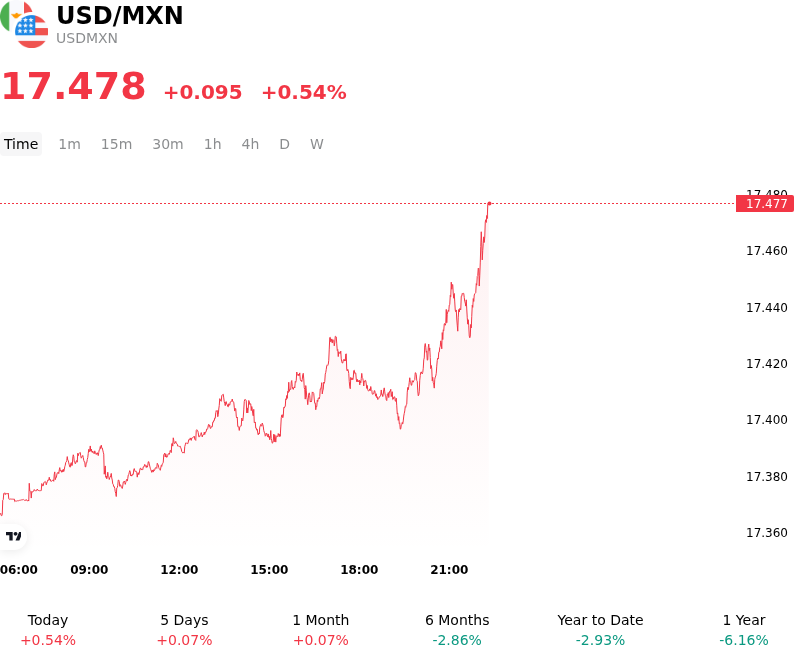
USD/MXN (USDMXN) is up 0.54% at Jul 7 10:20(ET), now at $17.47829, with a 7-day down of 0.02%.
SummaryOverview

What is driving USD/MXN (USDMXN)’s stock price up today?

The upward movement in USDMXN was driven by a combination of recovering demand for the US dollar, shifting central bank expectations, and trade-related uncertainties weighing on the Mexican peso.

The primary catalyst supporting the US dollar was a stabilization in US interest-rate expectations. Following a period of softer labor market data that had previously depressed the greenback, the US dollar found a firm footing. US service sector data continued to point to a moderate expansion rather than a hard landing, keeping the Federal Reserve's monetary policy outlook relatively steady. This reduced the urgency for aggressive monetary easing, lending support to US Treasury yields and fueling demand for the dollar.

In contrast, the Mexican peso faced downward pressure as domestic economic conditions and central bank policy expectations weighed on its structural carry-trade appeal. Although Banco de México (Banxico) maintained its benchmark interest rate at 6.50% at its latest meeting, its overall bias has leaned more dovish due to soft domestic growth indicators and a decline in inflation. Recent indicators showed that Mexico's GDP had faced a weak start to the year, with total gross investment contracting and private sector analysts forecasting stagnant growth of just 1.10% for the full year. With headline and core inflation easing more than expected to multi-month lows, market participants anticipate that dovish policymakers at Banxico will have room to resume interest rate cuts in the medium term. This prospect of a narrowing interest rate differential between the US and Mexico has begun to erode the peso's carry appeal.

Beyond monetary policy, geopolitical and trade-related risks contributed to the peso's underperformance. The recent US decision not to extend the United States-Mexico-Canada Agreement (USMCA) in its current form on July 1 ushered in a period of periodic reviews, creating a cloud of regulatory and trade uncertainty. Because Mexico relies heavily on exports to the US, concerns over upcoming negotiations regarding rules of origin and the auto industry have kept peso investors cautious. Additionally, a brief flare-up in global risk aversion—evidenced by geopolitical tensions in the Middle East and minor disruptions near the Strait of Hormuz—bolstered safe-haven demand for the US dollar at the expense of emerging market assets.

Overall, the appreciation of USDMXN reflects the dollar's recovery as US growth expectations remain resilient, while the peso struggles against domestic growth concerns, looming USMCA renegotiation risks, and a projected narrowing of Mexico’s yield advantage.

Technical Analysis of USD/MXN (USDMXN)

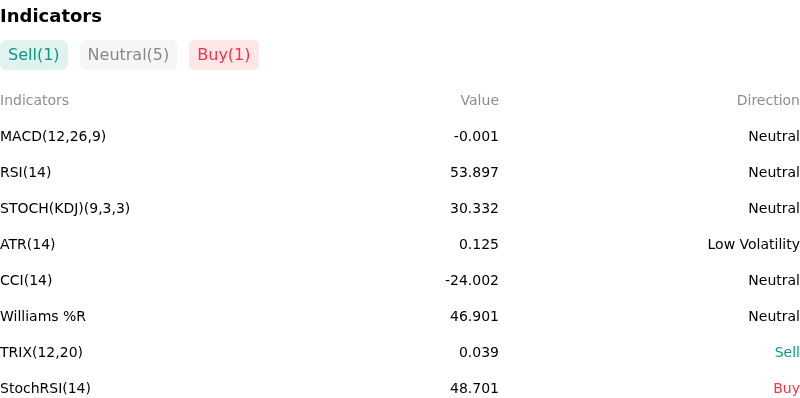
Technically, USD/MXN (USDMXN) shows a MACD (12,26,9) value of -0.001, indicating a neutral signal. The RSI at 53.897 suggests neutral condition and the Williams %R at 46.901 suggests neutral condition. Please monitor closely.
IndicatorAnalysis

More details about USD/MXN (USDMXN)

Recent Events and Risks:

  • USMCA Trade Negotiation and Tariff Fears: The Mexican Peso faces mounting downside pressure from structural trade uncertainty, driven by heightened speculation surrounding the formal 2026 USMCA review. Remarks regarding a potential renegotiation, along with long-standing tariff threats, have revived a trade-risk premium that directly weighs on MXN and keeps the pair volatile.
  • Dovish Banxico Shift vs. Resilient Fed Outlook: Although the Bank of Mexico (Banxico) recently cut its policy rate to 6.5%, any signs of further dovish deceleration in Mexico's inflation or weakening domestic growth may force Banxico to resume rate cuts. Concurrently, persistent concerns that the US Federal Reserve could keep interest rates elevated to battle high inflation threaten to compress the yield differential that anchors MXN's carry trade attractiveness.
  • Mexican Growth Slowdown and Commodity Pressures: Mexico's economic growth indicators have struggled, causing domestic analysts to cut growth projections and heightening fears that the country's export momentum is losing steam. This sluggishness, combined with softer WTI crude oil prices, compromises Mexico's export revenues and exposes the highly liquid currency to sudden risk-off sentiment shifts.
  • Positioning and Global Risk Sentiment Vulnerability: The Mexican Peso remains highly susceptible to global risk-off flows. Should broader market volatility spike or U.S. Treasury yields resume their upward path, traders are highly likely to unwind leveraged carry trade positions, exposing the USDMXN to sharp, asymmetric upside shocks as capital flees emerging market assets.
Disclaimer: For information purposes only. Past performance is not indicative of future results.
placeholder
Bitcoin CME gaps at $35,000, $27,000 and $21,000, which one gets filled first?Prioritize filling the $27,000 gap and even try higher.
Author  FXStreet
Aug 22, 2023
Prioritize filling the $27,000 gap and even try higher.
placeholder
Pinduoduo Earnings Incoming: Morgan Stanley Sees Long-Term Profit Potential​Insights – On November 21, Chinese e-commerce giant Pinduoduo (PDD) will release its Q3 2024 earnings.
Author  Mitrade
Nov 20, 2024
​Insights – On November 21, Chinese e-commerce giant Pinduoduo (PDD) will release its Q3 2024 earnings.
placeholder
Elon Musk’s xAI and Neuralink Launch New Funding Rounds​Billionaire Elon Musk recently raised funds for his two high-profile tech companies, xAI and Neuralink.
Author  Insights
Jun 03, 2025
​Billionaire Elon Musk recently raised funds for his two high-profile tech companies, xAI and Neuralink.
placeholder
Bitcoin briefly loses 2025 gains as crypto plunges over the weekend.Bitcoin experienced a sharp decline this weekend, briefly erasing its 2025 gains and dipping below its year-opening value of $93,507. The cryptocurrency fell to a low of $93,029 on Sunday, representing a 25% drop from its all-time high in October. Although it has rebounded slightly to around $94,209, the pressures on the market remain significant. The downturn occurred despite the reopening of the U.S. government on Thursday, which many had hoped would provide essential support for crypto markets. This year initially appeared promising for cryptocurrencies, particularly after the inauguration of President Donald Trump, who has established the most pro-crypto administration thus far. However, ongoing political tensions—including Trump's tariff strategies and the recent government shutdown, lasting a historic 43 days—have contributed to several rapid price pullbacks for Bitcoin throughout the year. Market dynamics are also being influenced by Bitcoin whales—investors holding large amounts of Bitcoin—who have been offloading portions of their assets, consequently stalling price rallies even as positive regulatory developments emerge. Despite these sell-offs, analysts from Glassnode argue that this behavior aligns with typical patterns seen among long-term investors during the concluding stages of bull markets, suggesting it is not indicative of a mass exodus. Notably, Bitcoin is not alone in its struggles, as Ethereum and Solana have also recorded declines of 7.95% and 28.3%, respectively, since the start of the year, while numerous altcoins have faced even steeper losses. Looking ahead, questions linger regarding the viability of the four-year cycle thesis, particularly given the increasing institutional support and regulatory frameworks now in place in the crypto landscape. Matt Hougan, chief investment officer at Bitwise, remains optimistic, suggesting a potential Bitcoin resurgence in 2026 driven by the “debasement trade” thesis and a broader trend toward increased adoption of stablecoins, tokenization, and decentralized finance. Hougan emphasized the soundness of the underlying fundamentals, pointing to a positive outlook for the sector in the longer term.
Author  Mitrade
Nov 17, 2025
Bitcoin experienced a sharp decline this weekend, briefly erasing its 2025 gains and dipping below its year-opening value of $93,507. The cryptocurrency fell to a low of $93,029 on Sunday, representing a 25% drop from its all-time high in October. Although it has rebounded slightly to around $94,209, the pressures on the market remain significant. The downturn occurred despite the reopening of the U.S. government on Thursday, which many had hoped would provide essential support for crypto markets. This year initially appeared promising for cryptocurrencies, particularly after the inauguration of President Donald Trump, who has established the most pro-crypto administration thus far. However, ongoing political tensions—including Trump's tariff strategies and the recent government shutdown, lasting a historic 43 days—have contributed to several rapid price pullbacks for Bitcoin throughout the year. Market dynamics are also being influenced by Bitcoin whales—investors holding large amounts of Bitcoin—who have been offloading portions of their assets, consequently stalling price rallies even as positive regulatory developments emerge. Despite these sell-offs, analysts from Glassnode argue that this behavior aligns with typical patterns seen among long-term investors during the concluding stages of bull markets, suggesting it is not indicative of a mass exodus. Notably, Bitcoin is not alone in its struggles, as Ethereum and Solana have also recorded declines of 7.95% and 28.3%, respectively, since the start of the year, while numerous altcoins have faced even steeper losses. Looking ahead, questions linger regarding the viability of the four-year cycle thesis, particularly given the increasing institutional support and regulatory frameworks now in place in the crypto landscape. Matt Hougan, chief investment officer at Bitwise, remains optimistic, suggesting a potential Bitcoin resurgence in 2026 driven by the “debasement trade” thesis and a broader trend toward increased adoption of stablecoins, tokenization, and decentralized finance. Hougan emphasized the soundness of the underlying fundamentals, pointing to a positive outlook for the sector in the longer term.
placeholder
Gold Price Forecast: XAU/USD struggles to extend recovery above 20-day EMAGold price (XAU/USD) is down 0.8% to near $4,140 during the European trading session on Monday. The precious metal faces selling pressure as the three-day rally hits a pause after failing to extend above $4,202.
Author  FXStreet
Yesterday 10: 23
Gold price (XAU/USD) is down 0.8% to near $4,140 during the European trading session on Monday. The precious metal faces selling pressure as the three-day rally hits a pause after failing to extend above $4,202.
goTop
quote