


USD/JPY (USDJPY) Drops on Jul 2: Was It the Dollar, Rates, or Data?
USD/JPY (USDJPY) is down 0.64% at Jul 2 02:50(ET), now at $161.513, with a 7-day down of 0.16%.
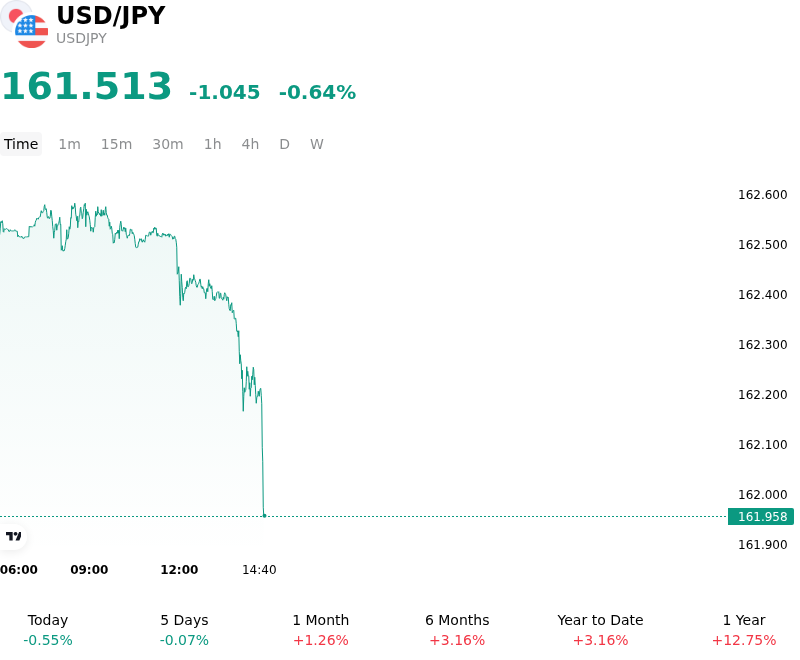
What is driving USD/JPY (USDJPY)’s stock price down today?
The decline in USD/JPY is primarily driven by a combination of cooling U.S. labor market indicators, shifting tactics from Japanese currency authorities, and resilient domestic data bolstering expectations for further policy normalization by the Bank of Japan.
The initial pressure on the U.S. dollar emerged following softer-than-expected U.S. macroeconomic releases. The June ADP private payrolls report missed consensus estimates, coming in at ninety-eight thousand against expectations of one hundred ten thousand. This was compounded by a moderation in the ISM Manufacturing PMI. These prints prompted a pullback in U.S. Treasury yields, leading market participants to trim hawkish Federal Reserve expectations ahead of the official government nonfarm payrolls report. With the June jobs report brought forward to Thursday due to the upcoming U.S. holiday, investors showed reluctance to extend long-dollar positions in a pre-holiday, potentially low-liquidity environment.
On the other side of the pair, the Japanese yen received a substantial boost from escalating intervention risks and a strategic shift in Tokyo's currency defense. Having recently hit a fresh forty-year low near 162.84, USD/JPY has entered territory where direct market intervention is widely anticipated. Market reports indicating that Japan's Ministry of Finance is shifting to unsignalled, "ambush-style" intervention tactics rather than relying on traditional verbal warnings have significantly raised the risk of holding short-yen positions. By utilizing silence as a policy tool, authorities have introduced heightened two-way risk, forcing speculative traders to cover short positions ahead of the U.S. labor market data.
This tactical caution is reinforced by supportive domestic fundamentals. The Bank of Japan's June Tankan survey revealed corporate sentiment reaching an eight-year high, while long-term inflation expectations among firms broke record highs. Hawkish remarks from central bank officials, including newly appointed board member Ayano Sato emphasizing the inflationary threat of yen weakness, have solidified the case for further interest rate hikes following the central bank's landmark rate hike to one percent in June. Although the structural yield gap between the Federal Reserve and the Bank of Japan remains wide, the combination of tactical intervention fears and domestic policy momentum has paved the way for JPY outperformance during this session.
Technical Analysis of USD/JPY (USDJPY)
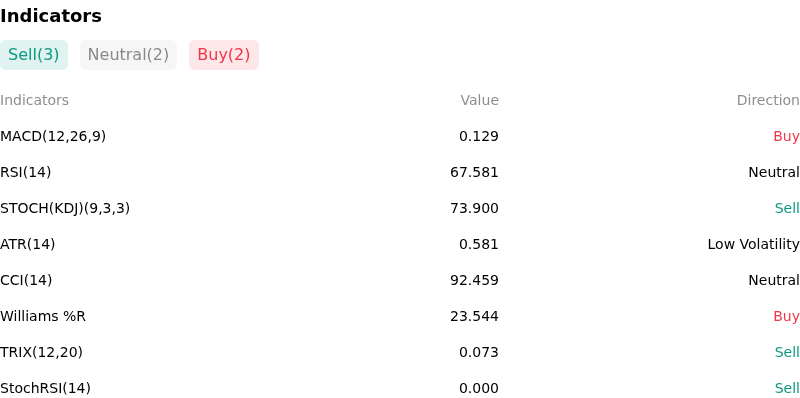
Technically, USD/JPY (USDJPY) shows a MACD (12,26,9) value of 0.129, indicating a buy signal. The RSI at 67.581 suggests neutral condition and the Williams %R at 23.544 suggests buy condition. Please monitor closely.
More details about USD/JPY (USDJPY)
Recent Events and Risks:
- Imminent Yen-Buying Intervention Risk: With the USD/JPY pair surging to a fresh 40-year high near 163.00, Japanese authorities have escalated their verbal warnings. Finance Minister Satsuki Katayama and Chief Cabinet Secretary Minoru Kihara have reiterated readiness to take appropriate action in the foreign exchange market, threatening a massive, immediate downward shock to USD/JPY if the Ministry of Finance executes yen-buying operations similar to their record ¥11.7 trillion intervention.
- US Nonfarm Payrolls and Employment Data Downside Risk: The upcoming release of the US Nonfarm Payrolls (NFP) report for June presents a significant downside catalyst for the pair. Early signs of cooling in the US labor market—evidenced by below-consensus June ADP private payrolls and a weak ISM Manufacturing PMI—suggest that any downside surprise in the official employment figures could rapidly unwind hawkish Federal Reserve rate expectations and trigger a sharp pullback in the US dollar.
- Crowded Short-Yen Positioning and Short-Squeeze Potential: Speculative short-yen carry trade positioning remains heavily stretched near two-year highs, with net shorts estimated at over $11 billion. This highly crowded positioning significantly increases the risk of a violent carry trade unwind and short-squeeze, where a minor fundamental trigger or official intervention could cause a rapid, multi-figure drop in USD/JPY.
- Geopolitical Energy Shocks and Terms-of-Trade Pressures: Ongoing US-Iran and Middle Eastern geopolitical hostilities continue to drive oil-related risk premiums. Because Japan is highly dependent on Middle Eastern energy imports, any escalation that disrupts crude supplies threatens to worsen Japan’s terms of trade and trade balance, injecting high intraday volatility into USD/JPY as market participants hedge against energy-driven economic disruptions.
Recommended Articles


