

Solana (SOLUSD) Is up 2.46% on Jul 1: What Do On-Chain Data and Market Sentiment Show?

Source Tradingkey

Solana (SOLUSD) is up 2.46% at Jul 1 00:00(ET), now at $74.48, with a 7-day up of 11.70%.
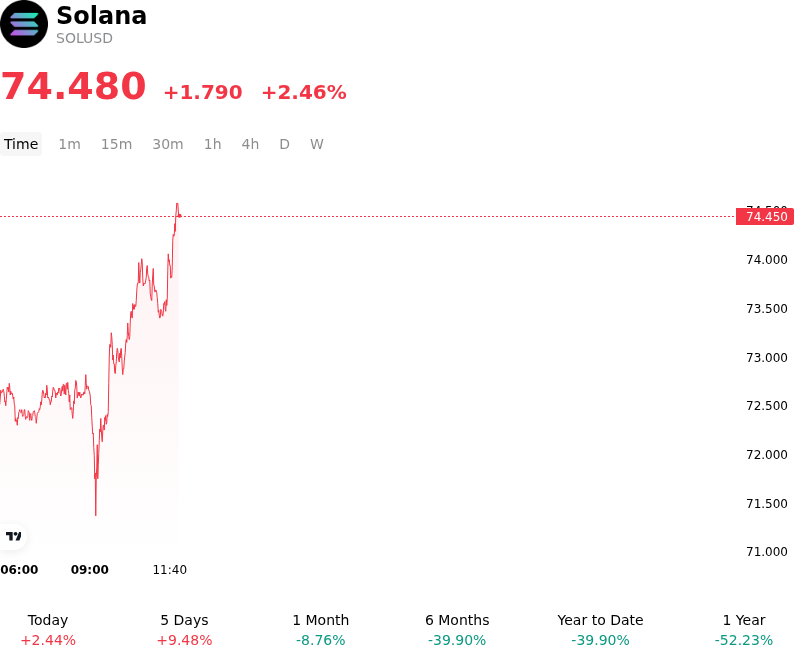
SummaryOverview

What is driving Solana (SOLUSD)’s stock price up today?

Capital inflows into Solana have accelerated, driven by robust institutional adoption milestones, expanding real-world asset integration, and major on-chain liquidity developments. These factors have collectively enhanced investor sentiment and provided fundamental justification for the asset's upward trajectory, allowing it to act as a resilient outlier within the broader digital asset market.

A primary catalyst for the positive price movement is the deepening institutionalization of the network. Regulated investment products have continued to attract substantial capital, with spot Solana exchange-traded funds (ETFs) in key markets accumulating over one billion dollars in combined assets under management. Unlike traditional spot digital asset products, multiple Solana-based fund structures feature native staking mechanisms, distributing validator yields directly to shareholders. This structural yield advantage has created a steady baseline of spot buying pressure and discouraged the capital outflows seen in other non-yielding investment vehicles.

Further bolstering institutional demand is the network's growing role in hosting real-world asset (RWA) infrastructure. Solana recently processed record-breaking transaction volumes for tokenized equities, cementing its dominance in the public-ledger migration of traditional financial securities. High-profile corporate partnerships, including MoneyGram joining the network as a validator and financial institutions integrating Solana for cross-border stablecoin settlements, have demonstrated that allocators view the blockchain as an enterprise-grade utility rather than a purely speculative environment.

On-chain liquidity has also experienced a massive influx, notably highlighted by the rapid minting of hundreds of millions of dollars in USD Coin (USDC) by Circle directly on the Solana network. This sudden increase in stablecoin supply has provided decentralized finance applications with significant liquidity, lowering transaction friction and driving network activity to historic highs. Furthermore, corporate treasury moves, such as Upexi’s strategic partnership with Blueprint to stake over two million SOL tokens, have locked up substantial circulating supply, effectively reducing immediate overhead selling pressure.

While macro headwinds, such as the Federal Reserve’s hawkish monetary policy stance, continue to pressure the broader risk-asset landscape, Solana's idiosyncratic network growth has allowed it to recapture key technical support levels. The combination of active spot ETF demand, zero-fee stablecoin launches, and steady fundamental progress on upcoming scaling upgrades continues to support a constructive long-term outlook, though investors remain cautious of potential supply overhangs from estate liquidations and derivatives market concentration.

Technical Analysis of Solana (SOLUSD)

Technically, Solana (SOLUSD) shows a MACD (12,26,9) value of 2.080, indicating a neutral signal. The RSI at 55.090 suggests neutral condition and the Williams %R at 7.395 suggests overbought condition. Please monitor closely.
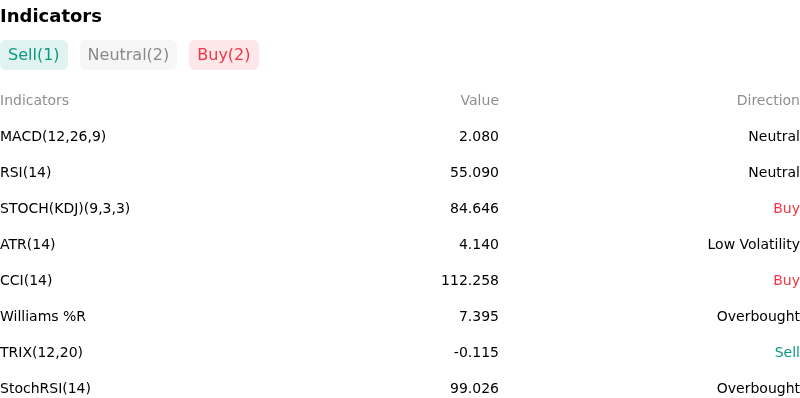
IndicatorAnalysis

More details about Solana (SOLUSD)

Recent Events and Risks:

  • Slowing On-Chain Demand and DEX Metrics: Solana’s decentralized exchange (DEX) swap volumes and organic fee generation have significantly cooled off from their historic peaks. This rapid drop in transaction-level activity raises monetization and utility concerns for the native token, especially given the network’s near-zero marginal fee structure.
  • FTX Bankruptcy Liquidations and Token Unlocks: The market remains under pressure from persistent supply-side concerns, driven by anticipated asset liquidations from the FTX bankruptcy estate alongside scheduled mid-year native token unlocks, which continue to add overhead structural supply.
  • Elevated Whale Exchange Inflows and Short Positioning: On-chain tracking data from the last 72 hours has identified an influx of approximately 600,000 SOL tokens deposited into centralized exchanges, signaling that large-scale holders may be positioning to distribute or hedge. This localized supply is exacerbated by derivatives data showing concentrated whale short positions.
  • Crowded Retail Long Setup and Liquidation Vulnerability: While derivatives open interest has climbed back toward $5.31 billion, long positioning remains highly crowded, with over 72% of Binance accounts holding net-long accounts. This extreme imbalance leaves the asset highly vulnerable to long-liquidation cascades and intraday volatility if key support levels fail.
Disclaimer: For information purposes only. Past performance is not indicative of future results.
placeholder
Bitcoin CME gaps at $35,000, $27,000 and $21,000, which one gets filled first?Prioritize filling the $27,000 gap and even try higher.
Author  FXStreet
Aug 22, 2023
Prioritize filling the $27,000 gap and even try higher.
placeholder
Pinduoduo Earnings Incoming: Morgan Stanley Sees Long-Term Profit Potential​Insights – On November 21, Chinese e-commerce giant Pinduoduo (PDD) will release its Q3 2024 earnings.
Author  Mitrade
Nov 20, 2024
​Insights – On November 21, Chinese e-commerce giant Pinduoduo (PDD) will release its Q3 2024 earnings.
placeholder
Elon Musk’s xAI and Neuralink Launch New Funding Rounds​Billionaire Elon Musk recently raised funds for his two high-profile tech companies, xAI and Neuralink.
Author  Insights
Jun 03, 2025
​Billionaire Elon Musk recently raised funds for his two high-profile tech companies, xAI and Neuralink.
placeholder
Bitcoin briefly loses 2025 gains as crypto plunges over the weekend.Bitcoin experienced a sharp decline this weekend, briefly erasing its 2025 gains and dipping below its year-opening value of $93,507. The cryptocurrency fell to a low of $93,029 on Sunday, representing a 25% drop from its all-time high in October. Although it has rebounded slightly to around $94,209, the pressures on the market remain significant. The downturn occurred despite the reopening of the U.S. government on Thursday, which many had hoped would provide essential support for crypto markets. This year initially appeared promising for cryptocurrencies, particularly after the inauguration of President Donald Trump, who has established the most pro-crypto administration thus far. However, ongoing political tensions—including Trump's tariff strategies and the recent government shutdown, lasting a historic 43 days—have contributed to several rapid price pullbacks for Bitcoin throughout the year. Market dynamics are also being influenced by Bitcoin whales—investors holding large amounts of Bitcoin—who have been offloading portions of their assets, consequently stalling price rallies even as positive regulatory developments emerge. Despite these sell-offs, analysts from Glassnode argue that this behavior aligns with typical patterns seen among long-term investors during the concluding stages of bull markets, suggesting it is not indicative of a mass exodus. Notably, Bitcoin is not alone in its struggles, as Ethereum and Solana have also recorded declines of 7.95% and 28.3%, respectively, since the start of the year, while numerous altcoins have faced even steeper losses. Looking ahead, questions linger regarding the viability of the four-year cycle thesis, particularly given the increasing institutional support and regulatory frameworks now in place in the crypto landscape. Matt Hougan, chief investment officer at Bitwise, remains optimistic, suggesting a potential Bitcoin resurgence in 2026 driven by the “debasement trade” thesis and a broader trend toward increased adoption of stablecoins, tokenization, and decentralized finance. Hougan emphasized the soundness of the underlying fundamentals, pointing to a positive outlook for the sector in the longer term.
Author  Mitrade
Nov 17, 2025
Bitcoin experienced a sharp decline this weekend, briefly erasing its 2025 gains and dipping below its year-opening value of $93,507. The cryptocurrency fell to a low of $93,029 on Sunday, representing a 25% drop from its all-time high in October. Although it has rebounded slightly to around $94,209, the pressures on the market remain significant. The downturn occurred despite the reopening of the U.S. government on Thursday, which many had hoped would provide essential support for crypto markets. This year initially appeared promising for cryptocurrencies, particularly after the inauguration of President Donald Trump, who has established the most pro-crypto administration thus far. However, ongoing political tensions—including Trump's tariff strategies and the recent government shutdown, lasting a historic 43 days—have contributed to several rapid price pullbacks for Bitcoin throughout the year. Market dynamics are also being influenced by Bitcoin whales—investors holding large amounts of Bitcoin—who have been offloading portions of their assets, consequently stalling price rallies even as positive regulatory developments emerge. Despite these sell-offs, analysts from Glassnode argue that this behavior aligns with typical patterns seen among long-term investors during the concluding stages of bull markets, suggesting it is not indicative of a mass exodus. Notably, Bitcoin is not alone in its struggles, as Ethereum and Solana have also recorded declines of 7.95% and 28.3%, respectively, since the start of the year, while numerous altcoins have faced even steeper losses. Looking ahead, questions linger regarding the viability of the four-year cycle thesis, particularly given the increasing institutional support and regulatory frameworks now in place in the crypto landscape. Matt Hougan, chief investment officer at Bitwise, remains optimistic, suggesting a potential Bitcoin resurgence in 2026 driven by the “debasement trade” thesis and a broader trend toward increased adoption of stablecoins, tokenization, and decentralized finance. Hougan emphasized the soundness of the underlying fundamentals, pointing to a positive outlook for the sector in the longer term.
placeholder
Gold Price Forecast: Does Gold Falling Below $4,000 Mean the Bull Market Is Over? Will It Still Rise in the Second Half of 2026?Heading into the second half of 2026, the gold market has transitioned from a strong-performing asset at the start of the year into one pulling back from its highs. Recently, gold prices
Author  TradingKey
Jun 29, Mon
Heading into the second half of 2026, the gold market has transitioned from a strong-performing asset at the start of the year into one pulling back from its highs. Recently, gold prices
goTop
quote