




The Dust Is Settling on the SpaceX IPO. Here Is What Australian Traders Need to Know Next

SpaceX (SPCX) priced at $135 per share on June 11, opened at $150 the following morning, surged past $225 intraday, and then pulled back to close day one at $160.95. Five days later it trades above $200, giving early buyers a 48% gain from IPO price in less than a week.
SpaceX raised $85.7 billion in the largest initial public offering in stock market history. The company became one of the world's biggest listed companies on its very first day of trading, valued above $2 trillion before the opening session even closed. The hype was real.
The question now is what actually happens next, because the easy money from the IPO pop is already made and the hard part of owning a loss-making company at 109 times revenue is just beginning.
This article covers what the post-IPO price action is telling traders, why SpaceX and Bitcoin are now structurally linked, and how Australian traders can access SPCX since it trades on Nasdaq in USD without a direct ASX equivalent.
What the First Five Days of Trading Actually Tell You
The first week of trading after a major IPO tells you more about sentiment than fundamentals, and SPCX's first five days have been one of the most extreme sentiment readings in modern market history.
Retail bought SPCX harder than any other stock on debut day, with net retail buying running 3.5 times Nvidia's per VandaTrack data. That is not a normal IPO dynamic. Most landmark IPOs see institutional investors dominate the early sessions while retail waits for the dust to settle. SPCX flipped that entirely.
The stock opened at $150, climbed intraday past 30% to a peak above $176, then pared gains to close at $160.95 for a 19.2% first-day gain. It then continued higher through the week. As of June 16, SPCX traded between $195.13 and $225.64, with the stock settling near $192.50 for the session and after-hours activity pushing it back above $200.
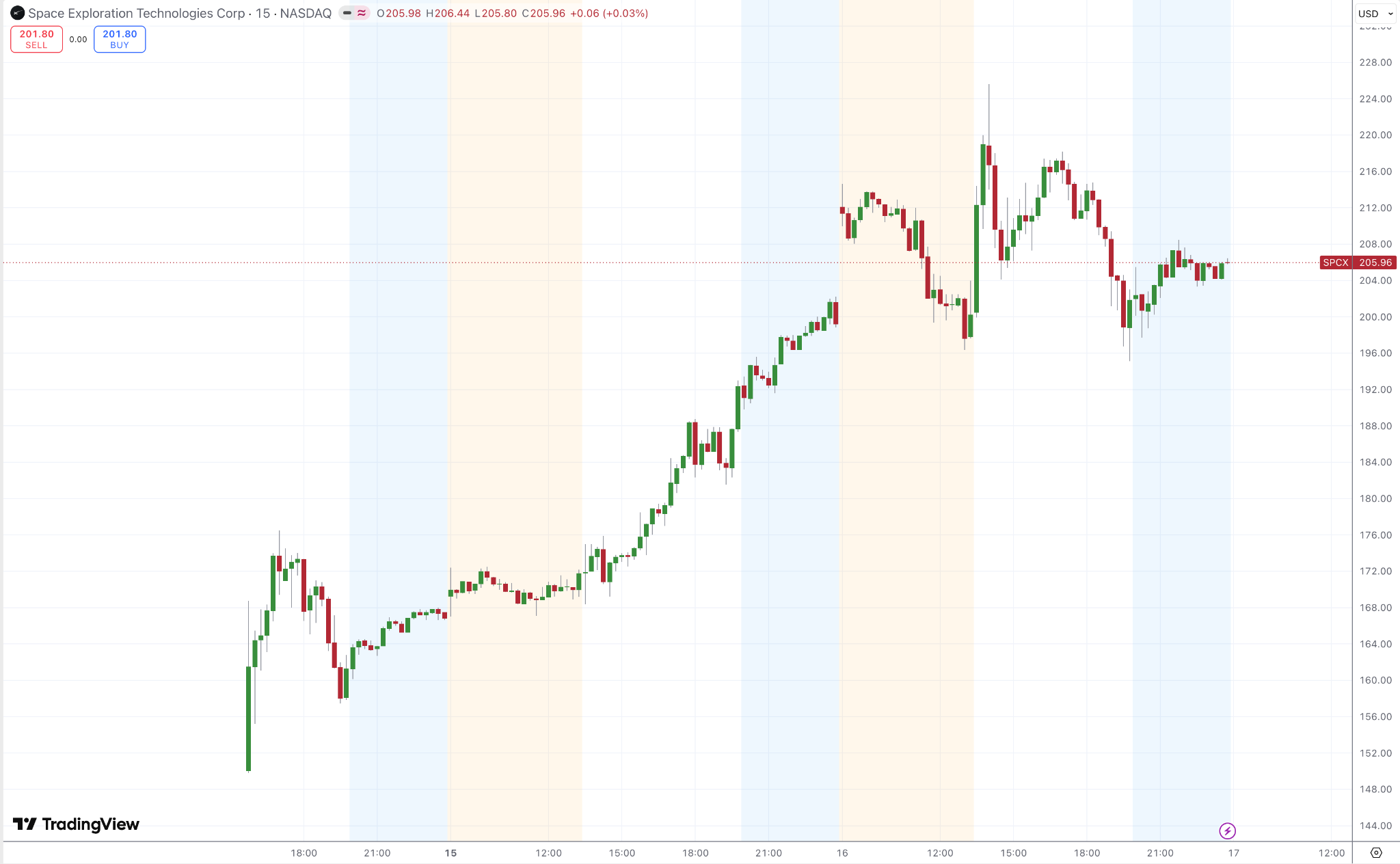
Source: SPCX TradingView 15-Min Chart
The gap between the $164 average analyst price target and the $200-plus current trading price tells you everything about who is moving this stock right now. Analysts are applying discounted cash flow models to a company that has not posted a net profit. Retail traders are buying the story of Starlink, Starship, xAI, and Elon Musk's personal brand all in one ticker. Both groups are right about different things and wrong about different things, which is exactly what creates the volatility that traders should expect in the months ahead.
The Bitcoin Connection Nobody Is Talking About Enough
This is the angle most coverage is missing and it matters directly for traders who hold both SPCX and crypto.
SpaceX holds 18,712 Bitcoin on its corporate balance sheet, valued at just under $1.2 billion at current prices. That puts SpaceX among the largest corporate holders of Bitcoin in the world, alongside MicroStrategy and Tesla. Every significant move in Bitcoin now directly affects SpaceX's balance sheet and vice versa.
Alongside its Nasdaq debut, a tokenized version of SpaceX stock issued on Solana by Backpack enabled on-chain trading and redemption of the underlying shares, testing investor appetite for the convergence of traditional equities and blockchain markets.
SpaceX is not just a space company that happens to own some Bitcoin. It is the first mega-cap listed company to have its equity simultaneously trading on Nasdaq, in perpetual futures on Hyperliquid, and as a tokenized instrument on Solana. That convergence of traditional and crypto markets in a single company is genuinely new territory.
Bitcoin ETFs saw record multi-session redemptions totalling about $4.4 billion in the week before the SpaceX listing, as retail money shifted toward SpaceX allocations.
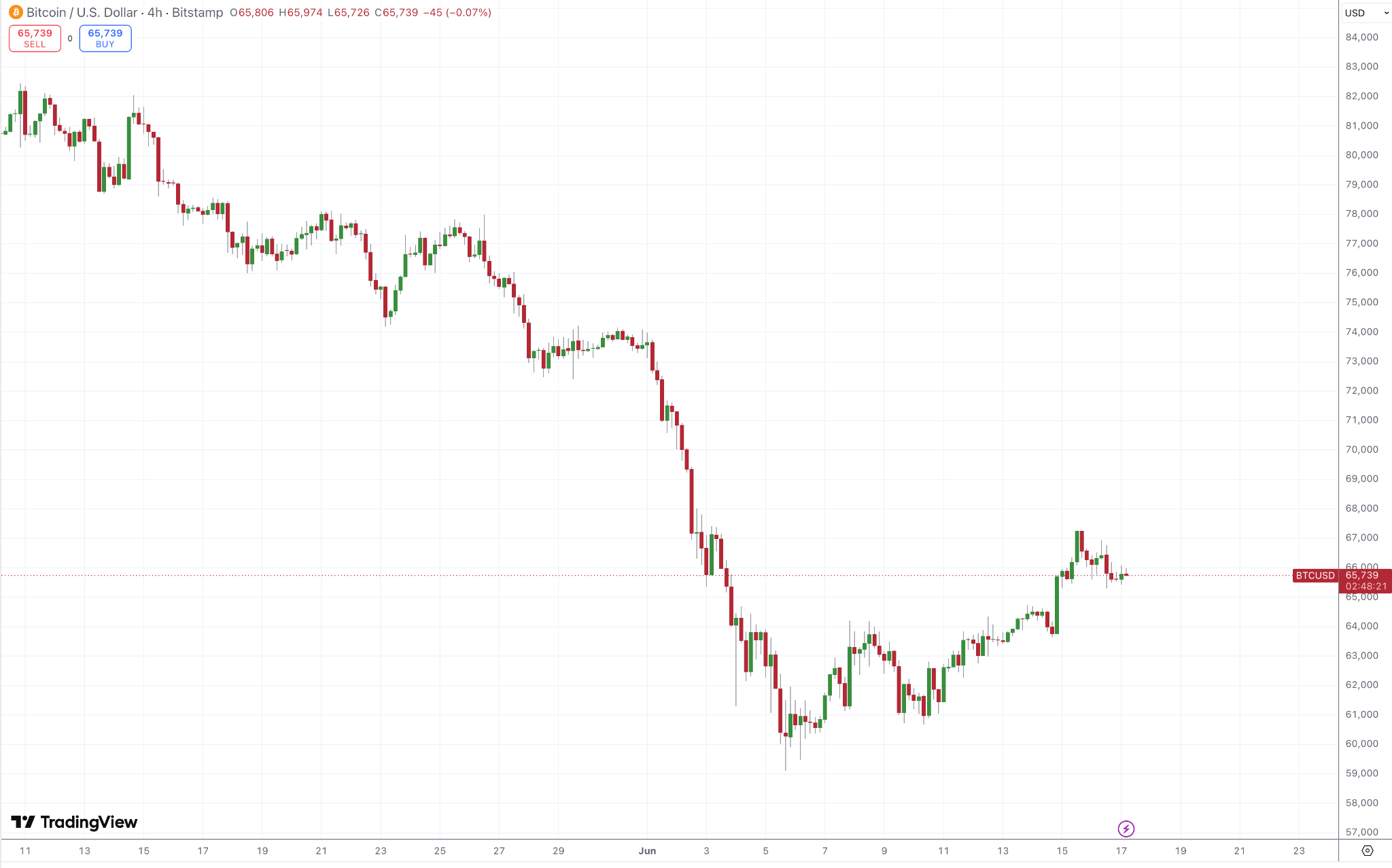
Source:Bitcoin TradingView 4H Chart
Stablecoin flows and on-chain data showed no clear signs of abnormal cashing out from crypto markets beyond those ETF redemptions. The capital rotation from Bitcoin ETFs into SPCX was real, measurable, and temporary. Traders watching Bitcoin in the weeks after the IPO should watch whether that $4.4 billion finds its way back into crypto now that the SpaceX allocation window has closed.
“Trade SpaceX Stock with an ASIC-regulated broker. Fast AUD funding via PayID. ”
The Valuation Debate: Is SPCX Worth $200?
This is the most important question any trader needs to answer before taking a position in either direction.
SpaceX reported revenue of $18.67 billion in 2025 with a net income margin of negative 45% and a negative return on equity of 25.46%. At $200 per share, the stock trades at a price-to-sales ratio of 109 and an EV/EBITDA of 1,123, reflecting extreme investor expectations for future space economy growth. Those are not traditional valuation multiples. They are a bet on an entirely different future.
The bull case for holding SPCX at $200 rests on three pillars. Starlink satellite internet is the dominant revenue engine, with AI compute rental deals with Google and Anthropic opening a third revenue stream alongside the launch business. Starlink generates over 61% of total 2025 revenue and is growing rapidly. If Starlink reaches 50 million subscribers and SpaceX scales its AI compute business through xAI, the revenue multiple starts to look less extreme in a 2028 or 2029 timeframe.
The bear case is simpler. SpaceX lost $4.28 billion in its most recent quarter and the average analyst price target of $164 sits 18% below where the stock trades today. The 180-day lockup on insider ownership means the float is constrained through late 2026, which is artificially inflating the price by limiting the supply of shares that can trade. When that lockup expires, insiders will face the choice of selling into a market that has priced in extraordinary future growth at current levels.
What to Watch in the Next 90 Days
Five specific events will determine whether SPCX consolidates at current levels or gives back a significant portion of the IPO pop.
September 2 Earnings
The September 2, 2026 earnings report will be the first fundamental anchor for the post-IPO valuation. Traders will see for the first time how Starlink subscription growth is tracking, whether the AI compute rental revenue is scaling, and how the Starship development costs are running against revenue. A strong revenue beat with narrowing losses could push SPCX toward the $227 high estimate. A miss could test the $161 IPO close support.
MSCI Inclusion
MSCI inclusion is expected following the listing, which would force passive funds tracking MSCI indexes to buy SPCX regardless of valuation. That forced buying from index funds represents a structural inflow that is independent of whether analysts think the stock is worth $164 or $227.
Bitcoin Treasury Moves
SpaceX holds 18,712 Bitcoin. Any significant move in Bitcoin now registers directly on SpaceX's balance sheet. A Bitcoin rally to $70,000 adds over $200 million to SpaceX's treasury. A crash to $40,000 creates a balance sheet headwind that will show up in the September earnings report as a mark-to-market loss.
Lockup Expiry
The 180-day lockup expires in December 2026. As that date approaches, the market will begin pricing in the potential supply of insider shares hitting the open market. Traders who are long SPCX in October and November should have the lockup calendar marked clearly.
Starlink Subscriber Data
SpaceX does not report monthly subscriber data like a traditional SaaS company, but channel checks, satellite capacity data, and Elon Musk statements all provide leading indicators for Starlink growth. Any indication that subscriber growth is decelerating will hit the stock immediately given how much of the valuation depends on Starlink reaching tens of millions of paying users.
“Trade SpaceX Stock with an ASIC-regulated broker. Fast AUD funding via PayID. ”
How Australian Traders Access SPCX
SPCX trades on Nasdaq in US dollars and is not available directly on the ASX. Australian traders who want exposure have a few practical routes available to them.
Mitrade, regulated by ASIC under licence AFSL 398528, offers US-listed stocks as CFD instruments, which means Australian traders can go long or short on SPCX price movements without needing a US brokerage account or converting AUD to USD.
You can go long if you expect the post-IPO momentum to continue toward the $227 analyst high target. You can go short if you expect the valuation at 109 times revenue to mean revert toward the $164 consensus average. Stop-loss and take-profit controls appear directly on the order screen before you confirm any trade, and zero commission applies across all instruments.
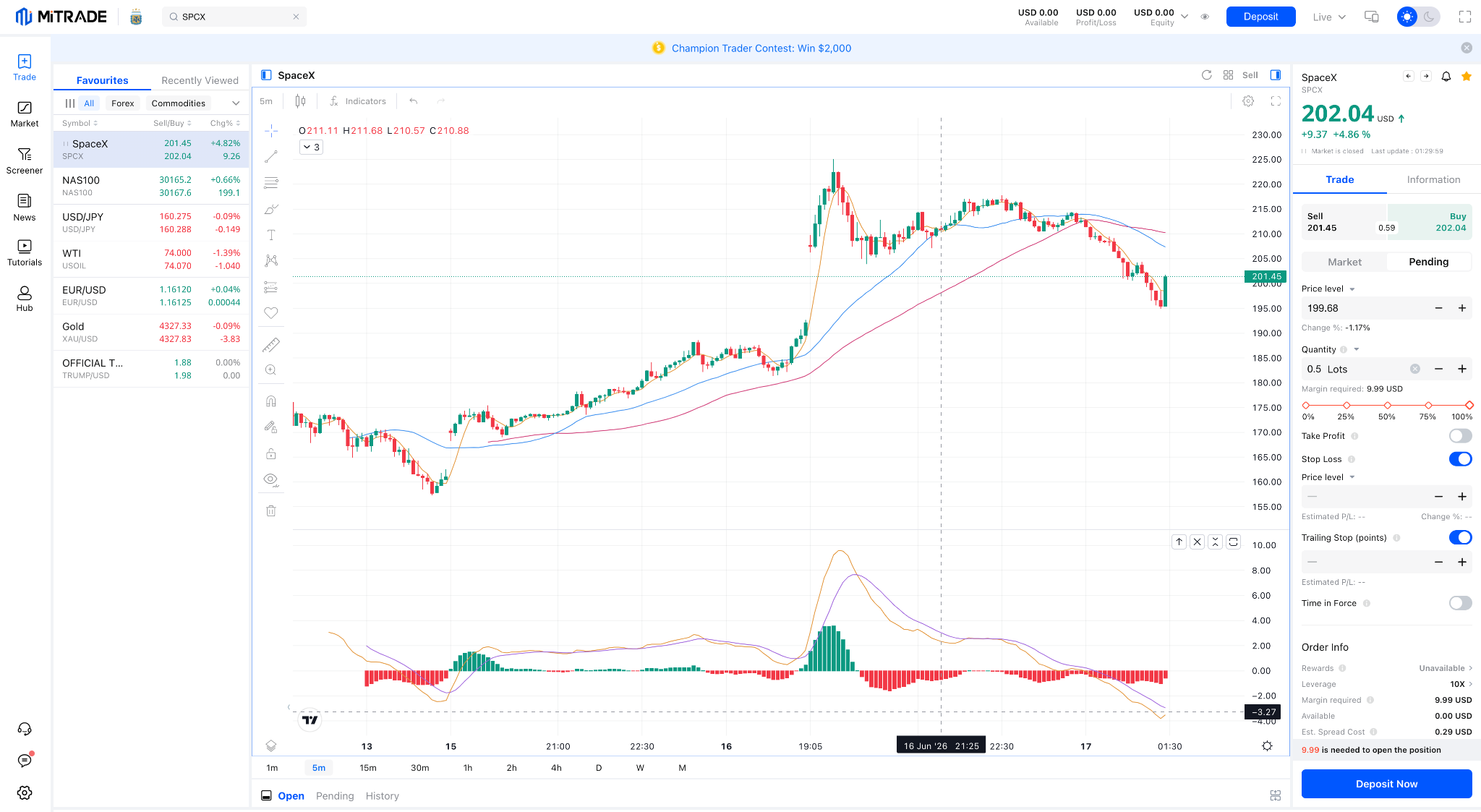
Source: SPCX Mitrade 15-Min Chart
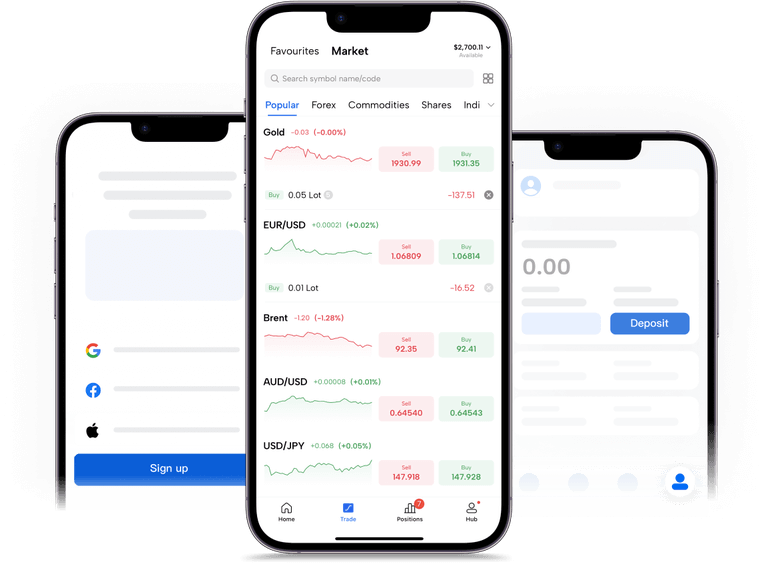
A free demo account on Mitrade loads $50,000 in virtual funds and mirrors live SPCX price movements so Australian traders can practise positioning around the September 2 earnings date before committing real capital. The platform runs identically across web, iOS, and Android with no feature difference between versions.


Pros of Trading SPCX as a CFD
You can go short on SPCX if you believe the 109 times revenue valuation is disconnected from the fundamental reality of a loss-making company, a position that is impossible to take if you only hold the physical stock.
You can react immediately to Starlink subscriber data, Bitcoin treasury moves, and Elon Musk statements that move the stock without needing to wait for an ASX session to open or for a US brokerage account to process a transfer.
You can access SPCX price movements from an ASIC-regulated Australian account with zero commission and no currency conversion costs on entry, removing the AUD/USD exchange rate as an additional variable alongside the equity risk.
You can position for the September 2 earnings event with precise risk management by setting your stop loss at the $161 IPO close support and your take profit at the $227 analyst high target before the trade is even open.
You can trade small size. At $200 per share, buying a single SPCX share on Nasdaq requires significant capital. A CFD on Mitrade gives you meaningful exposure to SPCX price movements with a much smaller initial outlay.
1. What is SpaceX's ticker symbol and where does it trade?
SpaceX trades on the Nasdaq Composite under the ticker SPCX, where it listed on June 12, 2026 at an IPO price of $135 per share. It is not available directly on the ASX. Australian traders access SPCX exposure through CFD platforms like Mitrade, through international brokers with US market access, or through any tokenized SPCX instruments that become available on blockchain platforms.
2. What price did SpaceX close on its first day of trading?
SpaceX stock opened at $150 on June 12, 2026, an 11% jump from its IPO price of $135, surged past 30% intraday, and closed its first session at $160.95 for a 19.2% first-day gain. The stock continued higher through the following week, trading above $200 by June 16.
3. Why does SpaceX hold Bitcoin and why does it matter for traders?
SpaceX holds 18,712 Bitcoin on its corporate balance sheet, valued at just under $1.2 billion at current prices. This makes SpaceX one of the largest corporate Bitcoin holders globally and creates a structural link between SPCX and Bitcoin price movements. A significant Bitcoin rally or crash will show up directly in SpaceX's quarterly earnings as a mark-to-market gain or loss.
4. Is SpaceX profitable?
SpaceX reported revenue of $18.67 billion in 2025 but has not posted a net profit, reporting a net income margin of negative 45% in its most recent quarter. The company trades at 109 times revenue, a multiple that requires exceptional and sustained growth in both Starlink subscribers and its newer AI compute rental business to justify at current prices.
5. What are the key risks of holding SPCX after the IPO?
The five key risks are the 180-day insider lockup expiring in December 2026 and releasing a significant supply of shares, the September 2 earnings report revealing whether the revenue trajectory justifies the $2 trillion valuation, Bitcoin treasury volatility directly affecting the balance sheet, Starlink subscriber growth decelerating below market expectations, and the extreme valuation multiple of 109 times revenue leaving no room for any fundamental disappointment.
6. Can Australian traders trade SpaceX on Mitrade?
Yes. Mitrade offers US-listed stocks as CFD instruments under ASIC regulation with licence AFSL 398528. Australian traders can go long or short on SPCX (SPCX) from the Mitrade platform across web, iOS, and Android with zero commission and no US brokerage account required. A free demo account with $50,000 in virtual funds is available to practise positioning around the September 2 earnings date before going live.
* The content presented above, whether from a third party or not, is considered as general advice only. This article should not be construed as containing investment advice, investment recommendations, an offer of or solicitation for any transactions in financial instruments.


