




Oil Price Rally Continues: Where to Trade WTI & Brent Crude Oil Before the Next Breakout

Today's Oil Market Performance
Oil Price Today
Global crude oil prices surged to their highest levels since May on 11 September as escalating conflict in the Middle East intensified fears of prolonged disruptions to global energy supplies. WTI crude (USOIL) jumped 7.51% to settle at $103.94 per barrel, while Brent crude (UKOIL gained 7.43% to $109.30, after reaching an intraday high of $109.68. Both benchmarks have now moved firmly above the psychologically important $100 level, marking a sharp acceleration from the roughly $86 WTI and $90 Brent levels seen at the start of September.
The latest rally has been driven by a sharp deterioration in the Middle East supply outlook. Attacks on oil tankers around the Strait of Hormuz have intensified, while Iran has threatened further retaliation following U.S. strikes on Iranian vessels. At the same time, Iran-aligned Houthi forces have seized Yemen's Mocha port, raising fresh concerns about shipping through the Bab el-Mandeb Strait and the wider Red Sea region. These developments have increased the risk that disruptions to oil transportation could persist rather than prove temporary.
The physical oil market is also coming under increasing pressure. Saudi Arabia's August oil production reportedly fell to around 6.2 million barrels per day, its lowest level of the year, while crude exports dropped sharply as security risks disrupted shipping routes. Meanwhile, the U.S. Energy Information Administration expects significant Middle Eastern production shut-ins to continue, reinforcing concerns that global supply could remain constrained.
The oil rally is also creating a new macroeconomic risk. With Brent now approaching $110 and WTI above $100, higher energy costs are feeding directly into inflation expectations. Global bond yields have risen sharply, with the U.S. 10-year Treasury yield approaching 5%, as markets reassess the likelihood of further interest-rate increases. This means the oil rally could increasingly affect not only energy markets but also currencies, bonds and equities.
With WTI above $100 and Brent near $110, traders are now watching whether crude can extend the breakout towards the next major psychological levels. If disruptions through the Strait of Hormuz and Bab el-Mandeb persist, WTI could target $105–110, while Brent could potentially challenge $110–115. Some analysts have warned that a prolonged supply disruption could push Brent significantly higher, with scenarios around $120 per barrel becoming increasingly relevant if the conflict remains unresolved.
However, the scale of the recent rally also raises the risk of a sharp correction. Any credible ceasefire, improvement in tanker traffic or progress towards restoring oil flows through key shipping routes could trigger profit-taking. Market analysts have also warned that crude is becoming technically overbought after its rapid advance.
For Australian investors, the surge in volatility is creating renewed interest in WTI (USOIL) and Brent (UKOIL) CFDs. CFDs allow traders to take long or short positions on oil prices without taking physical ownership of crude, providing a way to potentially trade both directions of the market. However, with daily price swings becoming significantly larger, leverage can amplify losses as well as gains, making position sizing and stop-loss management particularly important.
“Trade Crude Oil with an ASIC-regulated broker. Fast AUD funding via PayID. ”
Where to Trade Oil in Australia
Australian investors can trade crude oil through several financial instruments, including oil CFDs, futures, ETFs, and energy company shares. For most retail traders, oil CFDs are the most accessible option because they allow you to speculate on both rising and falling prices without owning physical barrels of oil.
The two most widely traded benchmarks are:
WTI (West Texas Intermediate) – the U.S. benchmark, traded under the symbol USOIL
Brent Crude – the international benchmark, traded under the symbol UKOIL
Oil CFDs are particularly popular because they offer:
Trade both long and short
Access to WTI and Brent from one account
Lower capital requirements than oil futures
Extended trading hours
Built-in leverage (subject to ASIC regulations)
Fast execution during major market events
💡 When choosing where to trade oil, look for a broker that offers competitive spreads, strong regulation, reliable execution, and an intuitive trading platform. For Australian traders, ASIC regulation is an important factor when evaluating broker safety.
Best Oil Brokers in Australia (2026)
These brokers provide access to the world's most actively traded oil benchmarks and are suitable for different trading styles—from beginners looking for a simple CFD platform to experienced traders seeking futures and advanced charting tools.
Whether you're looking to trade short-term price swings driven by geopolitical events or capitalize on longer-term oil trends, Mitrade provides a straightforward way to access the global energy markets without the complexity of futures contracts.
📌 Tip: Oil prices are highly sensitive to OPEC+ production decisions, U.S. inventory reports, geopolitical tensions, and global economic data. Before opening a position, always monitor the latest news and use appropriate risk management tools such as stop-loss orders.
“Trade Crude Oil with an ASIC-regulated broker. Fast AUD funding via PayID. ”
Oil Price Forecast: Can WTI and Brent Extend Their Rally?
The key question for traders is no longer whether oil can break above $100, but whether the latest breakout can extend towards $110 and potentially $120.
At the same time, the market is becoming increasingly stretched. A rapid rise of more than 13% in Brent over the week means that profit-taking and sharp intraday reversals are possible, particularly if there are signs of improving oil flows or progress towards de-escalation.
Outlook
The short-term oil price outlook remains strongly bullish, but the risk-reward profile has changed significantly after the move above $100.
The key levels traders should watch are:
WTI: $100 support → $105–110 resistance → $115–120 bullish target
Brent: $105–107 support → $110 resistance → $115–120 bullish target
WTI major support: $95–97
Brent major support: $100–102
If the current supply disruption persists, WTI could remain above $100 and move towards $110, while Brent could test $110–115 and potentially $120 in a more severe supply-shock scenario. Reuters reports that analysts see prices potentially approaching the March highs near $119.48 if disruptions persist.
However, traders should also be prepared for substantial volatility. After Brent gained nearly 13% in a single week, the market is vulnerable to profit-taking, particularly if geopolitical tensions ease or physical oil flows improve.
There is also an important divergence between the short-term geopolitical outlook and longer-term supply-demand forecasts. While current disruptions are pushing prices sharply higher, the EIA expects production and exports to gradually recover and Brent prices to eventually decline as global inventories rebuild.
For Australian traders considering WTI and Brent CFDs, the next major move will therefore depend on whether the market sees another escalation in supply disruptions or evidence that oil flows are returning to normal. With WTI above $100 and Brent near $110, both scenarios could produce large price swings, making position sizing, leverage and stop-loss management particularly important.
How to Trade Oil CFDs with Mitrade
If you want to benefit from oil price movements without buying physical crude or trading complex futures contracts, oil CFDs offer a flexible alternative.
With Mitrade, Australian traders can speculate on both WTI (USOIL) and Brent (UKOIL) markets from a single trading account.
Step 1: Open a Trading Account: Create your Mitrade account online and complete the verification process.
Step 2: Fund Your Account: Deposit funds using your preferred payment method.
Step 3: Search for Oil Markets: Choose either:
WTI Crude (USOIL)
Brent Crude (UKOIL)
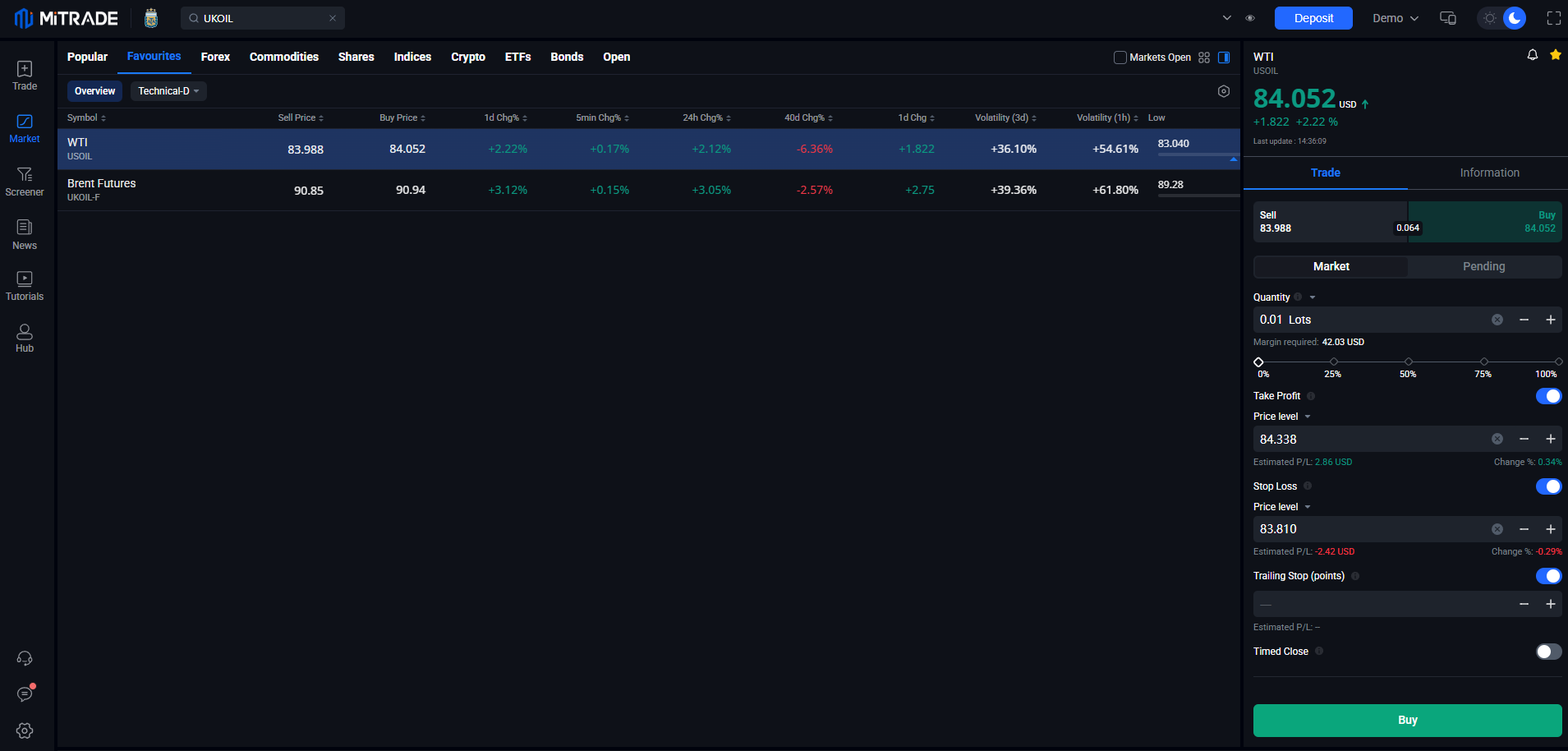
Step 4: Analyse the Market: Use Mitrade's built-in charts and technical indicators to identify trading opportunities based on support, resistance, trendlines and momentum.
Step 5: Place Your Trade: Decide whether oil prices are likely to:
Rise → Open a Buy (Long) position.
Fall → Open a Sell (Short) position.
Set your preferred position size together with stop-loss and take-profit levels before executing the trade.
Why Trade Oil CFDs with Mitrade?
Commission-free CFD trading
Access to both WTI and Brent crude
Competitive spreads
Long and short trading opportunities
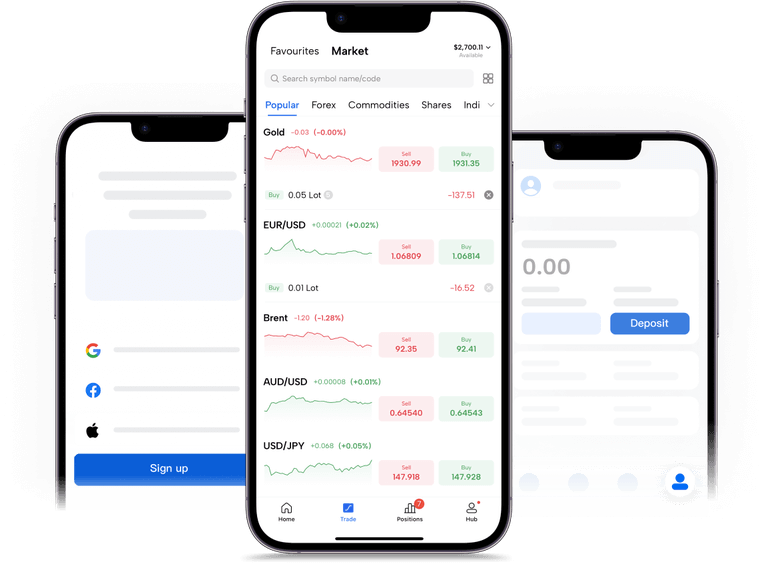
User-friendly mobile and desktop platforms
Free demo account for beginners
Real-time market analysis and price alerts
Because CFDs are leveraged products, they can amplify both profits and losses. Always use appropriate risk management and only trade with capital you can afford to risk.


1. Is now a good time to trade oil?
Oil remains highly volatile due to geopolitical tensions, OPEC+ policy decisions and global economic data. Active traders may find increased volatility creates more trading opportunities, but it also raises risk.
2. What is the difference between WTI and Brent crude?
WTI (West Texas Intermediate) is the primary U.S. oil benchmark, while Brent is the international benchmark used to price most globally traded crude oil. Brent generally trades at a premium because of its global relevance and transportation dynamics.
3. Can Australians trade oil CFDs?
Yes. Australian investors can trade WTI and Brent crude oil CFDs through ASIC-regulated CFD brokers such as Mitrade, allowing them to speculate on both rising and falling oil prices without owning physical oil.
4. What affects oil prices the most?
The main drivers include:
Middle East geopolitical tensions
OPEC+ production decisions
U.S. crude inventory reports
Global economic growth
U.S. Dollar strength
Supply disruptions and extreme weather
Disclaimer: The content presented above, whether from a third party or not, is considered as general advice only. CFD trading involves significant risk of loss. Past performance does not guarantee future results. This article serves informational purposes only and does not constitute financial advice. Consider your risk tolerance before trading.


