




Share CFD Trading Australia: How It Works & How to Start

Share CFD trading allows traders to speculate on the price movements of individual company shares without owning the underlying stocks. Through contracts for difference (CFDs), traders can take positions on rising or falling share prices, access Australian and international markets, and use leverage to gain market exposure with a smaller initial margin.
However, share CFDs are fundamentally different from traditional share investing. Leverage can magnify losses as well as gains, while trading costs and market volatility can affect outcomes.
For Australian traders, understanding these differences is particularly important as interest rate expectations, company earnings and global market developments continue to influence share prices.
This guide explains what share CFD trading is, how it works, how it compares with traditional share trading, and the steps Australians can take to explore CFDs through a trading platform such as Mitrade.
What Is a Share CFD and How Does It Work?
A share CFD (Contract for Difference) is a financial derivative that allows traders to speculate on changes in a company's share price without purchasing the underlying shares.
When you trade a share CFD, you enter into an agreement with a CFD provider to exchange the difference between the opening and closing value of a position.
For example, instead of buying shares in BHP Group directly through a stockbroker, a trader could open a CFD position referencing BHP's share price.
If the price moves in the trader's favour, the position may generate a profit. If it moves against the position, the trader incurs a loss.
Unlike traditional shareholders, CFD traders do not acquire ownership of the underlying company or shareholder voting rights.
How Does Share CFD Trading Work?
Share CFD trading generally involves three elements:
Choosing an underlying share: Select a CFD referencing a listed company, such as BHP, Commonwealth Bank or Apple, where the instrument is available.
Selecting a trading direction: Open a buy (long) position if you expect the share price to rise, or a sell (short) position if you expect it to fall.
Managing and closing the position: Monitor price movements, trading costs and margin requirements. The difference between the opening and closing prices determines the trading profit or loss, before applicable charges.
For instance, buying 100 CFD units at A$50 creates A$5,000 of market exposure. If the underlying price rises to A$52, the gross gain is A$200. If it falls to A$48, the gross loss is A$200.
Going Long vs Going Short on Shares
One feature of share CFDs is the ability to speculate on either direction of a company's share price.
Going long (buying): A trader opens a buy position when expecting the underlying share price to increase. A price rise benefits the position, while a decline creates a loss.
Going short (selling): A trader opens a sell position when expecting the underlying share price to decrease. A price decline benefits the position, while a rise creates a loss.
For example, if a trader opens a short CFD position referencing a share priced at A$100 and closes it at A$95, the gross gain is A$5 per CFD unit, before costs.
However, if the price increases to A$105, the position incurs a gross loss of A$5 per unit.
Short CFD positions can incur significant losses if prices rise sharply. The availability of short positions also depends on the instrument and provider.
Share CFD Leverage and Margin Explained
Leverage allows traders to control a larger position by depositing only part of its total notional value as initial margin.
For retail clients in Australia, CFDs referencing individual shares are generally subject to a maximum leverage ratio of 5:1 under ASIC's product intervention framework, equivalent to a minimum initial margin of 20%.
This means a hypothetical A$5,000 share CFD position would require at least A$1,000 in initial margin at 5:1 leverage.
* Illustrative long position, excluding all trading costs and assuming the position remains open. Actual margin close-out may occur before the illustrated price change is reached.
The example demonstrates why leverage is risky: relatively small movements in the underlying share can cause much larger percentage changes relative to the margin committed.
CFD Trading vs Share Trading: What's the Difference?
One of the most important questions for Australian investors is whether to trade share CFDs or buy traditional shares.
Although both provide exposure to share price movements, they differ significantly in ownership, leverage, costs, investment horizon and risk.
Which Is More Suitable for Your Trading Goals?
Traditional share investing may be more aligned with objectives such as long-term ownership, dividend income and building a diversified investment portfolio without leverage.
Share CFD trading may be considered by experienced traders seeking short-term exposure, the ability to speculate on falling prices or certain hedging strategies.
However, these features do not make CFDs suitable for everyone. Their complexity, financing costs and potential for rapid losses mean they may be inappropriate for investors with limited trading experience, a low tolerance for losses or a long-term buy-and-hold objective.
Before choosing either approach, consider your investment timeframe, financial circumstances, risk tolerance and understanding of the product.
“Trade Share CFDs with an ASIC-regulated broker. Fast AUD funding via PayID. ”
Why Trade Share CFDs in Australia? Benefits and Risks
Australian traders can use share CFDs to obtain price exposure to selected domestic and international companies through a CFD trading platform.
However, the benefits must be weighed against the additional risks of derivatives.
Access to Australian and Global Share Markets
Share CFD providers may offer instruments referencing companies listed on the Australian Securities Exchange (ASX) and major international exchanges.
Examples of companies frequently followed by Australian market participants include:
Commonwealth Bank and other major Australian banks.
Apple, Nvidia and Tesla in the US technology and growth sectors.
Instrument availability, trading hours and contract specifications differ by provider.
Trading Rising and Falling Share Prices
CFDs can provide exposure to both upward and downward price movements, provided the relevant buy or sell position is available.
For example, traders may monitor a bank's earnings announcement, a mining company's production update or a US technology company's financial results when assessing possible price movements.
However, a well-researched market view can still be wrong. Share prices may move unexpectedly following economic releases, company announcements or changes in investor sentiment.
Key Risks of Leveraged Share CFDs
The principal risks include:
Leverage risk: Small underlying price changes can produce large losses relative to initial margin.
Market and gap risk: Prices may move sharply, particularly after earnings announcements or outside normal trading hours.
Margin close-out risk: Positions may be automatically closed if account equity falls below required levels.
Financing risk: Overnight charges can accumulate and reduce trading returns.
Execution and liquidity risk: Spreads may widen and orders may execute at less favourable prices during volatile conditions.
Currency risk: Trading CFDs referencing foreign shares may introduce additional currency exposure or conversion costs.
Australian and US Shares to Watch for CFD Trading in 2026
Market volatility can create significant price movements in individual shares, but it also increases the risk of rapid losses for leveraged traders.
As of 15 October 2026, Australian equities are being influenced by changing interest rate expectations, persistent inflation concerns, commodity prices and developments in global technology markets.
Australia's September labour market report showed the unemployment rate at 4.7%, with employment falling by approximately 39,000 people. The weaker data prompted investors to reassess the possibility of another Reserve Bank of Australia (RBA) interest rate increase.
These developments are relevant to share CFD traders because monetary policy expectations can affect banks, mining companies, growth stocks and broader market sentiment.
The following companies illustrate different market drivers worth researching.
1. BHP Group (ASX: BHP): Iron Ore Prices and China Demand
Sector: Materials and mining
BHP is one of Australia's largest resources companies. Its share price is influenced by iron ore and copper prices, Chinese industrial activity, operating costs and global economic expectations.
On 14 October 2026, the Australian materials sector faced selling pressure as investors considered global inflation and interest rate risks. Iron ore was quoted at approximately US$90.65 per tonne in ABC's late-afternoon market snapshot.
For traders researching a BHP share CFD, relevant indicators include:
Iron ore price movements and Chinese steel demand.
BHP production reports and earnings announcements.
Australian dollar movements.
Global manufacturing and infrastructure investment trends.
A rise in commodity prices does not automatically translate into a higher BHP share price. Currency movements, company-specific costs and broader equity market sentiment can also influence performance.
2. Commonwealth Bank (ASX: CBA): Interest Rates and Banking Earnings
Sector: Financial services
Commonwealth Bank is a major Australian financial institution whose share price can respond to RBA policy, mortgage demand, funding costs, credit quality and investor expectations.
On 14 October 2026, CBA shares closed at A$151.17, down approximately 2.16% from the previous session, while major Australian banks contributed to the broader ASX decline.
The September employment figures released on 15 October introduced another variable into the interest rate outlook.
For CBA, traders may monitor the interaction between interest rates and banking profitability.
Higher interest rates can influence net interest margins, but they may also increase pressure on borrowers and credit quality. Lower interest rate expectations can support certain economic activities while creating different challenges for bank earnings.
Key events to monitor: RBA announcements, Australian inflation data, employment reports, bank trading updates and mortgage market conditions.
3. Nvidia (NASDAQ: NVDA): AI Investment and Technology Volatility
Sector: Semiconductors and artificial intelligence
Nvidia is closely followed by global equity traders because of its exposure to AI computing infrastructure, semiconductor demand and technology-sector investment.
US technology shares remain sensitive to inflation expectations, bond yields, AI infrastructure spending and company earnings.
In the US session preceding 15 October 2026, the Nasdaq declined by approximately 2%, illustrating the volatility affecting growth-oriented equities.
For traders following Nvidia CFDs, potential market drivers include:
Quarterly earnings and forward revenue guidance.
AI infrastructure spending by major technology companies.
US inflation data and Federal Reserve interest rate expectations.
Semiconductor export restrictions and supply-chain developments.
Valuation expectations across the technology sector.
Nvidia can experience substantial price movements around earnings announcements. Such events can create significant gap and execution risks for leveraged positions.
How Do I Start Share CFD Trading in Australia?
Step 1: Choose an Australian-Regulated CFD Provider
Before considering a CFD provider, verify its Australian Financial Services Licence (AFSL) through ASIC's official registers.
Check the provider's regulatory status, product range, fee disclosures, platform features and client protection arrangements.
Mitrade operates an Australian CFD trading service and describes its Australian Financial Services Licence and ASIC regulatory framework on its Australian website.
Step 2: Open and Verify Your Trading Account
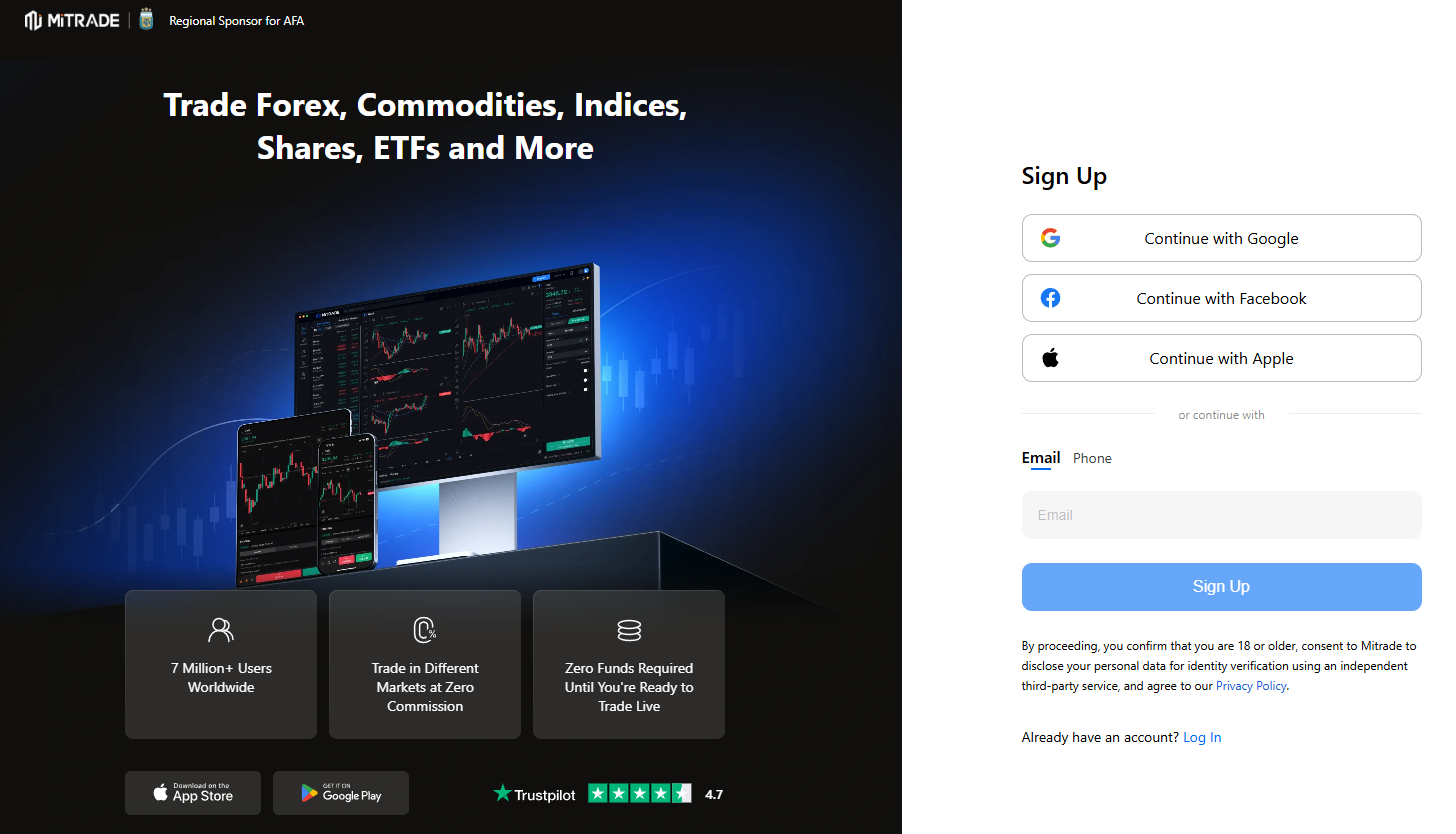
Opening a live CFD account typically requires personal information, identity verification and an assessment of whether the product is appropriate for the applicant.
Source: Mitrade Log in page
Step 3: Explore Share CFDs on a Demo Account
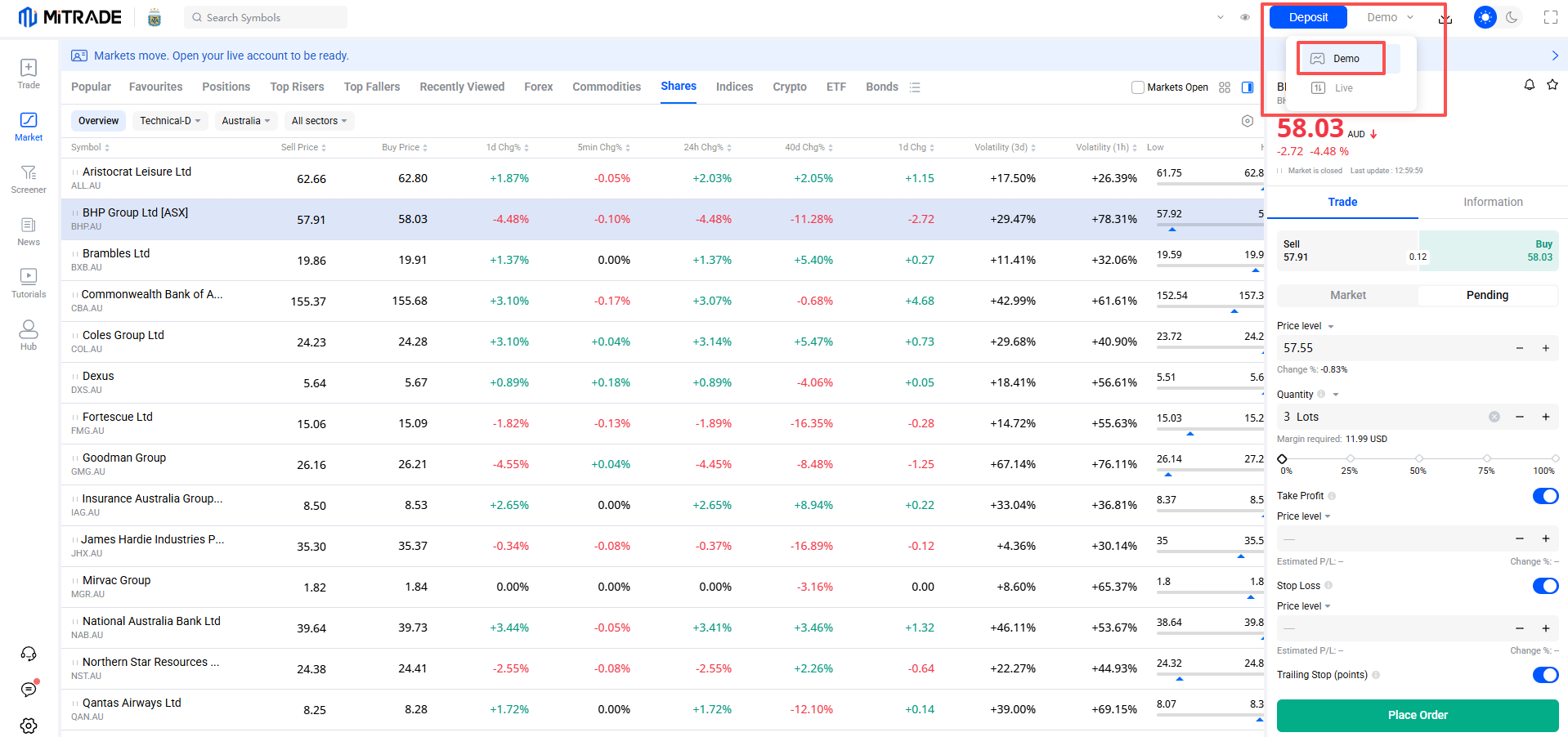
A demo account allows users to practise navigating a trading platform and placing simulated orders without committing real funds.
Mitrade offers a demo trading environment for registered users, allowing them to become familiar with its web and mobile platforms.
Source: Mitrade Trading page
“Trade Share CFDs with an ASIC-regulated broker. Fast AUD funding via PayID. ”
Step 4: Understand Margin and Trading Costs
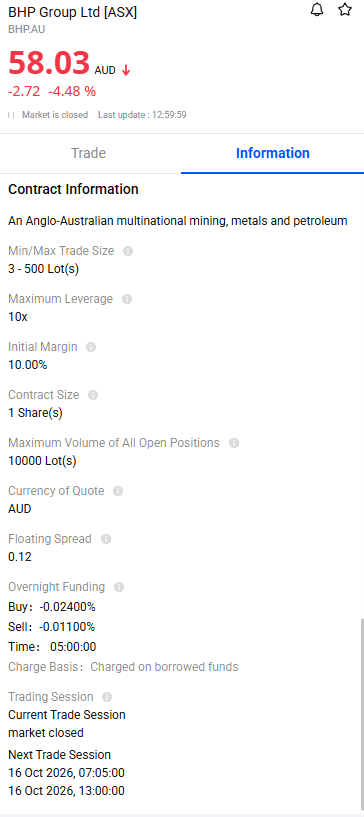
Before opening any live position, review the instrument's contract specifications.
Source: Mitrade (BHP.ASX Order Screen)
Step 5: Place and Monitor a Share CFD Trade
Once a trader has understood the risks and been approved for live trading, the general order process is:
Search for the available share CFD instrument.
Review the current bid and ask prices.
Select the buy or sell direction.
Choose a position size.
Check the required margin and applicable costs.
Consider risk controls, including stop-loss and take-profit orders.
Review the order details before confirming.
Monitor the position, account equity and market developments.
Stop-loss orders can help define a planned exit, but they do not guarantee execution at the requested price. Gapping and volatile conditions may result in slippage.
A trader should also understand how to close a position manually and how the platform handles margin requirements.
Why Consider Mitrade for Share CFD Trading?
Choosing a trading platform involves assessing more than the number of instruments available.
Relevant considerations include regulatory status, ease of use, pricing transparency, order-management features and access to educational resources.
Mitrade provides an Australian CFD trading platform covering multiple asset classes, including share CFDs, indices, forex and commodities.
Its published Australian CFD information highlights several features:
Access to multiple markets: Explore eligible Australian and international share CFDs alongside other CFD instruments.
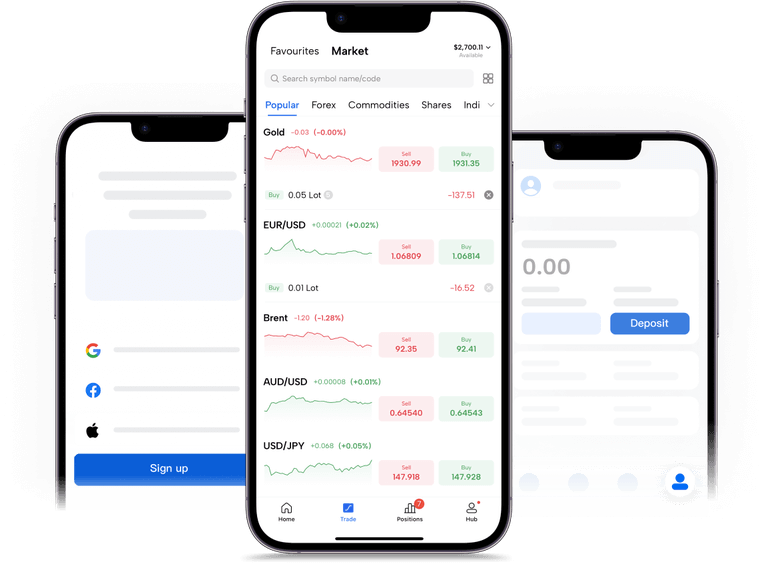
Web and mobile trading: View charts, monitor positions and manage orders using supported trading interfaces.
Demo trading: Become familiar with the platform and practise order entry in a simulated environment before considering live trading.
Visible trading costs: Review applicable spreads, overnight funding and instrument information before opening positions.
Retail client protections: Australian retail CFD accounts are subject to applicable ASIC requirements, including leverage limits and negative balance protection.
These features do not eliminate market, leverage, counterparty or execution risk.
Before opening a live account, review Mitrade's current product documents and determine whether CFD trading is appropriate for your financial circumstances, experience and objectives.


You might be interested in…
1. What is a share CFD?
A share CFD is a derivative contract that allows traders to speculate on the price movements of an individual company's shares without owning those shares. Profits and losses depend on the difference between the opening and closing prices, adjusted for applicable trading costs.
2. How do I start share CFD trading in Australia?
Start by learning how CFDs work, checking that a provider holds an Australian Financial Services Licence and reading the relevant product disclosures. A demo account can help you understand order placement, leverage and margin. Live trading should only be considered after assessing product suitability and the potential for significant losses.
3. What is the difference between CFD trading and share trading?
Traditional share trading involves buying and owning company shares. Share CFD trading involves a derivative contract based on share price movements without ownership. CFDs may provide leveraged exposure and the ability to take short positions, but introduce additional costs and risks.
4. Is share CFD trading legal in Australia?
Yes. CFDs can be offered legally in Australia by appropriately licensed providers, subject to applicable financial services laws and ASIC requirements. Retail CFD trading is subject to leverage limits and other consumer protection measures.
Disclaimer: The content presented above, whether from a third party or not, is considered as general advice only. CFD trading involves significant risk of loss. Past performance does not guarantee future results. This article serves informational purposes only and does not constitute financial advice. Consider your risk tolerance before trading.


