





TL;DR
One lot is 100 ounces. A one dollar move in gold changes one lot by $100, so gold positions are much smaller than forex positions for the same risk.
Leverage is capped at 20:1. Australian retail traders put up at least 5% of the position value as margin.
Overnight fees apply every night. Buy positions paid 0.02395% and sell positions 0.01129% on the full position size, not just the margin.
Long trades cost more to hold. On the demo, holding eight ounces long cost about $7.70 per night, compared with about $4.70 for ten ounces short.
Fees hit at 9am Sydney time. That's when the trading day rolls over during daylight saving.
There's a daily break from 9am to 10am. Orders can't be changed in that window.
Gold trades in US dollars. Profits and losses are in US dollars before any conversion to Australian dollars.
US data moves gold fast. Interest rate news and US jobs data can push gold through a stop in minutes.
Size from the stop, not the margin. Low margin can still sit behind a large loss.
Gold has been one of the most volatile major markets of 2026. It spiked close to 5,600 in late January, then slid back towards 4,000 by November.
Moves that size create opportunities in both directions. They also punish traders who jump in without a plan.
This guide shows how to trade gold CFDs in Australia, one step at a time. Every number comes from real screenshots of a Mitrade demo account, from the contract details to the final order.
What Is a Gold CFD?
A gold CFD is a contract that lets you profit or lose from changes in the gold price without owning any physical gold.
The market is quoted as XAU/USD, which is the price of one troy ounce of gold in US dollars. You can buy if you expect the price to rise or sell if you expect it to fall.
There are no bars to store and no delivery. Each trade settles in cash when you close it.
That flexibility comes with leverage, which magnifies losses as well as gains. So the plan matters more than the prediction.
Step 1: Read the Gold Contract Before You Trade
Every CFD market has its own contract details. Reading them first tells you what one lot really means in dollars.
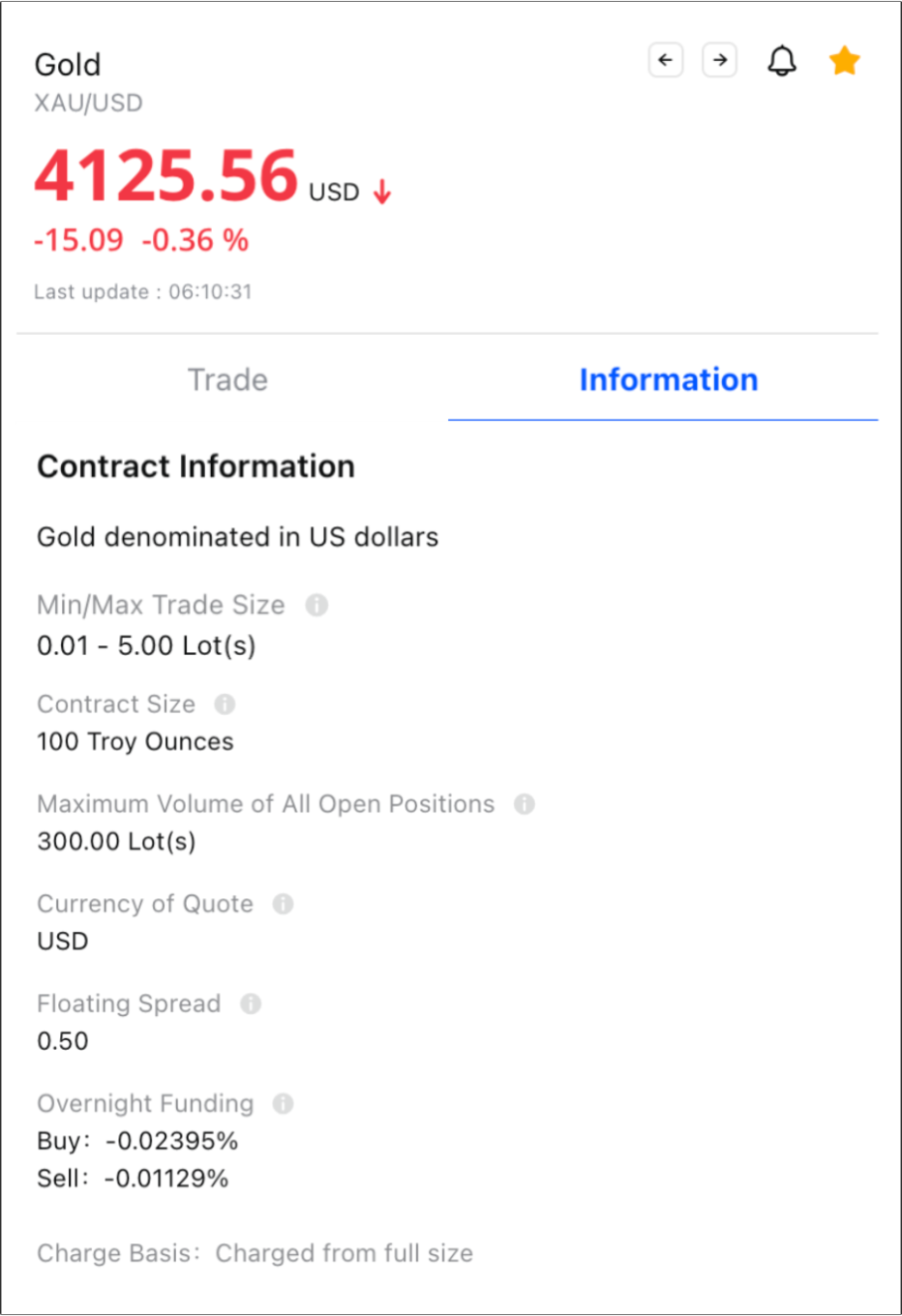
Here are the details for gold on the Mitrade platform.
Contract size and trade size
One lot of gold equals 100 troy ounces. The smallest trade is 0.01 lot, or one ounce, and the largest single trade is 5.00 lots.
This is why gold positions look small. At around 4,100, a single full lot controls more than $400,000 worth of gold.
Spread
The floating spread was 0.50 at the time of the screenshot. That is the gap between the buy and sell price.
On 0.08 lots, or eight ounces, a 0.50 spread costs $4 to open the trade. The spread is floating, so it can widen during fast markets.
Overnight funding
Positions held overnight pay a funding charge. On the demo account, buy positions paid 0.02395% per night and sell positions paid 0.01129%.
The charge applies to the full position size, not just the margin. It is taken at 9am Sydney time during daylight saving, when the trading day rolls over.
Trading hours
Gold trades almost around the clock on weekdays. During daylight saving, the session runs from 10am to 9am Sydney time the next day.
That leaves a one hour break each morning. Plan any order changes around that window.
Step 2: Understand What Moves the Gold Price
Gold does not react to company earnings or dividends. It reacts to a handful of big forces.
US interest rates. Gold pays no interest, so it tends to struggle when US rates rise and benefit when rates fall.
The US dollar. Gold is priced in US dollars. A stronger dollar makes gold more expensive for other buyers, which can weigh on the price.
Risk sentiment. Gold often attracts buyers during market stress, wars or banking scares. Calmer markets can pull money back into shares.
Central bank buying. Many central banks hold gold as a reserve asset. Steady buying from them can support the price over long periods.
For Australian traders, one extra point matters. Gold CFDs are quoted in US dollars, so profits and losses are in US dollars before any conversion.
Step 3: Read the Chart Before You Pick a Direction
Start with the big picture. A year view shows where the market has been and which levels still matter.
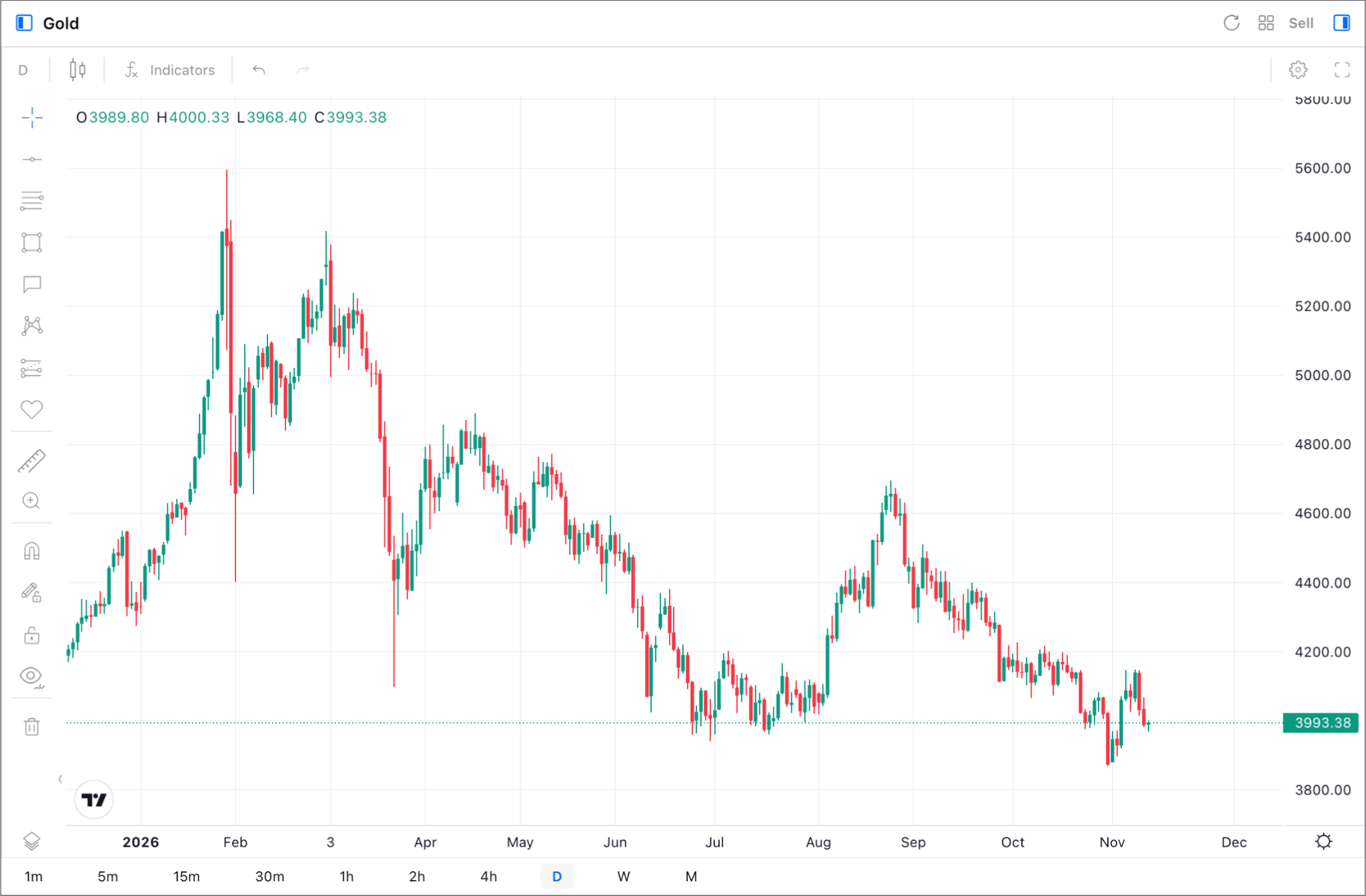
Image: Mitrade (Gold Daily Chart, 2026)
Gold surged to a spike near 5,600 in late January. It made a second peak near 5,400 in early March, then fell hard.
One level kept returning. The red line near 4,414 acted as support in late March and through May, then broke in June.
It capped gold in early August and broke again in September. Gold now trades below it, so 4,414 is the major ceiling overhead.
Zoom in to find the trading zones
The year view sets the scene, but trades need closer levels. Zoom in to the last few months and mark the zones where price actually turned.
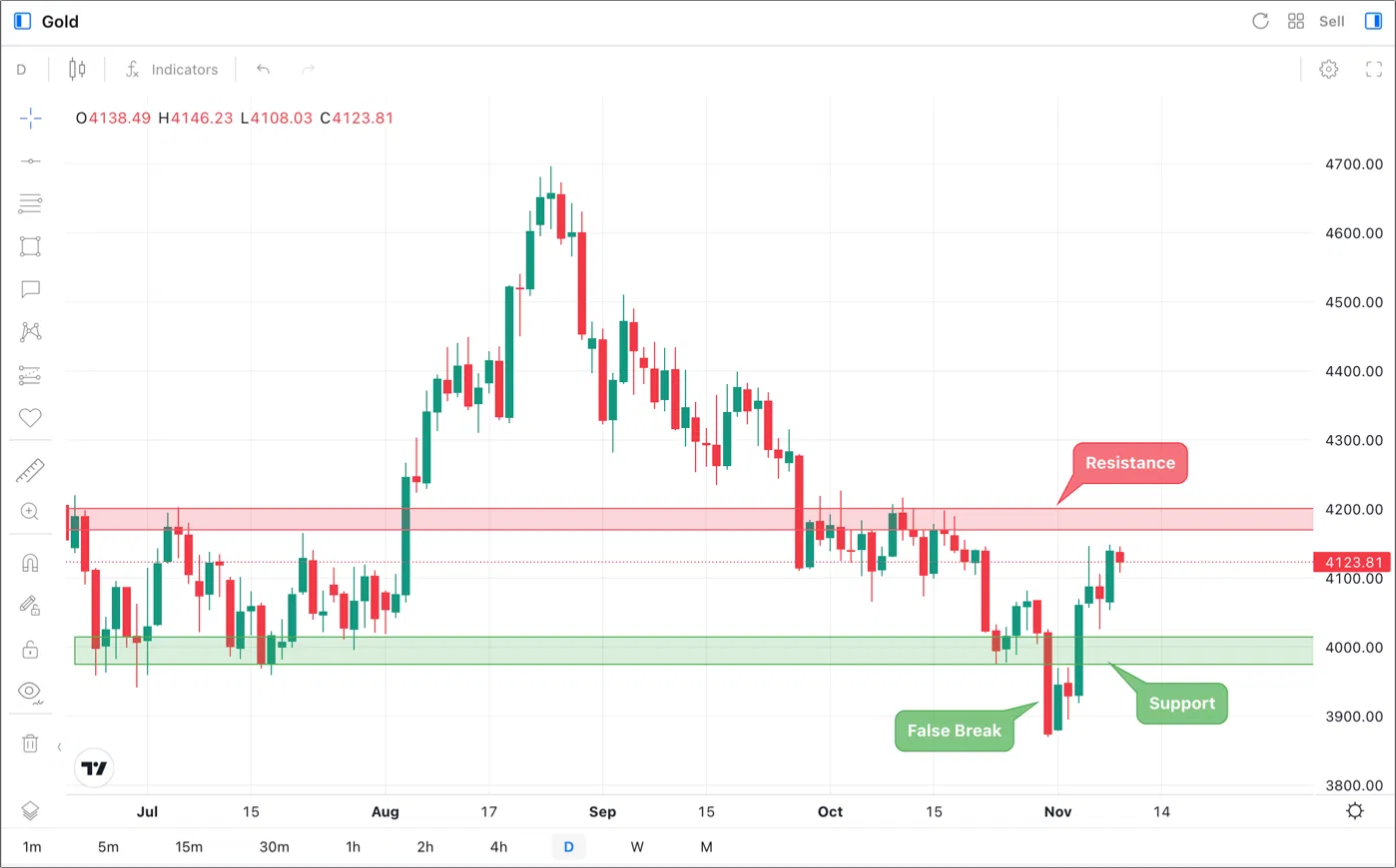
Resistance sits at about 4,170 to 4,200. It capped gold in July and then capped almost every rally in October.
Support sits at about 3,975 to 4,015. Buyers held it through July and again in late October.
At the start of November, gold dropped to about 3,870, below the support zone. It snapped back inside within days, which made it a false break.
Our support and resistance trading guide explains why zones work better than single lines. Those two zones now frame both trades below
Step 4: Plan a Long Gold Trade
A long trade profits if gold rises. The cleanest place to buy is near support, not in the middle of the range.
With gold at about 4,122, a Buy Limit order waits for price to come back down. It only fills if gold returns to the zone.
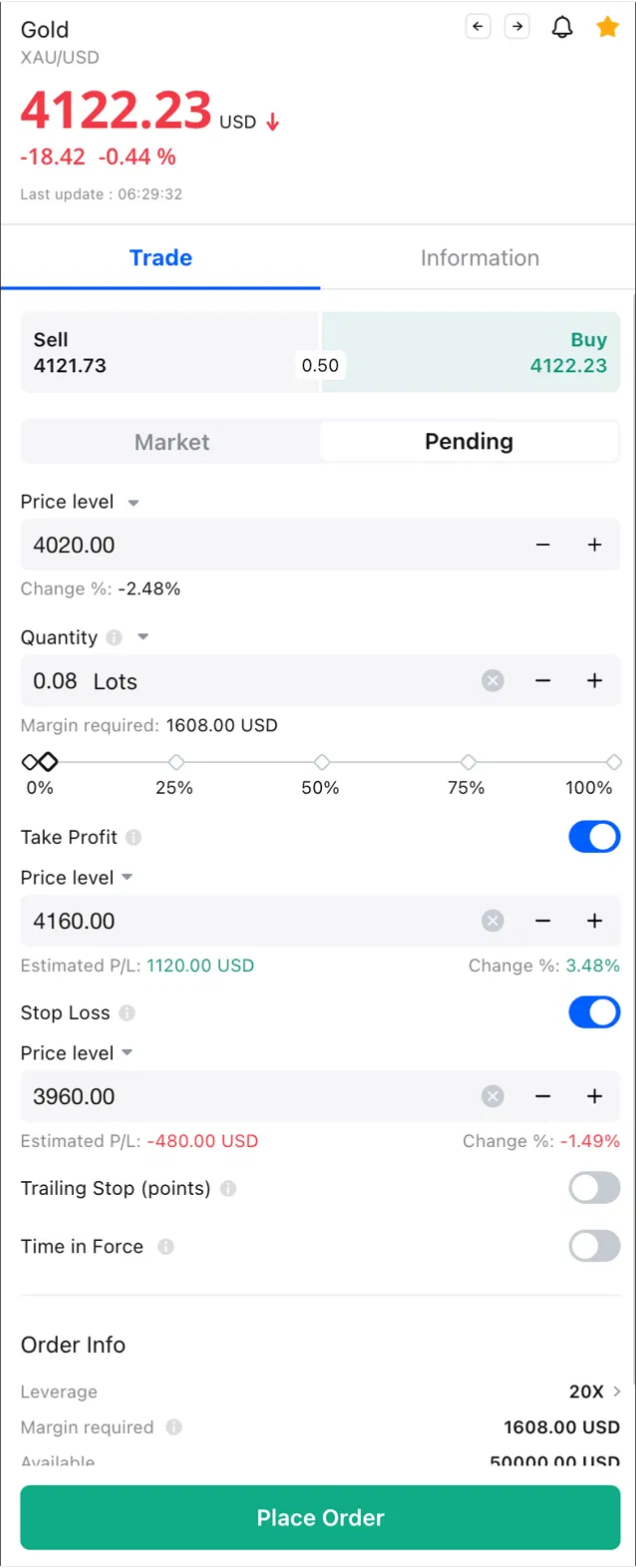
Image: Mitrade (Gold Buy Limit Order)
Entry. The Buy Limit sits at 4,020, just above the top of the support zone.
Stop loss. The stop sits at 3,960, below the whole zone. If gold closes beneath it, the reason for the trade is gone.
Take profit. The target sits at 4,160, just before resistance begins.
Size. At 0.08 lot, the estimated loss at the stop is $480. The estimated gain at the target is $1,120.
That is a reward to risk ratio of about 2.3. On a $50,000 demo balance, the risk is just under 1% of the account.
The lot size came last. The zones set the stop and target, then the lots were adjusted until the loss matched the risk limit.
Our position sizing guide covers that method in more detail. It is the habit that keeps one losing trade from doing serious damage.
Step 5: Plan a Short Gold Trade
A CFD lets you sell first and buy back later. That means a falling gold price can be traded as well.
The short trade uses the same chart in reverse. It sells near resistance and targets support.
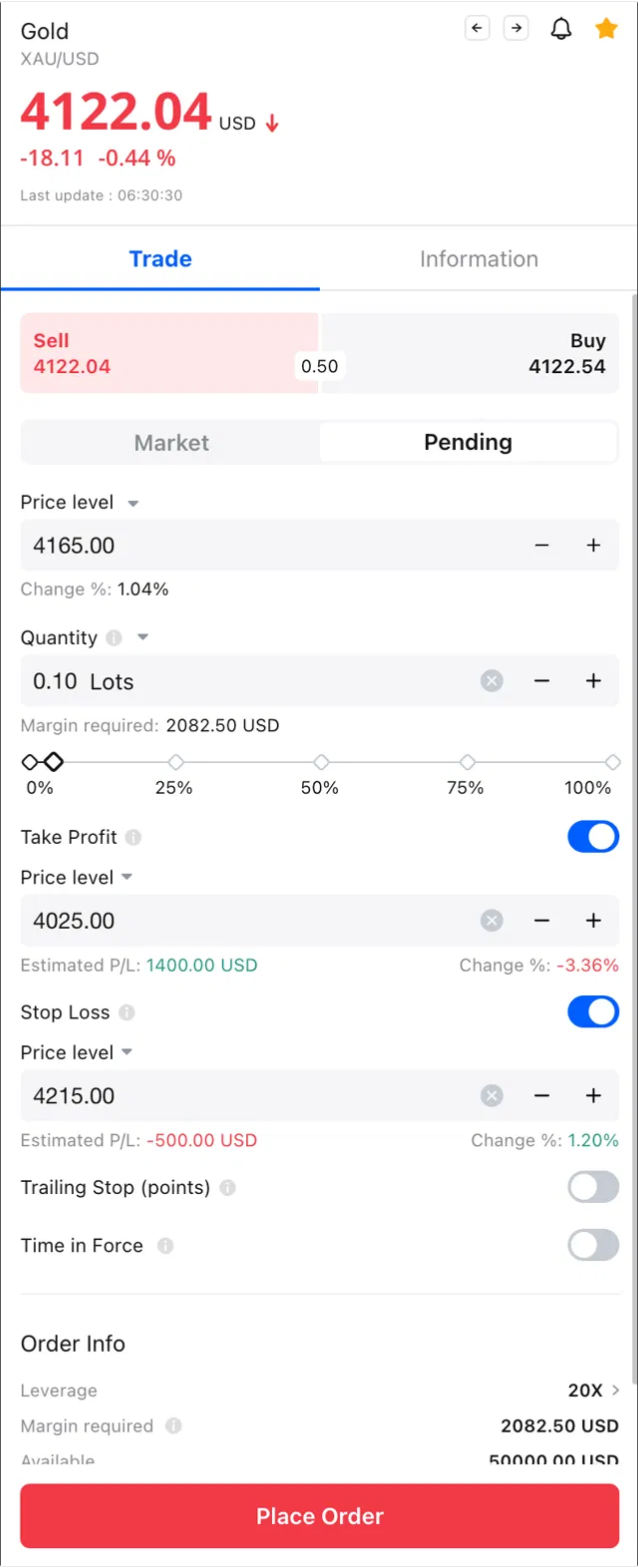
Image: Mitrade (Gold Sell Limit Order)
Entry. The Sell Limit sits at 4,165, just below the resistance zone.
Stop loss. The stop sits at 4,215, above the whole zone.
Take profit. The target sits at 4,025, just above support.
Size. At 0.10 lot, the estimated loss at the stop is $500. The estimated gain at the target is $1,400.
That is a reward to risk ratio of 2.8. The stop is closer than on the long trade, so the position can be slightly larger for the same risk.
Both orders can wait together
Pending orders do not need watching. Once placed, they sit in the Pending tab until price reaches them.

Image: Mitrade (Pending Gold Orders)
Only one of these orders is likely to fill first. If gold drops to support, the buy triggers, and if it rallies to resistance, the sell triggers.
“Trade gold CFDs with an ASIC-regulated broker. Fast AUD funding via PayID. ”
Step 6: Understand Leverage and Margin on Gold
In Australia, ASIC caps retail leverage on gold at 20:1. That means you put up at least 5% of the position value as margin.
The order screens confirm it. The long trade controls eight ounces at 4,020, worth $32,160, and needs $1,608 in margin.
The short trade controls ten ounces at 4,165, worth $41,650. Its margin is $2,082.50, again exactly 5%.
Margin is not your risk. The risk is the distance to your stop multiplied by your position size.
Leverage only reduces the deposit needed to open a trade. It becomes dangerous when it tempts traders into bigger positions than their stop allows.
Step 7: Manage an Open Gold Trade
Pending orders show the plan. An open trade shows how that plan behaves in real time.
To demonstrate, a separate market buy was opened at 0.03 lot. It used a stop at 3,960 and a target at 4,400, just under the major ceiling.
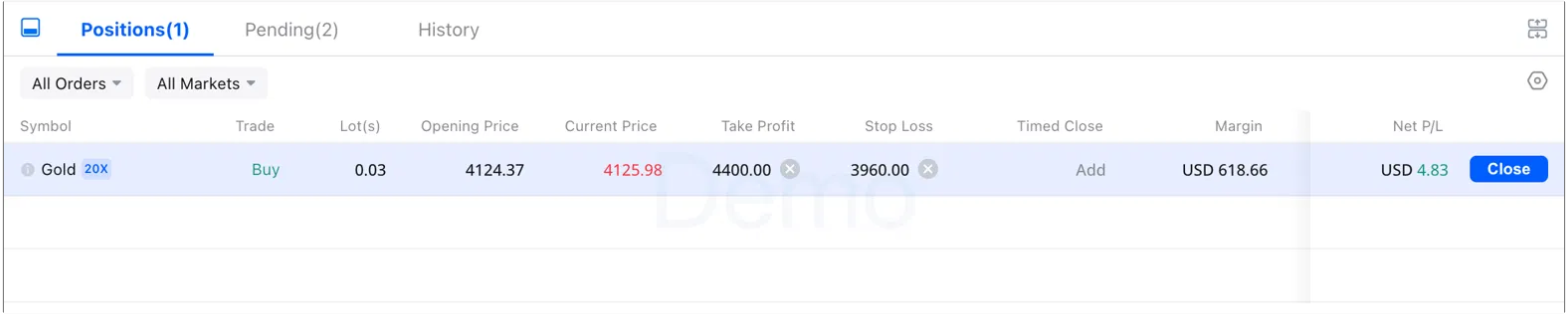
Image: Mitrade (Open Gold Position)
The trade opened at 4,124.37 with $618.66 in margin. A few minutes later, it showed a floating profit of $4.83.
That number moves with every tick. It only becomes real when the trade closes, either by hand or when price hits the stop or target.
Using a trailing stop
A trailing stop moves your stop loss automatically as price moves in your favour. It keeps the same distance behind the price, but never moves backwards.
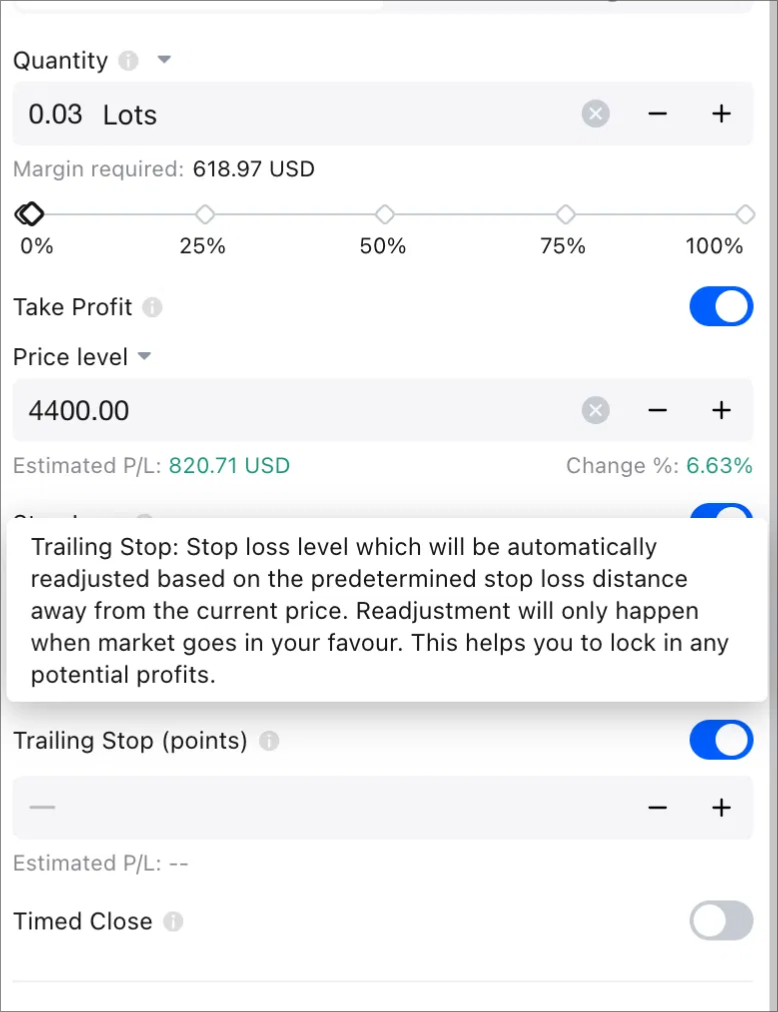
Image: Mitrade (Trailing Stop Setting)
On Mitrade, you set the trailing stop when you place the order. The platform describes it as a stop that readjusts only when the market moves your way, to help lock in profits.
Trailing stops suit trending moves. In a tight range like the current one, they can close a trade too early on normal noise.
Step 8: Count the Full Cost of a Gold Trade
Gold CFD costs come from two places: the spread and overnight funding. Both are easy to estimate before you trade.
Take the long trade at 4,020. The 0.50 spread on eight ounces costs $4 to open.
Holding it overnight costs about $7.70 per night at the buy rate of 0.02395%. Hold it for ten nights and that becomes about $77.
The short trade is cheaper to hold. Ten ounces at 4,165 costs about $4.70 per night at the sell rate.
Funding rates change over time, so check the Information tab before holding any trade for days. A slow trade can lose a meaningful slice of its profit to funding alone.
Common Mistakes When Trading Gold CFDs
Most gold losses come from a few repeat habits. Each one has a simple fix.
Buying in the middle of the range. Wait for the price to reach a zone, or use a limit order.
Using the same lot size as forex. One gold lot is 100 ounces, so size every trade from the stop.
Placing stops inside the zone. The early November false break shows why stops belong beyond the whole zone.
Ignoring US data. Interest rate news and US jobs data can move gold sharply in minutes.
Forgetting overnight funding. Long trades held for weeks can cost more than expected.
Treating margin as risk. A small margin can still sit behind a large loss.
How to Trade Gold CFDs: FAQs
How much money do I need to trade gold CFDs?
The minimum trade on Mitrade is 0.01 lot, or one ounce. At 20:1 leverage, that needs 5% of one ounce's value as margin.
What is one lot of gold?
On Mitrade, one lot of gold equals 100 troy ounces. A one dollar move in gold changes the value of one lot by $100.
What leverage can Australians use on gold CFDs?
ASIC caps retail leverage on gold at 20:1. That means a margin of at least 5% of the position value.
When can I trade gold from Australia?
During daylight saving, gold trades from 10am to 9am Sydney time the next day, Monday to Friday. There is a short daily break between 9am and 10am.
Can I short gold with a CFD?
Yes. You can sell gold first and buy it back later, profiting if the price falls. A stop loss is just as important on a short trade.
Can I practise trading gold CFDs on Mitrade?
Yes. Mitrade is regulated by ASIC and offers a free demo account with $50,000 in virtual funds, which was used for every trade in this guide.

Trade XAU/USD with Tight Spreads
You might be interested in…
Disclaimer: The content presented above, whether from a third party or not, is considered as general advice only. CFD trading involves significant risk of loss. Past performance does not guarantee future results. This article serves informational purposes only and does not constitute financial advice. Consider your risk tolerance before trading.


