




How to Trade Forex in Australia: The Complete AUD Guide for 2026

The Reserve Bank of Australia raised rates on September 29, yet the Australian dollar still slipped below US 70 cents. For anyone learning how to trade forex in Australia, that kind of move raises an obvious question about what really drives the currency.
If you are new to currency trading, our guide on forex trading in Australia covers the basics of pairs, leverage and margin. This guide goes one step further and focuses on the currency Australian traders know best.
You will learn what moves the AUD, how to choose the right AUD pair for your view, and which dates matter most in Q4 2026. On Mitrade, an ASIC regulated platform, all of the pairs covered here can be traded from one account.
What Drives the Australian Dollar in 2026
The Australian dollar is a commodity linked currency whose value moves mainly on four drivers: the interest rate gap between the RBA and the US Federal Reserve, iron ore prices and Chinese demand, global risk sentiment, and the strength of the US dollar.
Each driver can dominate at different times. The AUD climbed strongly in the first half of 2026, while the second half of the year has been shaped by central banks.
Understanding which driver is in control matters more than any single indicator. A trader who buys the AUD on an RBA hike can still lose money if the US dollar rallies harder on the same day.
That is exactly what has happened in recent weeks. Higher Australian rates have not been enough to offset a stronger US dollar and weaker commodity prices.
The Rate Gap: RBA vs Fed in Q4 2026
Interest rates are the most powerful short term driver of the AUD. When Australian rates rise relative to US rates, holding the AUD becomes more rewarding, and money tends to flow in.
The RBA lifted its cash rate to 4.60% on September 29, its fourth rise of 2026. The Board said inflation remains elevated and left the door open to further hikes if needed.
Australian inflation gives the RBA good reason to stay alert. Headline CPI rose to 4.0% in the 12 months to August, while trimmed mean inflation held at 3.6%.
Across the Pacific, the Fed raised its target range to 3.75% to 4% in September. That leaves the RBA rate 60 basis points above the top of the Fed's range.
On paper, that gap should support the AUD. The problem is that markets care about where rates are heading, not just where they sit today.
Minutes from the Fed's September meeting showed most officials see another hike coming. Markets now price a 78.3% chance of a December Fed hike, according to CME FedWatch.
In Australia, the outlook is less certain. Westpac and ANZ expect a hike to 4.85% in November, while CommBank and NAB expect a hold.
If the Fed keeps hiking while the RBA pauses, the gap shrinks again. That expectation explains why the AUD has struggled even after the RBA's latest move.
Iron Ore, China and the AUD
Australia is the world's largest iron ore exporter, and most of that ore goes to one customer. China took 84.4% of Australia's iron ore exports in 2023 to 2024.
When Chinese steel mills buy more ore, export income rises, and demand for the AUD tends to follow. When Chinese demand slows, the currency often loses that support.
Iron ore has weakened sharply this quarter. The price fell to US$91.13 a tonne on October 7, down almost 9% over the past month.
That decline helps explain why the AUD has slipped despite higher local rates. Traders watching the AUD should keep one eye on iron ore and Chinese economic data alongside central bank news.
Risk Sentiment and the US Dollar
The AUD is often called a risk currency. When global investors feel confident, they buy higher yielding and growth linked currencies like the AUD.
When fear takes over, that money tends to flow back into safe havens such as the US dollar, the Japanese yen and the Swiss franc. The AUD usually falls in those periods, even if nothing has changed in Australia.
Equity markets offer a useful clue. Strong days on Wall Street often coincide with a firmer AUD, while sharp sell offs in global shares tend to drag it lower.
The US dollar itself is the final piece of the puzzle. Because AUD/USD is priced in US dollars, any broad move in the greenback shows up in the pair, regardless of Australian news.
That is why experienced traders check the overall direction of the US dollar before placing an AUD trade. If the US dollar is rising against every major currency, a weak AUD/USD may say more about America than about Australia.
How to Trade AUD/USD Right Now
AUD/USD is the most traded AUD pair and the one most Australians start with. It reflects both local factors and the global strength of the US dollar.
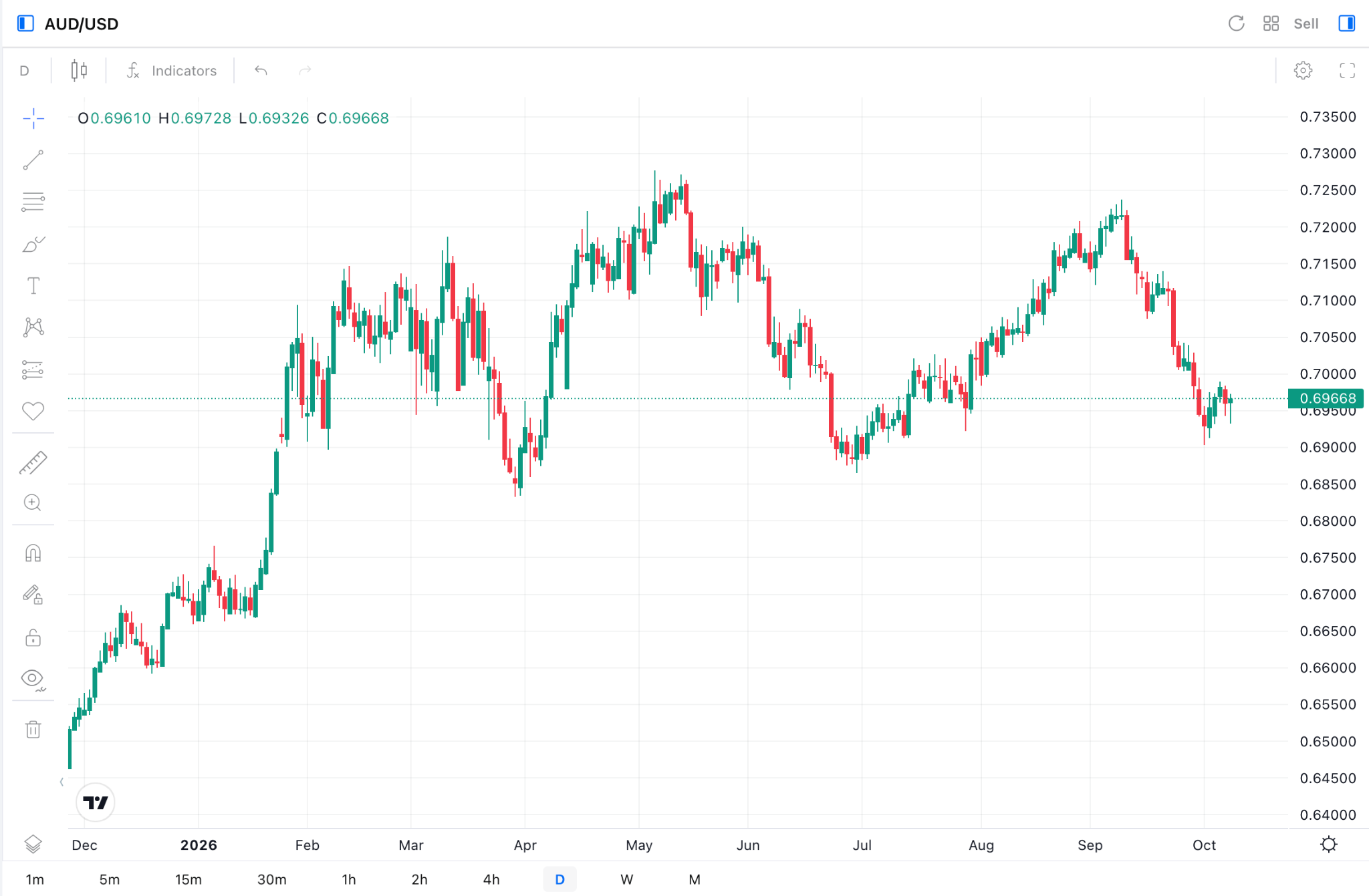
Image: Mitrade (AUD/USD Daily Chart)
The chart shows a strong rally in January that lifted the pair from around 0.67 to above 0.70. The AUD then traded in a range before peaking near 0.7275 in May.
A sharp sell off followed in June, with the pair finding support near 0.687. It recovered to around 0.724 in early September before falling again after the Fed's hike.
AUD/USD now trades near 0.6962, back below the 0.70 level. That 0.70 handle has acted as both support and resistance several times this year, so it remains the key level to watch.
On the downside, the June and March lows near 0.687 and 0.684 form the next support zone. A break below those levels would suggest the AUD's 2026 uptrend has ended.
For daily levels and analysis, Mitrade's AUD/USD today page tracks the pair in real time.
“Trade AUDUSD with an ASIC-regulated broker. Fast AUD funding via PayID. ”
Beyond AUD/USD: Choosing the Right AUD Pair
Many traders stop at AUD/USD, but other AUD pairs let you express a more specific view. The right pair depends on which driver you expect to move the AUD.
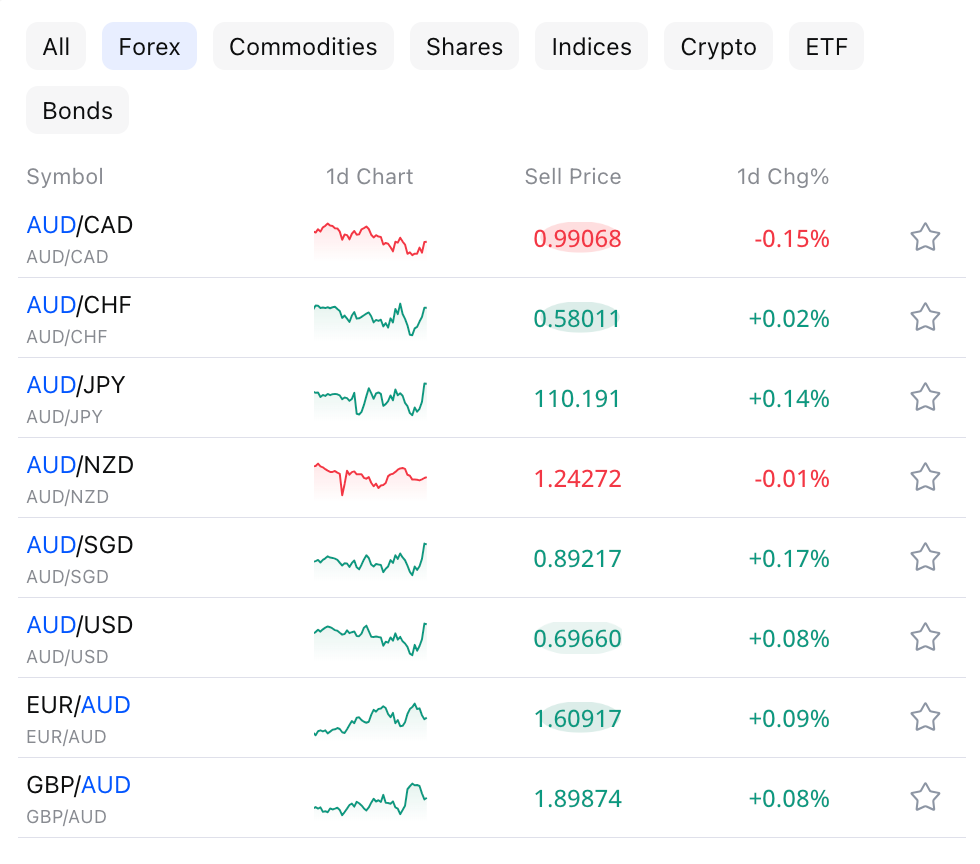
Image: Mitrade (AUD Forex Pairs List)
Mitrade's forex list covers a wide range of AUD pairs, including AUD/JPY, AUD/NZD, AUD/CAD, AUD/CHF, AUD/SGD, EUR/AUD and GBP/AUD. Each one isolates the AUD against a different economy.
AUD/JPY for risk sentiment
The Japanese yen tends to strengthen when markets turn fearful, while the AUD tends to weaken. That makes AUD/JPY one of the clearest gauges of global risk appetite.
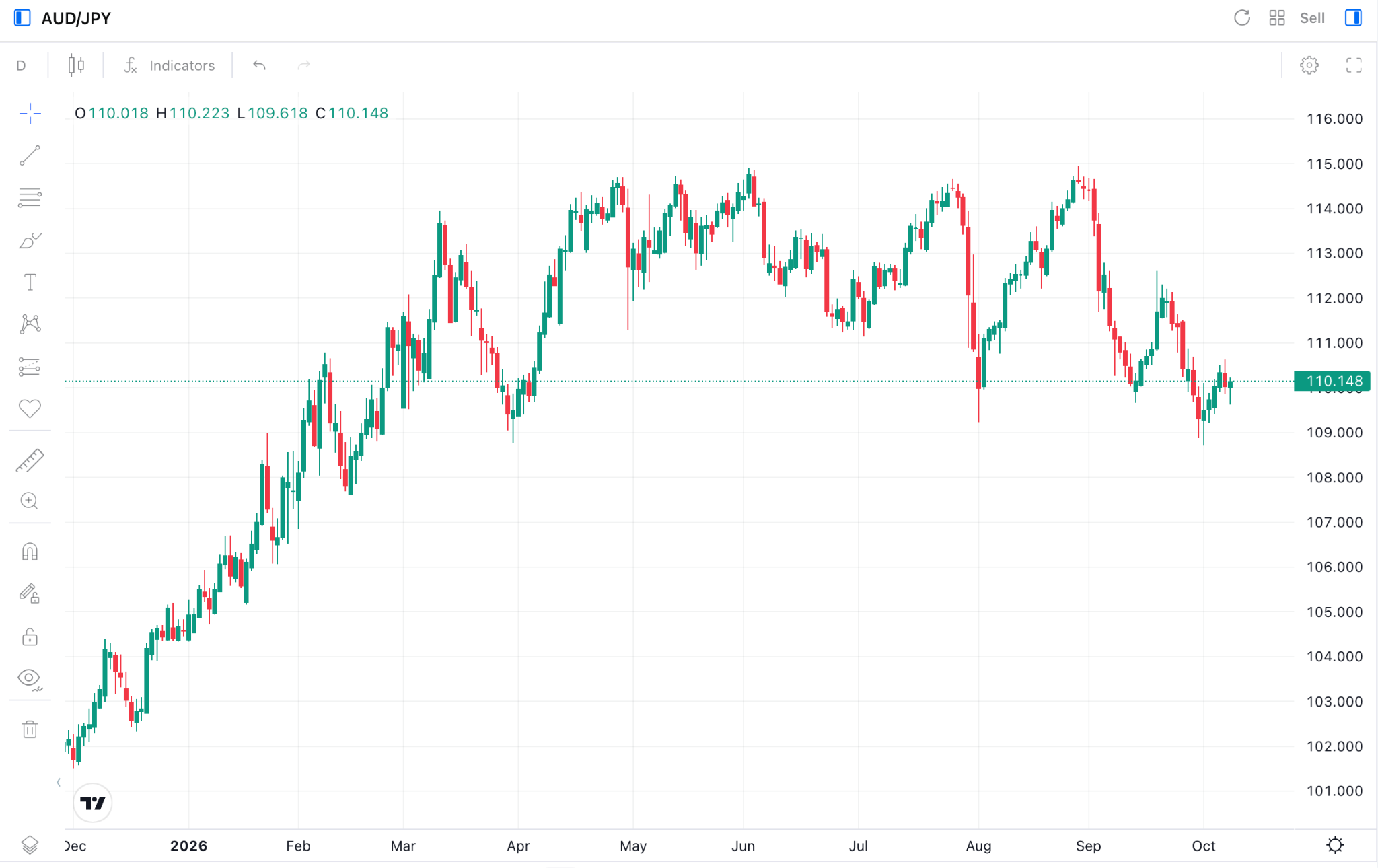
Image: Mitrade (AUD/JPY Daily Chart)
The chart shows AUD/JPY rallying from around 101 in December to above 114 by March. It then spent most of the year in a range between roughly 111 and 115.
The pair has since dropped toward 110, testing the lower edge of that range in early October. A clean break below 109 would signal that risk appetite is fading. For a deeper look at this pair, see whether AUD/JPY suits your trading style.
AUD/NZD for a purer RBA trade
Australia and New Zealand have similar economies, so many global factors cancel out. That leaves the pair driven mostly by the gap between the RBA and the Reserve Bank of New Zealand.
EUR/AUD and GBP/AUD for European views
These pairs let you trade the AUD against Europe rather than the US. They can be useful when the US dollar is moving on its own story and you want to avoid that noise.
AUD/CAD for commodity comparisons
Both currencies are commodity linked, but Canada leans on energy while Australia leans on metals. When oil and iron ore diverge, this pair often reflects it.
When to Trade Forex in Australia
Timing matters as much as direction. The AUD tends to move most when Australian, Asian and US news is released.
The RBA announces each decision at 2:30pm Sydney time, followed by a press conference an hour later. Both moments can trigger sharp swings in every AUD pair.
The ABS releases monthly CPI data at 11:30am Canberra time. Inflation surprises often move the AUD within seconds, because they change expectations for the next RBA decision.
Chinese economic data usually lands during the Asian morning, which overlaps with the Australian trading day. Strong or weak readings on Chinese activity can shift the AUD through the commodity channel.
Liquidity is usually strongest when the Sydney and Tokyo sessions overlap, and again when London opens in the Australian evening. Spreads on AUD pairs tend to be tighter during these windows, which lowers your trading costs.
Quieter periods, such as late Friday in the US, can bring thinner liquidity and wider spreads. Traders who hold positions over the weekend also face the risk of a price gap when markets reopen on Monday morning.
Major US data and Fed decisions arrive overnight in Australia. That means AUD positions held overnight can face big moves while most local traders are asleep, which makes stop losses especially important.
Key AUD Dates for Q4 2026
Several high impact events fall in the coming weeks. Traders should mark these on their calendar before opening new positions.
October 28: Australian September CPI release, plus the Fed decision in Washington later that day.
November 3: The RBA's next rate decision, with banks split between a hike and a hold.
December: Another Fed decision, with markets pricing a strong chance of a hike.
October 28 stands out as the biggest day for the AUD this quarter. A hot CPI reading could lift November hike odds, while a hawkish Fed could push the US dollar higher at the same time.
How to Trade Forex in Australia on Mitrade
Mitrade offers every AUD pair covered in this guide as a CFD, so traders can go long or short without owning any currency. That flexibility matters in a quarter where the AUD could break either way.
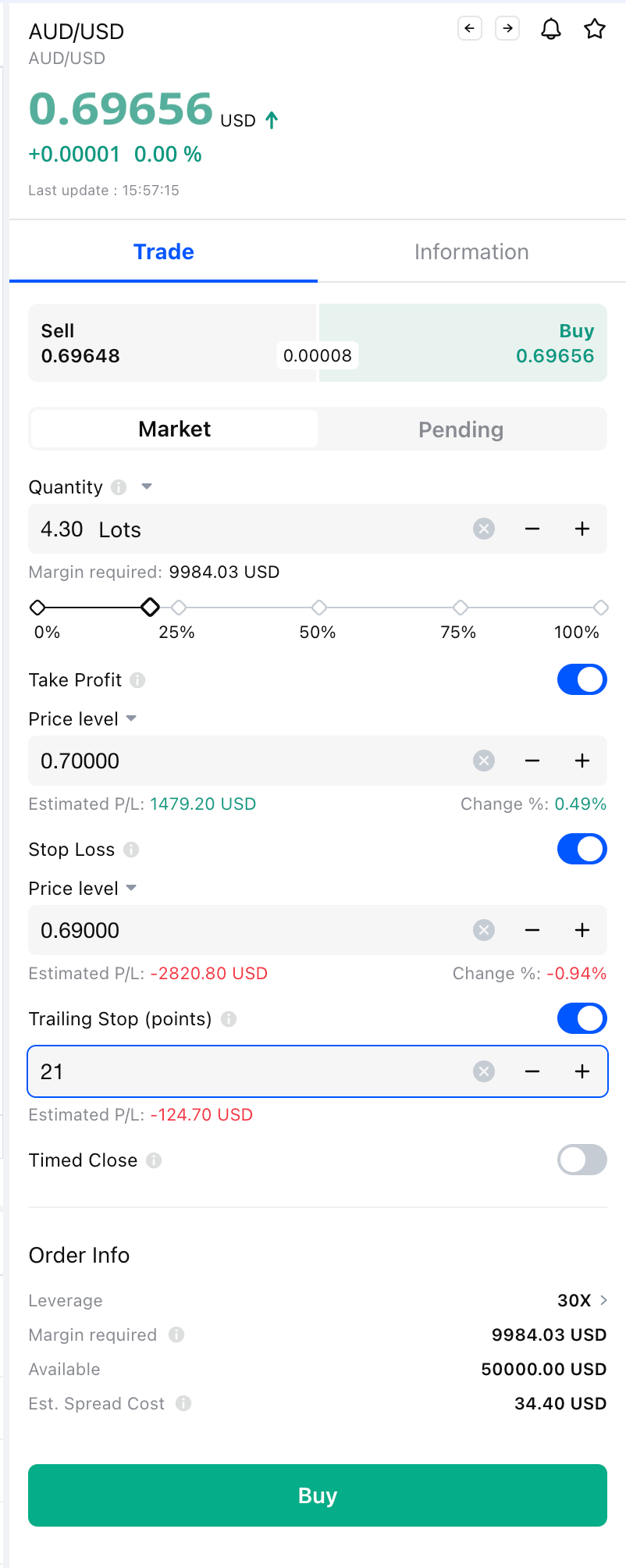
Image: Mitrade (AUD/USD Order Screen)
The order screen shows how simple risk controls are to set before you trade. You can add a take profit level, a stop loss and a trailing stop that follows the price as it moves in your favour.
The screen also shows the leverage, margin required and estimated spread cost before you confirm the trade. Checking these numbers first helps you understand exactly how much risk each position carries.
Under ASIC rules, leverage on major pairs is capped at 30:1. ASIC counts the AUD as a major currency, so most AUD pairs qualify, while pairs like AUD/NZD and AUD/SGD fall under the 20:1 cap for minors.
Leverage magnifies losses as well as gains. On event days such as October 28, smaller position sizes and wider stops can help you survive sudden spikes.
New traders can practise first on a free demo account loaded with US$50,000 in virtual funds. Trading profits may also have tax implications, so it helps to understand CFD tax rules before you start.


You might be interested in…
1. What moves the Australian dollar the most?
The interest rate gap between the RBA and the Fed is the biggest short term driver. Iron ore prices, Chinese demand, global risk sentiment and the US dollar also play major roles.
2. Why did the AUD fall after the RBA raised rates?
Markets expect the Fed to keep hiking while the RBA may pause. Falling iron ore prices and a stronger US dollar have also weighed on the AUD.
3. What is the best AUD pair for beginners?
AUD/USD is usually the best starting point because it is the most traded AUD pair. It has tight spreads and plenty of daily news and analysis to follow.
4. What time does the RBA announce its rate decision?
The RBA announces its decision at 2:30pm Sydney time on the second day of each meeting. The next decision is due on November 3.
5. What leverage can I use on AUD pairs in Australia?
ASIC caps leverage at 30:1 on major pairs, which includes most AUD pairs. Minor pairs such as AUD/NZD are capped at 20:1.
6. Can I trade AUD pairs on Mitrade?
Yes. Mitrade is regulated by ASIC and offers CFDs on a wide range of AUD pairs, including AUD/USD, AUD/JPY and AUD/NZD, with a free demo account for practice.
Disclaimer: The content presented above, whether from a third party or not, is considered as general advice only. CFD trading involves significant risk of loss. Past performance does not guarantee future results. This article serves informational purposes only and does not constitute financial advice. Consider your risk tolerance before trading.


