




Market News Today Australia: Gold Falls Below $3,900, WTI Oil Jumps as Nvidia Slides


Market Highlights
Global financial markets faced renewed volatility on Thursday, 12 November 2026, as escalating uncertainty surrounding US-Iran relations pushed crude oil prices higher, while hawkish Federal Reserve commentary and rising US Treasury yields sent gold to its lowest level in approximately a year.
Gold prices plunged nearly 3%, briefly falling towards US$3,853 per ounce as the benchmark US 10-year Treasury yield climbed above 5.1%. Meanwhile, WTI crude oil surged approximately 2.5%–2.6% to around US$88.70 per barrel after President Donald Trump indicated that Washington no longer needed to reach an agreement with Iran.
US equities also came under pressure following a major leadership change at Nvidia. Co-founder Jensen Huang resigned as CEO, triggering sharp volatility in the AI chipmaker's shares. Nvidia closed approximately 4.3% lower, although rival chipmakers AMD and Broadcom recorded strong gains.
For Australian CFD traders, the latest developments place gold (XAU/USD), WTI crude oil (USOIL), Nasdaq 100 (NAS100), USD/JPY and AUD/USD firmly in focus.
Gold (XAU/USD): Fell approximately 3% and touched around US$3,853 per ounce, pressured by rising Treasury yields and a stronger US dollar.
WTI Oil (USOIL): Rose approximately 2.5%–2.6% to around US$88.70 per barrel as geopolitical tensions renewed concerns about Middle Eastern oil supplies.
US Treasury Yields: The benchmark 10-year yield climbed above 5.1%, reinforcing pressure on gold and interest-rate-sensitive equities.
Nvidia (NVDA): Declined approximately 4.3% after Jensen Huang resigned as CEO and CFO Colette Kress was appointed interim chief executive.
US Stock Market: The Dow Jones fell approximately 0.36%, the S&P 500 declined 0.35%, and the Nasdaq Composite slipped 0.39%.
US Dollar: Strengthened as markets priced in the possibility of additional Federal Reserve tightening.
Bitcoin (BTC/USD): Fell more than 3%, trading around US$71,500 as risk-sensitive assets came under pressure.
Federal Reserve Outlook: Officials continued to highlight persistent inflation risks, keeping expectations of further interest-rate increases in focus.
Gold Price Today: XAU/USD Plunges Below US$3,900 as Treasury Yields Rise
Gold prices suffered another sharp decline on Thursday as rising US Treasury yields and a stronger US dollar weighed on precious metals.
Spot gold fell towards US$3,853 per ounce during the session, marking its lowest level in approximately a year. The decline extended the previous two days of selling, following stronger-than-expected US October inflation data.
The US 10-year Treasury yield climbed above 5.1%, increasing the opportunity cost of holding non-yielding assets such as gold.
Reuters reported that gold fell approximately 3% during the session as investors reassessed the likelihood of further Federal Reserve tightening.
Why Did Gold Fall Nearly 3%?
1. Treasury yields climbed above 5.1%
Higher bond yields make interest-bearing assets relatively more attractive than gold, which does not generate income.
2. Federal Reserve officials maintained a hawkish stance
Persistent inflation pressures have increased expectations that US interest rates could rise further.
3. The US dollar strengthened
A stronger US dollar can make gold more expensive for international buyers, potentially weighing on demand.
4. Selling pressure accelerated below key psychological levels
After breaking below US$4,000 earlier in the week, gold extended its decline through US$3,900, highlighting the importance of market positioning and momentum.
Bullish scenario: If gold stabilises above US$3,850 and recovers US$3,900, a technical rebound towards US$3,950 could become possible, particularly if Treasury yields retreat.
Bearish scenario: A sustained decline below US$3,850 could expose US$3,800, with further downside risk if the US dollar and Treasury yields continue to strengthen.
WTI Oil Price Today: Crude Jumps Over 2% as US-Iran Tensions Return
WTI crude oil rebounded sharply on Thursday as renewed uncertainty surrounding US-Iran relations raised concerns about potential disruptions to Middle Eastern energy supplies.
WTI futures advanced approximately 2.5% to US$88.72 per barrel, while Brent crude climbed around 3.3% to US$95.86.
The recovery followed remarks from US President Donald Trump suggesting that Washington no longer needed to reach an agreement with Iran, casting doubt on prospects for a near-term diplomatic breakthrough.
The renewed geopolitical risk premium helped offset concerns about rising oil production and potentially weaker global demand.
Why Did WTI Oil Prices Rise?
1. US-Iran diplomatic uncertainty intensified
Earlier reports had suggested that US Vice President JD Vance could become involved in renewed diplomatic discussions with Iranian officials.
However, Trump's latest comments appeared to reduce expectations of an imminent agreement.
For oil markets, a prolonged diplomatic stalemate could increase uncertainty surrounding regional exports and shipping routes.
2. Strait of Hormuz supply risks remain
The Strait of Hormuz is a strategically important route for global oil shipments.
Any further disruption to tanker traffic or regional energy infrastructure could increase transportation costs and support crude oil prices.
3. Higher oil prices could reinforce inflation concerns
A sustained recovery in crude oil prices could eventually feed into transportation, manufacturing and consumer prices.
This would complicate the Federal Reserve's efforts to bring inflation under control.
Bullish scenario: If WTI holds above US$88 and breaks through US$90, renewed geopolitical concerns could support a move towards US$92–95.
Bearish scenario: If diplomatic tensions ease or expectations of additional supply strengthen, a reversal below US$88 could expose US$85 and potentially US$83.
For Australian traders, oil price volatility can influence energy-sector sentiment and expectations for domestic inflation.
Federal Reserve Outlook: US Treasury Yield Climbs Above 5.1%
The Federal Reserve's monetary policy outlook remained a major driver of financial markets on Thursday.
Following stronger-than-expected US October CPI data, several Fed officials continued to emphasise the risk of persistent inflation.
The benchmark US 10-year Treasury yield climbed to approximately 5.1%, while shorter-dated yields also rose as investors increased expectations of further monetary tightening.
Higher yields created additional pressure on gold, equities and other interest-rate-sensitive assets.
Fed Officials Warn About Persistent Inflation
Austan Goolsbee — Chicago Fed President
Goolsbee warned that inflation remained at a concerning stage, particularly as price pressures appeared to be extending beyond energy and tariff-related categories.
He also highlighted the potential impact of large-scale AI infrastructure construction on demand and prices.
Mary Daly — San Francisco Fed President
Daly indicated that further monetary tightening could be necessary to contain persistent inflation.
Although AI-related investment may increase demand for certain resources, she suggested that its broader inflationary effects remained limited compared with other economic forces.
Beth Hammack — Cleveland Fed President
Hammack continued to emphasise the importance of maintaining a restrictive policy stance until inflation shows convincing signs of returning towards the Fed's target.
Why Does a 5% Treasury Yield Matter?
Higher US Treasury yields can affect several major markets simultaneously.
For Australian CFD traders, the interaction between US yields, the dollar and equity markets remains an important source of volatility.
Nvidia Stock Falls 4.3% After Jensen Huang Resigns as CEO
Nvidia shares experienced significant volatility on Thursday after the company confirmed that co-founder Jensen Huang had resigned as chief executive officer.
Nvidia announced that Chief Financial Officer Colette Kress would serve as interim CEO while the board searches for a permanent replacement.
The stock fell sharply during early trading before recovering some of its losses, eventually closing approximately 4.3% lower.
The leadership transition has created uncertainty for one of the world's most influential AI chipmakers, particularly as investors are already reassessing the financing and profitability of AI infrastructure projects.
Why Does Nvidia's Leadership Change Matter?
Nvidia plays a central role in the global AI infrastructure market through its graphics processing units, networking technology and relationships with major cloud providers.
A leadership transition could create uncertainty around strategic priorities, customer relationships and future product development.
However, the resignation does not by itself demonstrate a deterioration in demand for Nvidia's products.
Investors will be watching the company's succession plans, customer commitments and upcoming financial results.
AMD and Broadcom Rise as Investors Rotate Within the AI Sector
Despite Nvidia's decline, rival chipmakers recorded strong gains.
Selected AI stocks — 12 November 2026
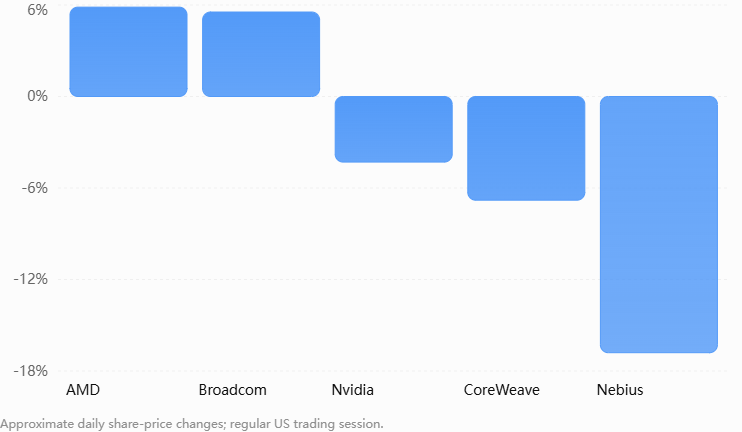
Selected stock movements from Reuters and closing-market reports.
AMD advanced approximately 5.9%, while Broadcom gained around 5.5%.
The contrasting performance suggests that some investors were reallocating exposure within the semiconductor sector rather than abandoning AI-related investments entirely.
Meanwhile, AI infrastructure providers such as CoreWeave and Nebius came under renewed pressure, reflecting concerns about financing, execution and their exposure to the broader AI ecosystem.
Nasdaq 100 Outlook: Can the AI Sector Stabilise?
The Nasdaq Composite declined approximately 0.39% on Thursday, while the broader US equity market also finished lower.
The sell-off in Nvidia and several AI infrastructure companies weighed on technology sentiment, although gains in competing semiconductor manufacturers helped offset some of the pressure.
For the Nasdaq 100, the key issue is whether AI-sector weakness remains concentrated in individual companies or develops into broader selling across major technology stocks.
Three Factors to Watch
1. Nvidia's management transition
Investors will monitor the company's ability to maintain strategic continuity and customer confidence.
2. AI infrastructure financing
High borrowing costs and substantial capital expenditure requirements remain important challenges for data-centre operators.
3. Federal Reserve policy
Higher Treasury yields can weigh on growth-stock valuations, even when corporate earnings remain strong.
Bullish scenario: Strong semiconductor earnings, stabilising yields and improved investor confidence could support a recovery in NAS100.
Bearish scenario: Further leadership uncertainty, disappointing AI earnings or continued increases in Treasury yields could lead to renewed selling pressure.
USD/JPY Near 160: Could Japan Intervene in Currency Markets?
The Japanese yen remained under pressure as rising US Treasury yields supported the dollar.
USD/JPY traded near the psychologically important 160 level, increasing market attention on the possibility of intervention by Japanese authorities.
A weaker yen can support the overseas earnings of Japanese exporters when converted into yen, but it can also increase import costs and inflation pressure.
What Should USD/JPY Traders Watch?
The main factors include the US-Japan interest-rate differential, Federal Reserve policy expectations, Bank of Japan communications and any official statements from Japan's Ministry of Finance.
A sudden decline in USD/JPY could reflect intervention, changing monetary policy expectations or ordinary market positioning. Traders should not assume that every sharp move is the result of government action.
Australian Market Outlook: What Does This Mean for ASX 200 and AUD/USD?
Australian financial markets may face mixed influences following Thursday's US session.
ASX 200: Energy Stocks Versus Technology Shares
Higher crude oil prices could support sentiment towards Australian energy producers.
However, weakness in Nvidia and other AI-related companies could weigh on technology-sector sentiment.
Higher global bond yields may also create pressure on companies with significant borrowing requirements.
AUD/USD: Stronger US Dollar Creates Headwinds
The Australian dollar weakened against the US dollar during Thursday's trading session.
Reuters identified the Australian dollar as one of the weaker major currencies, falling approximately 0.6%.
Further increases in US Treasury yields could maintain pressure on AUD/USD, although Australian economic data and RBA policy expectations remain important.
Australian Gold Miners
The decline in gold prices could weigh on the outlook for Australian gold producers.
However, the impact on individual companies depends on their operating costs, production volumes, currency exposure and hedging arrangements.
A weaker Australian dollar may partly cushion the impact of falling US-dollar bullion prices.
US Economic Data: Labour Market Remains Resilient as Housing Sales Fall
Recent US economic data offered mixed signals about economic activity.
Initial jobless claims increased to approximately 200,000 in the week ending 7 November, slightly above market expectations.
Meanwhile, October existing-home sales fell to an annualised rate of approximately 3.75 million, the weakest level in more than 16 years.
The figures suggest that higher interest rates are placing pressure on parts of the US economy, particularly housing, while the labour market remains relatively resilient.
For the Federal Reserve, this combination could make policy decisions more challenging.
Economic Calendar: Key Events for 13 November 2026
What Should Australian CFD Traders Watch Next?
1. Gold: Can XAU/USD Defend US$3,850?
Rising Treasury yields and a stronger dollar remain downside risks. A recovery above US$3,900 could improve short-term sentiment.
2. WTI Oil: Will US$90 Be the Next Test?
Renewed geopolitical tensions could support prices, while rising production remains a potential headwind.
3. Nasdaq 100: How Will Nvidia's Leadership Change Affect AI Stocks?
Semiconductor-sector rotation and AI financing conditions could drive further volatility.
4. US Treasury Yields: Can the 10-Year Yield Stay Above 5%?
Further increases could influence gold, currencies and equity valuations.
Explore Global Markets with Mitrade
The latest market movements demonstrate how geopolitical uncertainty, interest-rate expectations and company-specific developments can influence global financial markets.
Mitrade offers eligible traders access to selected global CFD markets, including indices, forex and commodities.
*CFDs are complex leveraged products and carry a high risk of losing money rapidly. Leverage magnifies both gains and losses, and trading is not suitable for every investor. Check the applicable product disclosure statement, fees and regulatory information before opening an account.

 Enjoy simple and fast trading Flexible leverage options available Follow real-time trading strategies Demo account with $50,000 virtual funds


Disclaimer: The content presented above, whether from a third party or not, is considered as general advice only. CFD trading involves significant risk of loss. Past performance does not guarantee future results. This article serves informational purposes only and does not constitute financial advice. Consider your risk tolerance before trading.


