




Gold Price Forecast: Can XAU/USD Recover Above $4,000 as Fed Decision Looms?

Gold prices have entered a critical phase as XAU/USD briefly fell below the psychological US$4,000 level on Friday, 23 October 2026, extending Thursday's sharp selloff.
Spot gold dropped to approximately US$3,987 during Asian trading before recovering towards US$4,015. The decline followed a nearly 3% fall on Thursday, when bullion broke below US$4,100 and approached US$4,020.
The selloff comes amid growing concerns over artificial intelligence (AI) investment valuations, elevated oil prices, persistent inflation risks and uncertainty surrounding the Federal Reserve's next interest rate decision.
Despite falling US Treasury yields, gold has struggled to attract sustained buying interest, suggesting that broader market deleveraging and inflation concerns may be outweighing traditional safe-haven demand.
For Australian investors, the key question is whether gold can establish support around US$4,000 or whether the recent breakdown signals a deeper correction towards US$3,800.
Gold Price Today: Key Market Highlights
Immediate resistance: US$4,030–US$4,050, followed by US$4,100.
Key support: US$4,000, followed by US$3,940–US$3,960 and US$3,800.
US Treasury yields: The benchmark 10-year yield fell below 5% on 22 October as investors moved towards government bonds.
Federal Reserve outlook: Markets are assessing the likelihood of further monetary tightening amid conflicting signals from inflation and economic growth.
Market sentiment: Technology-stock volatility, AI investment concerns and rising oil prices have increased uncertainty across financial markets.
Next major catalyst: The Federal Reserve's October policy decision, scheduled for 28 October 2026.
Why Is the Gold Price Falling Despite Rising Market Uncertainty?
Gold is traditionally considered a defensive asset during periods of financial uncertainty. However, its recent performance demonstrates that safe-haven demand does not always translate into higher prices.
Three major factors are influencing the current gold market.
1. AI Stock Selloff Triggers Broader Market Deleveraging
Concerns about the sustainability of AI-related capital expenditure have contributed to renewed selling pressure across US technology stocks.
As equity market volatility increases, investors may liquidate profitable or liquid positions to meet margin requirements and reduce overall portfolio exposure.
Gold is particularly vulnerable to this type of short-term selling because it is highly liquid and can be converted into cash quickly.
This helps explain why bullion has declined alongside equities despite increased demand for defensive assets.
The recent rise in the Cboe Volatility Index (VIX) also highlights growing investor anxiety.
If technology-stock weakness continues, gold could experience further liquidation pressure even if the broader economic outlook deteriorates.
2. Rising Oil Prices Increase Inflation Risks
Escalating tensions in the Middle East have pushed energy prices higher, raising concerns about renewed inflationary pressure.
Higher oil prices can increase transportation, manufacturing and consumer costs, complicating the Federal Reserve's efforts to control inflation.
For gold investors, the implications are mixed.
On one hand, persistent inflation may strengthen demand for gold as a long-term store of value.
On the other hand, higher inflation could encourage the Federal Reserve to maintain restrictive monetary policy or raise interest rates further.
Because gold does not generate interest income, higher real interest rates can reduce its attractiveness relative to interest-bearing assets.
This creates a challenging environment in which geopolitical uncertainty may support gold demand while monetary policy expectations place downward pressure on prices.
3. Falling US Treasury Yields Offer Limited Support
On Thursday, 22 October, the benchmark 10-year US Treasury yield fell below the important 5% threshold, while the two-year yield also declined sharply.
Lower Treasury yields would normally provide support for gold by reducing the opportunity cost of holding a non-yielding asset.
However, gold continued to fall.
This divergence suggests that short-term liquidity requirements, portfolio adjustments and uncertainty surrounding inflation may currently be more influential than the decline in bond yields.
A sustained recovery in gold may therefore require not only lower yields but also greater stability across equity and currency markets.
Federal Reserve Outlook: Could the October Rate Decision Trigger a Gold Rebound?
The Federal Reserve's upcoming monetary policy announcement is likely to be a major catalyst for XAU/USD.
The decision is scheduled for 28 October 2026, following the central bank's two-day policy meeting.
Investors will focus on whether policymakers signal a pause in further tightening or maintain concerns about persistent inflation.
Scenario 1: The Fed Signals a Less Hawkish Outlook
If the Federal Reserve emphasises slowing economic activity, weaker employment conditions or tighter financial conditions, expectations for additional rate increases could decline.
Such a development may put downward pressure on US Treasury yields and the US dollar.
This could create a more supportive environment for gold, particularly if the metal manages to hold above US$4,000.
Under this scenario, XAU/USD may attempt to recover towards US$4,050 and US$4,100.
Scenario 2: The Fed Maintains a Hawkish Stance
If policymakers remain concerned about energy-driven inflation, markets may continue to anticipate restrictive interest rates.
A stronger US dollar or a rebound in Treasury yields could limit gold's recovery.
In this scenario, a renewed break below US$4,000 may expose the next support region around US$3,940–US$3,960.
A more sustained decline could eventually bring US$3,800 into focus.
Scenario 3: Stagflation Concerns Intensify
A particularly complicated outcome would involve slowing economic growth alongside persistently high inflation.
This combination, commonly described as stagflation, can create conflicting pressures for gold.
Although gold has historically attracted interest during certain inflationary and stagflationary periods, aggressive monetary tightening and forced asset sales can still produce substantial short-term declines.
Investors should therefore avoid assuming that stagflation will automatically result in higher gold prices.
Gold Technical Analysis: Is US$4,000 the Most Important Support Level?
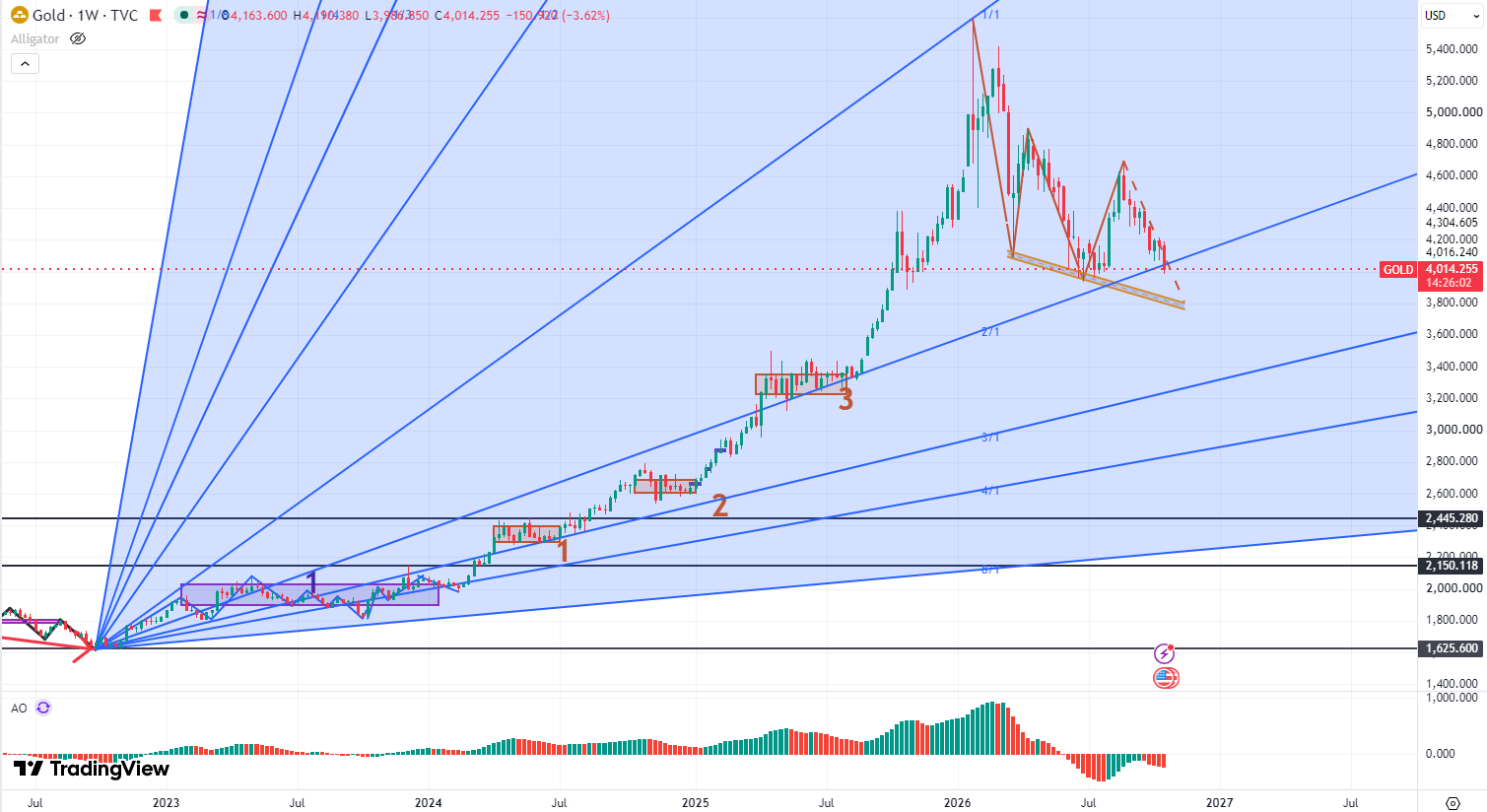
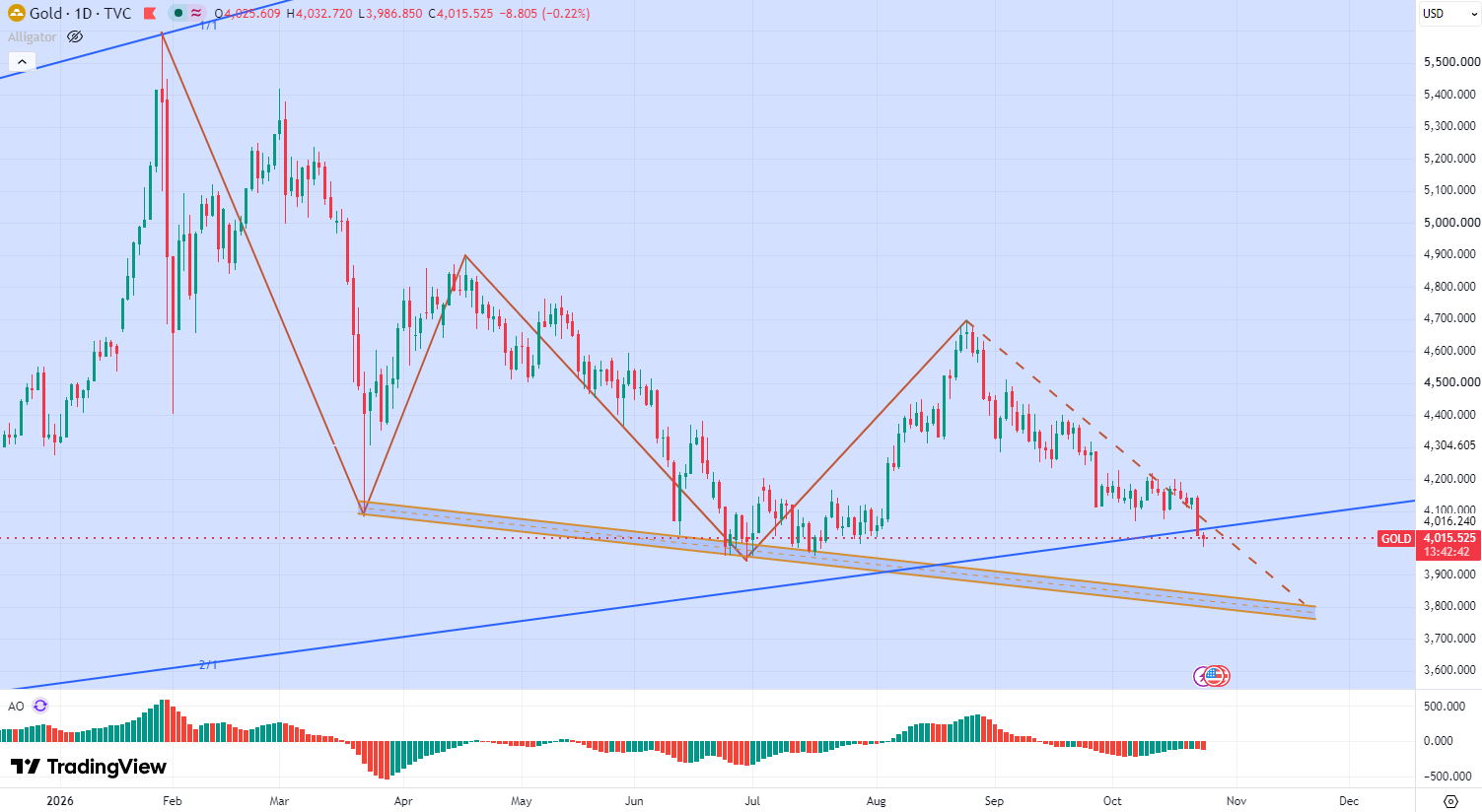
Gold's technical outlook has weakened following its breakdown below US$4,100.
After consolidating around the US$4,100–US$4,200 region earlier in October, XAU/USD experienced a sharp decline that brought the US$4,000 psychological level into focus.
Source: Tradingview
Friday's brief move below US$4,000 suggests that bearish momentum remains significant.
However, the subsequent recovery also indicates that some buyers are willing to enter the market at lower prices.
Source: Tradingview
Key Gold Support and Resistance Levels
Bullish Outlook: Gold Holds Above US$4,000
If gold stabilises above US$4,000 and establishes a series of higher intraday lows, a technical rebound may develop.
The first important upside area lies around US$4,030–US$4,050.
A decisive move above this region could encourage further buying towards US$4,100.
However, a sustained recovery above US$4,100 would provide stronger evidence that the recent selling pressure is easing.
Until then, rebounds may remain vulnerable to renewed selling.
Bearish Outlook: Gold Breaks Below US$4,000 Again
If XAU/USD falls below US$4,000 and fails to recover, the market could revisit Friday's low near US$3,987.
Further weakness may expose the US$3,940–US$3,960 support zone.
A sustained breakdown below this area could increase the likelihood of a move towards US$3,800.
Under a more severe medium-term correction, US$3,400 could become a longer-range technical reference, although reaching this level would require substantial additional selling pressure.
The direction of the next sustained move will likely depend on the interaction between monetary policy expectations, energy prices and overall financial market sentiment.
How to Trade Gold Price Movements with CFDs in Australia
Gold contracts for difference (CFDs) allow traders to speculate on gold price movements without owning physical bullion.
Unlike purchasing gold bars or coins, CFD trading involves taking a position on the price difference between opening and closing a trade.
Traders can potentially participate in both rising and falling markets, although losses are possible in either direction.
Trading a Potential Gold Rebound
Traders expecting a recovery may monitor whether XAU/USD stabilises above US$4,000 and breaks through nearby resistance.
A bullish setup could become more convincing if gold reclaims US$4,050 and buying momentum improves.
However, an intraday recovery alone does not confirm a sustained trend reversal.
Trading a Potential Gold Breakdown
Traders expecting further downside may focus on whether gold breaks below US$4,000 again and fails to recover.
A sustained move beneath nearby support could indicate additional bearish momentum.
Nevertheless, short positions can also face significant losses if gold rebounds sharply following unexpected economic or geopolitical developments.
Explore Gold CFD Trading with Mitrade
Australian traders interested in following gold price movements can explore gold CFDs through Mitrade.
The trading platform provides access to price charts, market information and tools for monitoring financial markets.
Before trading, investors should understand leverage, margin requirements, spreads, overnight funding costs and the potential for rapid losses.

Trade XAU/USD with Tight Spreads
What Should Australian Traders Watch Next?
Australian market participants may want to monitor:
US$4,000 support: Whether gold can hold or reclaim this psychological level.
US$4,050–US$4,100 resistance: Whether any rebound can develop into a more sustained recovery.
Federal Reserve commentary: Signals about inflation, interest rates and the future policy path.
Oil prices: Further increases could reinforce inflation concerns.
US dollar and Treasury yields: Changes in these markets may influence gold's short-term direction.
AUD/USD: Currency fluctuations may affect gold's value for Australian investors.
You might be interested in…
Disclaimer: The content presented above, whether from a third party or not, is considered as general advice only. CFD trading involves significant risk of loss. Past performance does not guarantee future results. This article serves informational purposes only and does not constitute financial advice. Consider your risk tolerance before trading.


